



While ABS-CBN Loses SC Case, Chinese-Filipino Firm Gets Quick Franchise Approval As Third Telco
Critics could not help but contrast the House of Representatives’ treatment of the franchise applications of ABS-CBN Corp. and DITO Telecommunity Corp. that is 40-percent owned by a Chinese government corporation.

The Supreme Court (SC) has dashed ABS-CBN Corp.’s last hope of getting back on air as it dismissed the network giant’s petition for being moot and academic – a day after the House of Representatives swiftly approved on third and final reading the franchise application of DITO Telecommunity Corp. to become the country’s third telco player.
Critics could not help but contrast the House’s treatment of the franchise applications of ABS-CBN and DITO, which is 40-percent owned by a Chinese government corporation and 35-percent owned by two companies of President Duterte’s campaign financier Dennis Uy.
In a statement on Tuesday, Aug. 25, SC Public Information Office chief Brian Keith Hosaka said the justices, sitting in full court, cited the House legislative franchises committee’s 70-11 vote to deny ABS-CBN’s franchise application on July 10 as the ground for dismissing its petition assailing the May 5 cease and desist order or CDO of the National Telecommunications Commission (NTC).
According to Hosaka, the court “finds it appropriate to dismiss the case on the ground of mootness” and that there is “no actual substantial relief” which ABS-CBN “would be entitled to” regardless of the high tribunal’s disposition of the merits of the petition.
Hosaka said the 14 justices who participated in Tuesday’s en banc session were unanimous in ruling against ABS-CBN, while Associate Justice Priscilla Baltazar-Padilla was on leave. Senior Associate Justice Estela Perlas-Bernabe was the member-in-charge of the case.
This was the second case related to ABS-CBN’s franchise that the SC dismissed for being moot and academic without tackling the merits. On June 23, the court threw out the unprecedented quo warranto petition filed on Feb. 10 by the Office of the Solicitor General, since the allegations of violations of the terms of ABS-CBN’s franchise had been overtaken by its expiration on May 4.
ABS-CBN’s petition – filed on May 7 or two days after it was forced to shut down its free-to-air television and radio operations – was hinged on the argument that the NTC should have waited for the House to first act on its long-pending application for the renewal of its franchise.
At the time, the House committee had been dragging its feet on the 13 bills filed by various congressmen. Cagayan de Oro 2nd District Rep. Rufus Rodriguez on Feb. 12 quoted Palawan 1st District Rep. Franz Alvarez, chair of the legislative franchise committee, as saying that the reason its proceedings on the ABS-CBN franchise bills were delayed was because “wala pang clearance sa itaas (there is no clearance yet from the higher-ups).”
The first committee hearing was held only on March 10, before Congress went on a recess until May 3, or the eve of the expiration of ABS-CBN’s franchise.
ABS-CBN argued that the NTC gravely abused its discretion when it ordered the stoppage of its free-to-air broadcasting operations, because the regulator in the past consistently issued provisional authorities to companies whose franchises expired while Congress’ proceedings were still pending.
The network staked its claim to a provisional authority on the assurances made by NTC Commissioner Gamaliel Cordoba in the Senate’s Feb. 24 hearing that it would follow its usual practices. ABS-CBN also questioned the lack of notice and hearing prior to the issuance of the CDO.
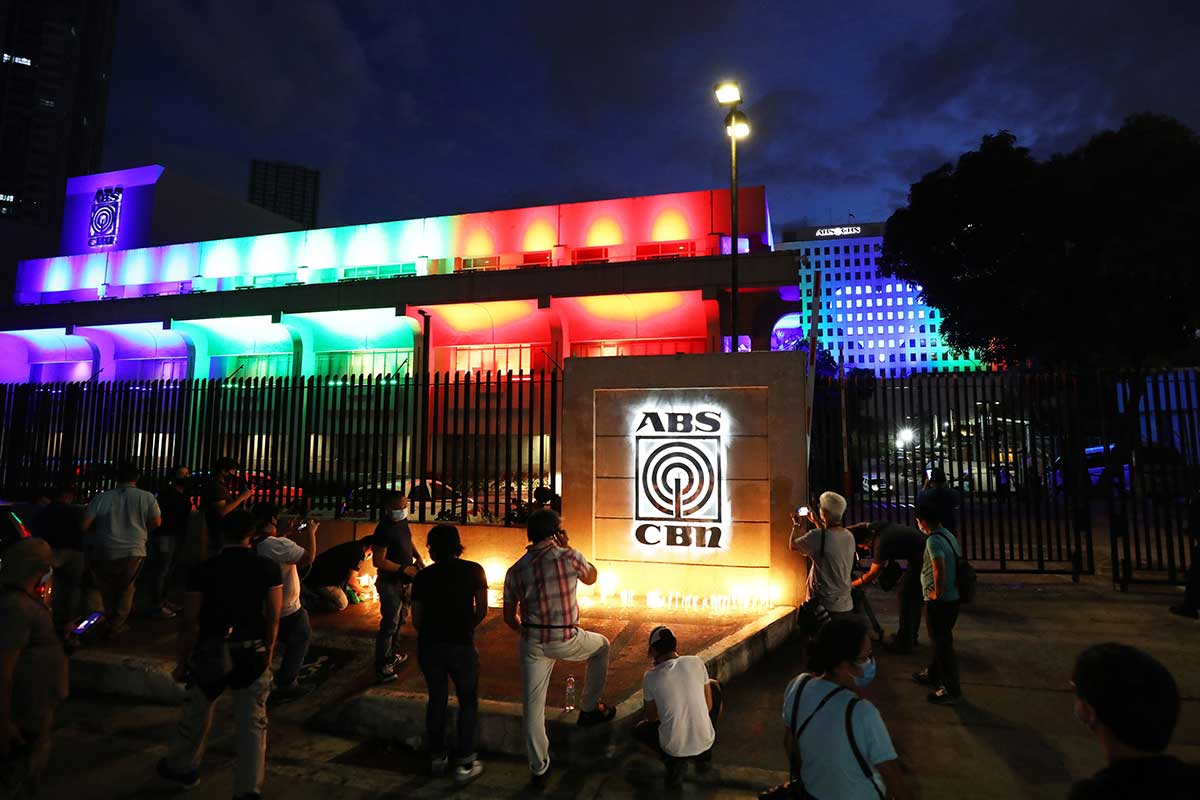
The NTC backtracked after Solicitor General Jose Calida, in a May 3 press release, told the regulator that no law granted it the power to issue a provisional authority to those with pending franchise applications. Calida warned that NTC officials could face graft charges if they agreed to the request of the Senate as a chamber and House Speaker Alan Peter Cayetano.
Malacañang had claimed President Duterte was neutral regarding the issue and even denied that he was referring to ABS-CBN when he proclaimed in a July 13 speech – three days after the House committee vote – that “without declaring martial law, I dismantled the oligarchy that controlled the economy of the Filipino people.”
The claim of neutrality was belied by the leak of recordings of soundbites that were apparently redacted from the official records. Duterte turned out to have mentioned ABS-CBN by name: “’Yun namang ABS-CBN, binaboy ako. Pero sinabi ko kapag ako nanalo, bubuwagin ko ang oligarchy ng Pilipinas. Ginawa ko (That ABS-CBN degraded me. But I said that if I win, I will dismantle the oligarchy in the Philippines. I did).”
Duterte again explicitly attacked ABS-CBN in his penultimate State of the Nation Address on July 27. “Great wealth enables economic elites and corporations to influence public policy to their advantage. Media is a powerful tool in the hands of oligarchs like the Lopezes who used their media outlets in their battles with political figures. I am a casualty of the Lopezes during the 2016 election,” he said.
National Union of Journalists of the Philippines chair Nonoy Espina said the SC’s resolution “wasn’t unexpected” since it would not have anything to rule on following the House’s denial of the network’s franchise application.
“It looks like it will need another Congress – and government – to set things right,” Espina said.
The organization posted a video announcement regarding an Aug. 28 event for the “PIRMA Kapamilya” signature campaign. The people’s initiative – a mode of directly enacting laws by way of referendum – seeks to gather the signatures of seven million registered voters to petition the Commission on Elections to hold a nationwide vote on a proposed franchise law for ABS-CBN.
The campaign’s proponents hoped to keep the issue alive notwithstanding the failure of efforts before the House and the Supreme Court. As part of a “multi-pronged approach,” Bayan Muna party-list Rep. Carlos Isagani Zarate and other lawmakers also wanted to elevate to the plenary the resolution adopted by the legislative franchises committee to deny ABS-CBN’s franchise application.
Such a move would allow all House members, numbering around 300, to take a second look at the findings of the committee regarding alleged violations, which were contrary to the statements of administrative and regulatory agencies that ABS-CBN had been compliant with the laws and rules.
“Huwag hayaan ’yung 70 or so lang ang mag-decide. ’Yung 70 ay hindi naman umabot sa one-third ng House (Let us not allow just the 70 or so to decide. Those 70 are not even one-third of the House),” Zarate said in an Aug. 10 virtual briefing.

But a fellow member of the Makabayan party-list bloc criticized what she believed was a “double standard.” While it took the House nearly a year to put ABS-CBN’s franchise in limbo, it only took three months for it to finish proceedings on the franchise bill of DITO, which was filed by Valenzuela City 1st District Rep. Weslie Gatchalian only last June 2.
Gabriela party-list Rep. Arlene Brosas questioned why the House quickly passed the franchise application of DITO without subjecting it to rigorous scrutiny just as it did in ABS-CBN's franchise renewal application – when both cases raised controversial issues like foreign ownership.
Opponents of ABS-CBN’s franchise application argued that the dual citizenship of chairman emeritus Eugenio Lopez III – a consequence of being born in the United States – disqualified him from media ownership, which the Constitution mandates to be 100-percent Filipino-owned.
They also questioned the constitutionality of Philippine depositary receipts, financial instruments issued by both ABS-CBN and main rival GMA Network Inc., to allow them to receive investment from foreigners without giving them any control or voting rights that would usually signal ownership.
Although telecommunications firms fall under the Constitution’s general requirement of 60-percent Filipino ownership, Brosas raised the “various national security implications” of allowing a company partly owned by the Chinese government to operate and gather data.
“The franchise of Mislatel or DITO Telecommunity took a smooth sailing process even if its operations will have huge implications in the country, while ABS-CBN was grilled on so many issues that are even far from franchise discussions,” Brosas stressed in a statement.
“There was never a clamor from this chamber to review and re-assess the technical capacity of DITO Telecommunity, or to investigate its compliance to tax laws. Is this how Congress treats allies of the President applying for franchise?” she argued.
For these reasons, Brosas said the Makabayan bloc voted against the franchise bill.
Similarly, lawyer Jesus Falcis III questioned: “Bakit ’pag kaalyado ni Duterte, ang bilis mapasa at special ang prangkisa (Why is it when it’s Duterte’s ally, the franchise is passed quickly and made special)?”
He noted that DITO had failed to fulfill its promise to be operational by July 2020.
“Wala pang operations and yet pinagkatiwalaan pa din at renewed for 25 more years (It had no operations and yet it was still trusted and renewed for 25 more years)!!” Falcis said.
He also cited the issue of contractualization, which lawmakers used to justify putting thousands of ABS-CBN workers out of their jobs in the middle of a recession caused by the government’s response to the coronavirus disease 2019 (COVID-19) pandemic.
Although lawmakers questioned ABS-CBN’s labor practices, House Bill No. 7332 seeks to grant a 40-percent cap on the number of DITO’s contractual employees, job orders, casual workers and independent contractors. This was not a privilege granted to Globe Telecom Inc. or Smart Communications Inc. under their respective franchise charters Republic Act No. 7229 and RA 10926.


