US Needs The Philippines To Challenge China – History Expert
The United States “has to have” the Philippines, a country poised to be “incorporated within a strategic zone controlled by China,” according to Dr. Alfred McCoy of the University of Wisconsin-Madison.
If the foreign policy of President Duterte’s administration seems “inconsistent” because of its swings in favor of the United States and China, this is because the Philippines is “at the cusp of that change” in the dynamics between the two military and economic powers, according to an American expert in Philippine political history.
Being “right at the fulcrum of that change” – just like during the Philippine-American War and the Second World War – “has had a profound impact on the Philippines,” doctor of philosophy and professor Alfred McCoy of the University of Wisconsin-Madison said as he discussed “The Geopolitics of Philippine Politics” in a webinar by the Philippine Political Science Association on Monday, Aug. 24.
McCoy is famous for his investigation on the fake medals of Ferdinand Marcos (which was published on the front page of The New York Times a month before the late dictator’s ouster in 1986), as well as the impact of torture in the military and the rise of the surveillance state in the Philippines.
In the PSSA’s forum, McCoy described the Philippines as a country whose politics has been “penetrated deeply” by “global geopolitical forces” that shape its diplomatic alliances, domestic affairs and everything in between.
Although Manila is caught in the middle of two rival giants, he stressed: “Absent an invasion or occupation, the Philippines remains the mistress of its destiny – as is every nation even if you’re just a medium-sized power.”
Responding to a question regarding the suspension last June of the process of abrogating the Visiting Forces Agreement with the US, McCoy noted that Duterte “has been inconsistent, launching towards Beijing, pulling back, being friendly with (US President) Donald Trump.”
But he said Duterte’s inconsistency was a result of Manila being forced to navigate the lack of clarity on whether it is Washington or Beijing that is the dominant power in the Western Pacific basin.
“If we say that this is a transitional moment, that China is rising and extending its penumbra of power... it’s natural that any Philippine leader will respond to this shift of power,” McCoy said.
“Without reflecting on the character of the current President, given the transitional period we’re in, given the lack of clarity about who’s the hegemon, therefore whoever sits in Malacañang is trying to negotiate this historical moment,” he added.

At the same time, McCoy noted that this is a time when “the United States is very much a declining power.”
“In terms of military power, the Philippines will be incorporated within a strategic zone controlled by China. In terms of economic activity, foreign trade, loans, technology development, external relations, economic relations, that is gonna be predominantly China,” McCoy said.
He believes that by 2030, China’s economy will be 40 percent larger in terms of purchasing power equity, or the real value of currency in the market. This will be “comparable, if not even more powerful” than that of the US, he said.
McCoy pointed out that China’s Belt and Road Initiative (BRI) has become the world’s largest economic scheme, 10 times larger than the US Marshall Plan that helped Western Europe recover from the Second World War.
He said this was China’s way of building an “emerging dominion over the World Island” – as predicted by Halford Mackinder’s 1904 paper “The Geographical Pivot of History,” which treated Eurasia and Africa as a “single and united base of sea power.”
Through the BRI, Beijing has aggressively invested in road and rail links through the interior of the Eurasian landmass, as well as ports along the Indian and Pacific Oceans that surround the continent.
“If it works – and we won’t know for the better part of another decade when projects are finished and whether it turns out to be productive... from Africa all the way to the Philippines, the lines of power will flow as if by natural law towards Beijing,” McCoy said.
At the same time, Beijing has also built a global navy and overseas bases from the Horn of Africa all the way to the Korean peninsula. It may likewise be able to “soon checkmate Washington with a growing armada of aircraft carriers” in this “latter-day game of empire,” McCoy emphasized.
“In other words, China is forging a future capacity to control waters from the East China Sea to the South China Sea and become the first power in 70 years to challenge the US Navy’s absolute dominion over the Pacific basin,” McCoy said. “By building the infrastructure in the Arabian and South China Sea, Beijing is forging a future capacity to surgically and strategically impair US military dominion over Eurasia and the Pacific.”
Meanwhile, for the US, McCoy noted that Trump’s administration has shifted “away from an emphasis on the Pacific littoral.”
This marked a reversal from former president Barack Obama’s attempt to rebuild alliances in the region, as shown by the Enhanced Defense Cooperation Agreement that allowed the rotation of American troops on Philippine military bases, McCoy said.
He expressed belief that the “core of the Trump policy, whether domestic, economic, military, is whatever Obama did, he does the opposite.”
McCoy attributed the Trump administration’s China policy to his trade adviser Peter Navarro, whom he described as an “idiosyncratic individual” who emphasized trade sanctions as the only way to keep the Asian giant in check.
“A change in administration and a less obsessive, a less bizarre policy formulation, a less bizarre, idiosyncratic adviser would produce a much more rational policy in Washington,” McCoy said.
He contended that for now, the US may not need the Philippines much if Washington only intends to keep mounting freedom of navigation exercises in the South China Sea that have been a “symbolic show of antagonism towards China largely for electoral reasons.”
But if the US is going to “seriously challenge” China and “impede its interference” in the fishing and oil exploration activities of Southeast Asian nations, it “is going to need a more immediate presence in the South China Sea” in the form of Philippine bases, McCoy said.
He noted how the map shows vast sailing distances and times between the US Navy’s bases in Guam, Okinawa and Darwin that the Philippines tends to cut down.
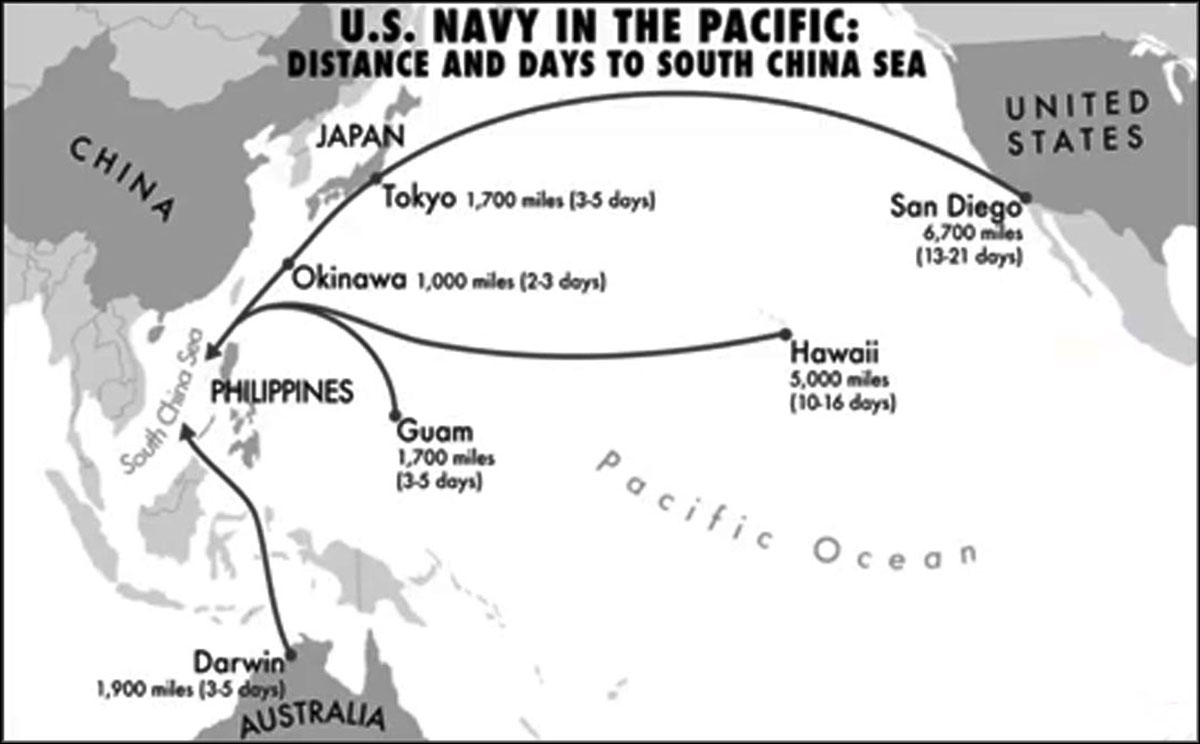
“Basically, the United States does not have... sufficient proximity in the South China Sea if it is going to challenge China. So it needs those Philippine bases if it is going to try and check China through some kind of symbolic military presence that nonetheless has enough substance to actually check China,” McCoy said.
“To take this strategic conflict to the next level, the United States has to have the Philippines. If you look at the map, it is the only point which the United States possibly can gain proximity in the South China Sea sufficiently to challenge China,” he added.