


Sing The Birthday Song In Washing Hands In This Time Of Coronavirus; 24 Suspected Cases Reported
The government has undertaken steps to prevent the novel coronavirus from entering the Philippines, but authorities are urging the public to take measures to protect themselves from the 2019-nCoV.
There is no need for everyone to wear masks or to quarantine people in the Philippines, but there are precautionary measures that the Department of Health (DOH) said must be taken to avoid contracting the novel coronavirus (2019-nCoV).
Singing the birthday song or praying while washing hands can help.
“You can sing ‘Happy Birthday.’ Say your little prayer of ‘Our Father’ and then wash your hands properly, which means the palm of the hands, the back of the hands and the digits... and then that (will take) 20 seconds. Nothing prevents you from extending it by another 20 seconds, so you can sing and you can pray. So that’s 40 seconds all in all,” DOH Secretary Franciso Duque III said in a press briefing at Malacañang on Monday.
And if you are introduced to someone, you might want to drop the handshake and the “beso beso” or cheek bussing for now.
There are no confirmed cases of 2019-nCoV in the country at this time, but health officials are not taking chances. As of yesterday, the DOH said the number of patients under investigation (PUIs) for the potentially deadly virus had climbed to 27.
Of these, DOH Undersecretary Eric Domingo said three were discharged after testing negative for the virus. “They are all foreign nationals, mostly Chinese. There is no Filipino PUI as of this time,” Domingo stressed.
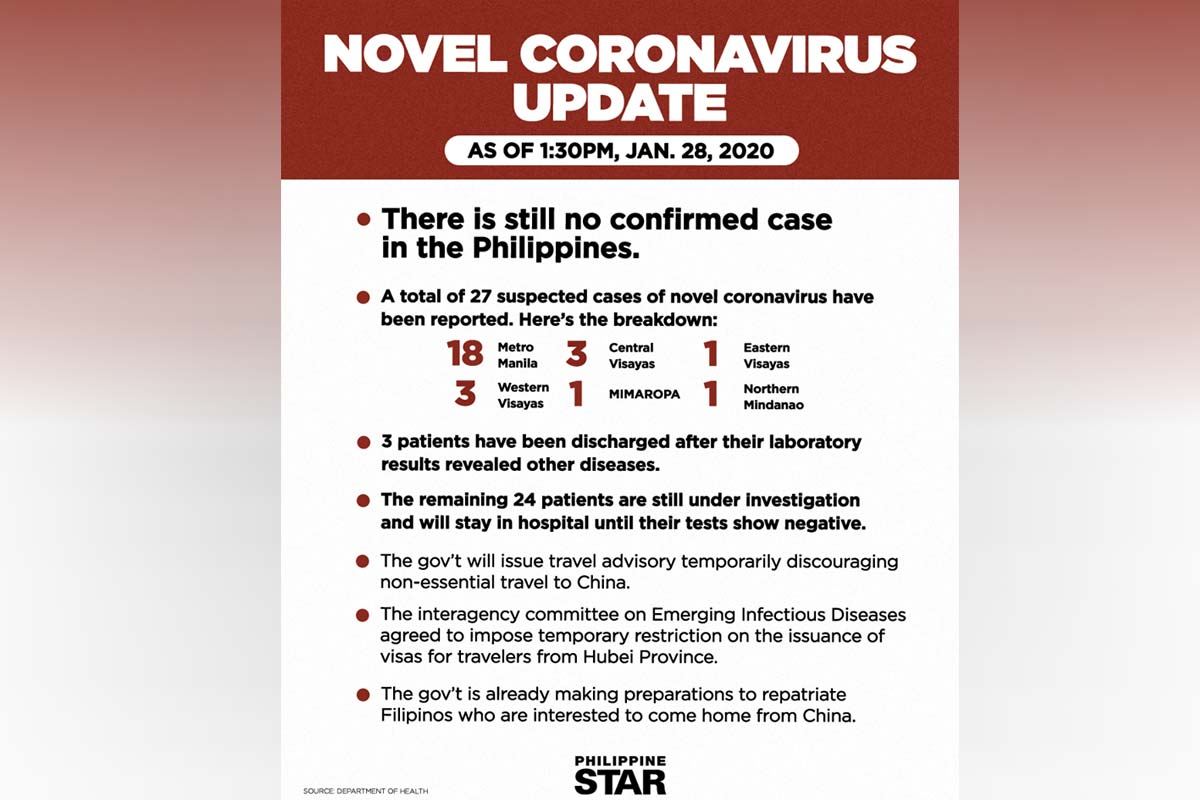
The DOH is now awaiting results of the laboratory samples taken from 19 patients while the remaining five are still undergoing preliminary tests.
The government has undertaken steps to prevent the virus from entering the Philippines, including strengthening border screening, providing protective equipment to health workers, and preparing isolation rooms in government hospitals. Still, authorities are urging the public to exercise preventive measures.
“Avoid shaking of hands at this time... (Perhaps you can just do the) fist bump,” Duque said. “Avoid beso beso, OK? Please, OK? Avoid it for now. If you want, you can touch the end of each other’s fingers so it would really be the least contact point, OK… that’s the best. Or perhaps just greet each other hello.”
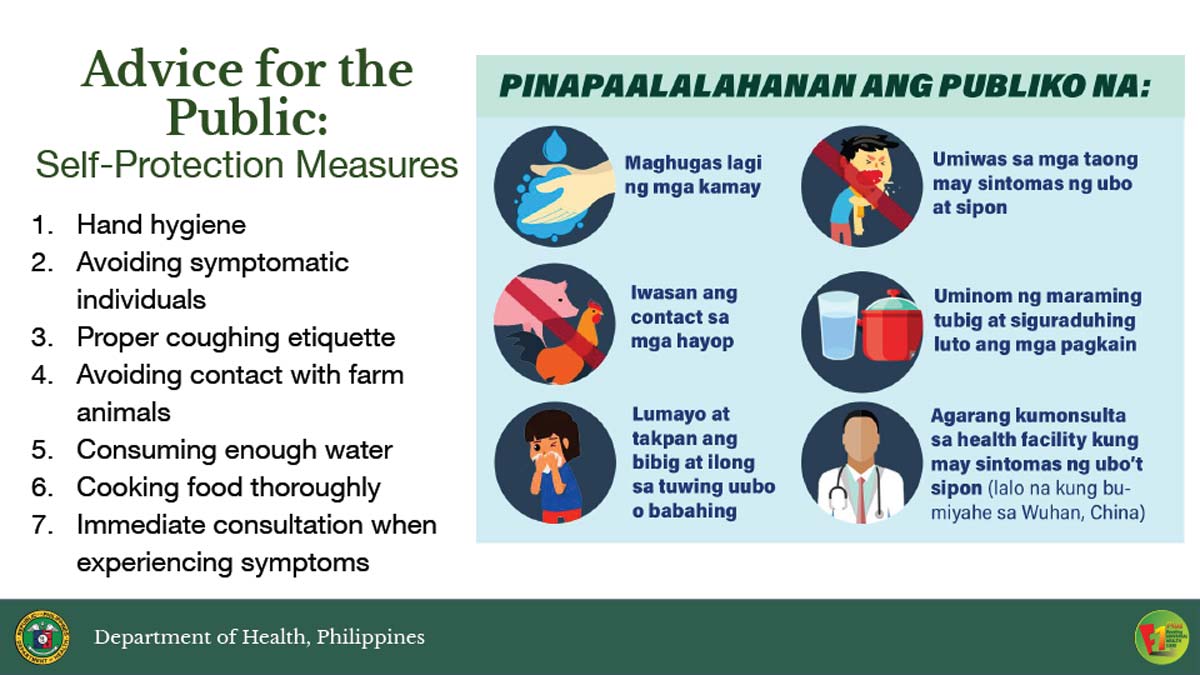
The DOH chief also advised the public to avoid contact with farm or wild animals and to refrain from consuming raw meat including the Filipino dish kilawin.
“Let’s make sure it’s cooked, always cooked... The food that needs to be taken in by our loved ones, the family, make sure that the preparation is adequate, it’s really cooked. It should not be half-cooked,” Duque said.
“‘Yang mga kilawin, tigil na muna natin... maraming mikrobyo din ’yang mga ’yan. Pasensya na ha kung may magagalit na naman sa akin. Bakit ang kilawin? Ang hilig-hilig ng mga Pilipino kainin, lalo na may kasamang tagayan (Stop eating kilawin for now. It has lots of germs. I’m sorry, many will get angry with me again for saying this. Filipinos are so fond of that dish especially when accompanied by liquor).”
Based on reports, nCoV possibly originated from bats and snakes in a wet market in Wuhan City, Hubei province in China.
Those who are suffering from coughs should also observe proper hygiene etiquette, Duque said.
“Maintain distance and cover coughs and sneezes with a tissue or the crook of your elbow... Avoid close contact with people showing cold or flu-like symptoms. And for those experiencing flu-like symptoms, if possible, just stay at home especially if you’re feverish. Don’t spread it. And if it cannot be avoided, just put on a N95 mask or a surgical mask. Momentarily, this will help prevent the spread,” he added.
Duque said travelers with symptoms of respiratory illness should seek medical attention immediately.
No need for quarantine, masks
Rabindra Abeyasinghe, World Health Organization (WHO) country representative, said as of this time, there is still no justification to quarantine all people coming from countries with confirmed cases of 2019-nCOV.
“Right now, the justification is very weak to quarantine everybody coming from all those places, because that means we have to quarantine people from 36 countries,” Abeyasinghe said.
Aside from China, other countries with confirmed cases of the virus are Australia, Canada, France, Germany, Japan, Malaysia, Nepal, Singapore, South Korea, Thailand, the United States and Vietnam.
The current global fatality rate of 2019-nCOV is 2.9 percent, Abeyasinghe said.
He said the WHO is undertaking risk assessment in a bid to minimize disruption of social life and risk to communities due to 2019-nCOV.
Abeyasinghe stressed they have yet to confirm reports that the infection can be transmitted during the incubation period or while the person is not manifesting symptoms.
“We are working with global teams of experts and we cannot confirm that report right now,” Abeyasinghe said.
.jpg)
He also noted that there is no need to wear a mask on a normal day in the Philippines amid the spread of the virus in Asia because there is no high risk in this country.
“Normal people going about their normal work don’t need to wear surgical masks or N95 masks,” Abeyasinghe stressed. “You don’t need to routinely wear masks from morning until evening.”
Meanwhile, those with signs and symptoms of a respiratory infection or those visiting a health care facility, a crowded place or a wet market may want to wear masks.