



Why Allow Chinese State Corporations To Be Part Owners Of Vital Phl Infrastructures, Industries?
Senate President Pro Tempore Ralph Recto is questioning the Chinese state corporations’ significant shares in energy, telecommunications, airports and other industries in the country.
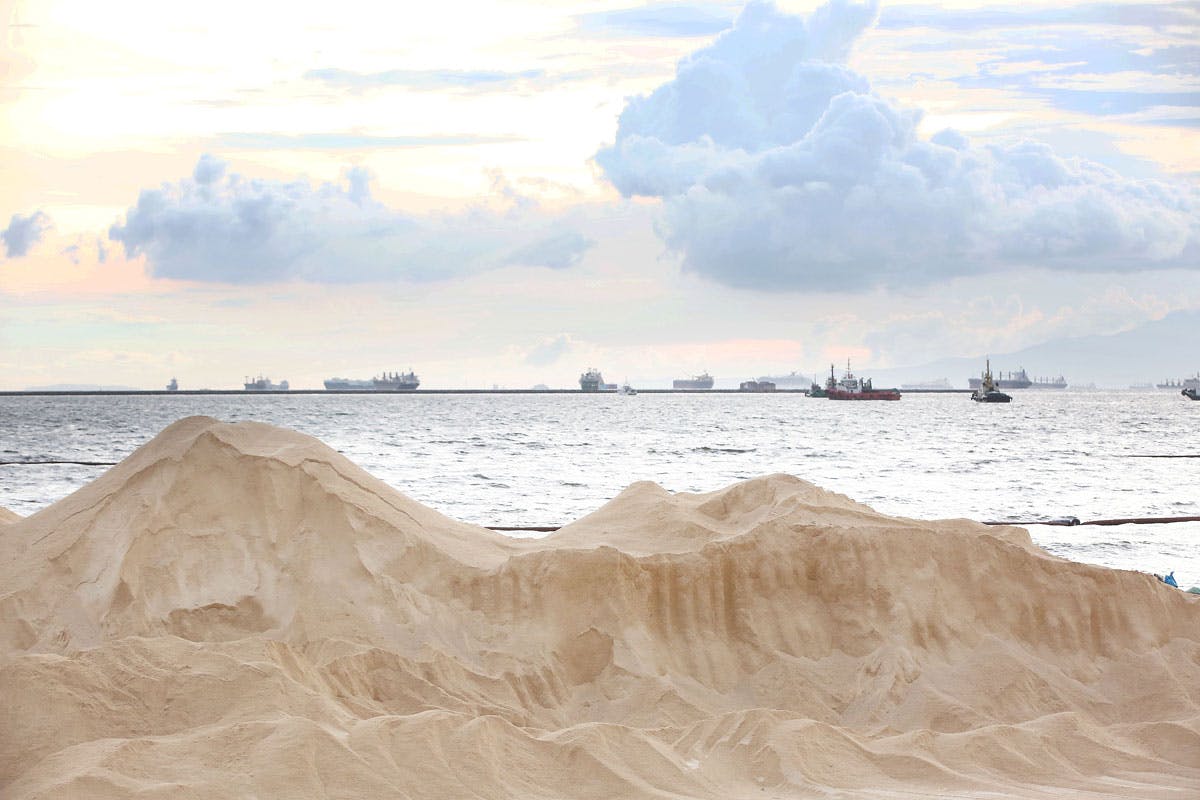
Senate President Pro Tempore Ralph Recto has raised alarm over the possible threats to national security posed by some China-backed reclamation projects in Manila Bay.
Recto says there are valid security concerns over the projects – the proposed Sangley Point International Airport and several reclamation undertakings in Manila Bay that are near the Philippine Navy’s base and headquarters – especially since the contractors include the state-owned China Communications Construction Co. (CCCC).
The CCCC is one of the firms involved in the construction of the militarized artificial islands in the West Philippine Sea, and among those blacklisted by the United States in August for involvement in the reclamation in the disputed waters, as well as by the World Bank over corruption issues.
Recto noted reports that the reclamation project would block government vessels’ access to the Navy headquarters located along Roxas Boulevard in Manila, while the proposed airport seeks to drive out the naval base at Sangley Point.
“They are legitimate concerns. We should not reward Chinese state corporations who are responsible for reclaiming and constructing military facilities in the Spratly islands to do business in the Philippines by reclaiming Manila Bay and creating an airport in Sangley Point, driving away our Philippine Navy from guarding Manila Bay,” Recto said recently. “This is clearly a national security concern.”
Recto warned that CCCC and other Chinese backers would have 40 percent ownership of the proposed airport.
“Why should we allow Chinese state corporations to own significant shares in energy, telecommunications and airports, and other industries?” he asked.
China’s State Grid Corp. has a 40 percent stake in the National Grid Corp. of the Philippines (NGCP), a private consortium that has operated the country’s power lines since 2009. Concerns over potential Chinese interference in the Philippine energy system have dogged the arrangement since it was forged a decade ago.
In November last year, lawmakers called for an urgent review of the arrangement after a report claimed that only Chinese engineers had access to key elements of the system, and that power could in theory be deactivated remotely on Beijing's orders. The NGCP has allayed such concerns.
In August, the House of Representatives voted overwhelmingly to approve on third and final reading a measure that would pave the way for a 25-year legislative franchise for a third telecommunications firm owned by Dennis Uy, a close friend of President Duterte.
Dito Telecommunity Corp. is owned by Udenna Corp. (35 percent), Chelsea Logistics (25 percent) and Beijing’s state-owned China Telecommunications Corp. (40 percent). Both Udenna and Chelsea Logistics are owned by Uy.
Navy chief Admiral Giovanni Bacordo earlier said he would not allow the naval base to be removed from Sangley Point just to give way to the airport project as the military installation is guarding the entrance to Manila Bay.
Manila Bay reclamation projects include two private proponents, UAA Kinmeng and Waterfront, which reportedly partnered with CCCC and China Harbour Engineering Corp. (CHEC) for a project that covers several hundred hectares.
Waterfront is reportedly the developer of two islands for commercial use right in front of the Navy headquarters.
Adjacent to the Waterfront project is the UAA Kinming Group Development, which has negotiated with the Manila city government for two reclamation projects in Manila. These are the 407-hectare City of Pearl and the 40-hectare Baseco Reclamation Project, which also effectively closes off the Manila Bay harbor, according to opponents of the ventures.
Critics have warned that when the two projects are built, it would cut off the Navy headquarters’ access to Manila Bay, giving it the unfavorable distinction of the world’s only such naval headquarters without its own passageway to the country’s territorial sea.
The Navy reportedly asked that the plan be revised to allow access of naval vessels to the headquarters, but Waterfront, CCCC and CHEC simply gave the Navy a winding channel that is only 120 meters wide.
Opponents of the reclamation say 120 meters is wide enough to accommodate only a few small motorboats, which must squeeze through a Z-shaped route before reaching the Navy headquarters.
Bacordo, however, told The Philippine STAR he was not perturbed with the arrangement.
“It is wide enough for our patrol gunboats,” Bacordo said in a telephone interview.
He said the Navy is kept abreast of developments in the reclamation project. Navy representatives participate at certain levels with the planning activities of the private contractors to ensure that the country’s security is protected, he explained.
Bacordo said he had already signed a few “certificates of no objection” on various stages of the projects concerning the Navy.


