



Phl To Stop Accepting Young Retirees; Gov’t Urged To Track Millions Of Chinese Nationals Now In The Country
Senators want to know where the millions of Chinese nationals are staying in the country for the sake of national security, even as the Philippine Retirement Authority will repeal its policy allowing foreigners as young as 35 to retire here.

Tourism Secretary Bernadette Romulo-Puyat announced on Wednesday, Oct. 21, that the Philippine Retirement Authority (PRA) board of trustees would already repeal its policy allowing foreigners as young as 35 years old to retire in the country.
Puyat said she directed PRA general manager Bienvenido Chy of the PRA to “review and change this long-standing policy.”
“We will move for its immediate repeal," she said.
The PRA is under the Department of Tourism. The board of trustees, chaired by Puyat, is expected to meet soon and reassess the policy but the date was not specified.
Puyat made the announcement as the influx of Chinese nationals in the country continues, and senators believe the government must know where the foreigners are, to ensure that they are not taking away jobs from Filipinos or posing risks to national security especially if they entered illegally.
Aside from the 27,678 Chinese “retirees” who are mostly 35 years old, the number of other Chinese nationals in the country who were able to enter through the “pastillas scam” is now around four million.
Senators Nancy Binay and Francis Pangilinan said on Wednesday, Oct. 21, that these Chinese nationals must be tracked down.
According to Binay, the young retirees can easily compete in the local job market or work in Philippine offshore gaming operations or POGOs.
Based on the Philippine Retirement Authority (PRA) list, there are a total of 70,520 foreign retirees in the Philippines. Of this number, the Chinese comprise the highest number or about 40 percent, followed by South Koreans at around 14,000 and Indians at about 6,000.
During a hearing on the proposed 2021 budget of the PRA on Monday, Oct. 19, Binay asked if the agency has a way to monitor if these retirees have truly stopped working, since the probability of them competing with Filipinos for local jobs is high.
Binay said she found the PRA’s age limit for retirees concerning and noted how foreigners could exploit this to work in the country without going through the proper channels.
Pangilinan, for his part, expressed alarm over the reported four million Chinese nationals who have arrived in the Philippines since 2017.
According to Pangilinan, the Bureau of Immigration itself had admitted that many of the four million Chinese were able to enter the country through the “pastillas scheme” or corruption in the BI.
“We call on the DND (Department of National Defense) and the AFP (Armed Forces of the Philippines) to look into the national security implications of what appears to be a ‘soft invasion’ by a foreign power in our shores,” Pangilinan said in a statement on Wednesday.
In a Senate hearing on Tuesday, it was revealed that unscrupulous BI officials had been taking bribes of P10,000 per Chinese national allowed entry into the country. Called the “pastillas scheme,” the corrupt officials have reportedly earned as much as P40 billion from the Chinese.
“Where are these four million? Are they still here? If they are here illegally, is there an organized effort to trace them and have them deported? Also, are there efforts to track the whereabouts and the movements of these foreigners? In the light of the West Philippine Sea conflict, the surreptitious entry of four million Chinese nationals is no laughing matter,” Pangilinan said.
On Monday, Sen. Richard Gordon also warned that the presence of young Chinese retirees is a national security concern because they could serve as a fifth column or a clandestine force that could be mobilized against the Philippines.
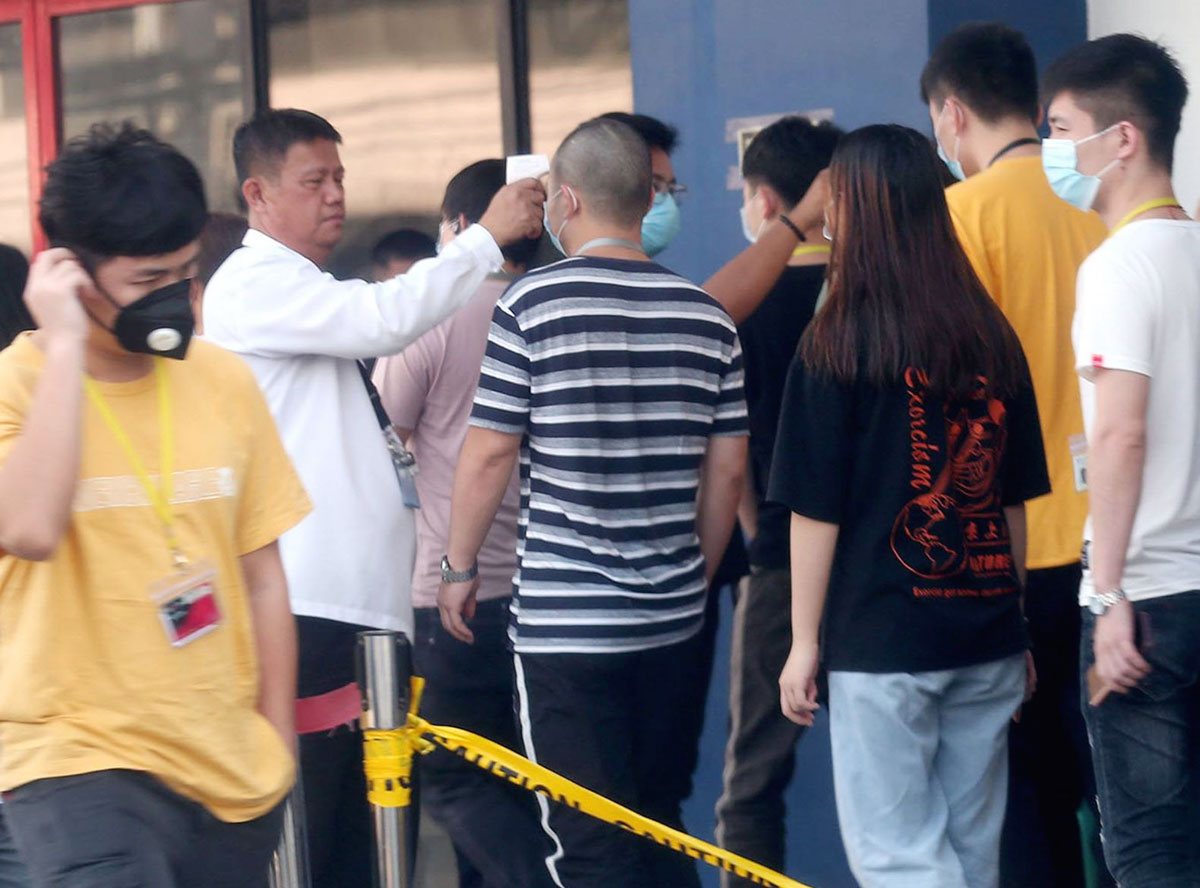
Review policies
Binay urged the PRA during the hearing to review its policy that allows relatively young foreigners to stay in the country as retirees.
She said this must be done to lessen the probability of foreign nationals exploiting the special resident retiree visa or SRRV to stay in the Philippines.
An SRRV allows a foreigner or a former Filipino indefinite stay with multiple entry privileges. Those granted with this visa are also eligible to work, study, and invest in the Philippines.
The agency should also implement a stricter vetting process for foreign retirees, she added.
“It’s high time to review the policy that at 35 years old, you can already retire in the Philippines just by depositing $50,000 in a bank or buy a condominium unit worth P2.5 million,” Binay pointed out.
She expressed concern over the seemingly relaxed national security policy in allowing Chinese nationals who are 35 years old – described by Gordon as “soldier’s age” – to stay in the Philippines as retirees.
“Maybe we should add more security measures and tighten vetting process regardless of the nationality we’re accepting as retirees,” she said.
To bolster national security against the flood of Chinese and other nationals, Pangilinan suggested that the government tighten its measures on foreigners arriving at the airports.
He also proposed that the Department of Justice create an inter-agency task force composed of the DND, BI, National Bureau of Investigation, Philippine National Police and the National Intelligence Coordinating Agency to put an end to the illegal entry of Chinese nationals and other foreigners, and ensure their immediate deportation.
Pangilinan said the BI officials behind the pastillas scam must be made liable for their actions as “it will serve as a warning and a precedent against officials still thinking of taking bribes.”
“The DND, AFP and the military intelligence should find out the national security implications of this ‘soft invasion,’ ” Pangilinan added.
Pangilinan believes the government’s refusal to stop the entry of Chinese nationals at the beginning of the pandemic in January is the reason why the number of coronavirus disease 2019 cases in the country continues to rise.
On Tuesday, Sen. Risa Hontiveros said a “business model” of visa scams and other frauds at the BI allowed corrupt officials to pocket an estimated P40 billion since 2017.
Hontiveros made the disclosure at the resumption of the Senate inquiry into allegations of corruption and human trafficking at the BI, particularly the pastillas scam, wherein bribe money is allegedly distributed in rolled office paper that looks like the local sweet delicacy. This corruption scandal broke out in January.
According to Hontiveros, the bulk of the suspected pocketed money came from the illegal facilitation of entry of Chinese nationals through the so-called visa upon arrival (VUA) and other schemes.
“There are corrupt officials in every corner of BI. In the pastillas scam, we estimate that the masterminds were able to pocket P30 billion. That’s based on the arrival data of Chinese nationals on non-VUA (schemes),” Hontiveros said in Filipino.
“For VUA, which is another revenue stream, the kickbacks go straight into the pockets of some officials,” she said.
According to figures provided by the BI, about four million Chinese nationals have entered the country since 2017.

Hontiveros also took note of this unusually large number, which she described as staggering.
“It’s like there were more Chinese nationals allowed into the country than the entire population of Quezon City,” she said.
Of the four million Chinese nationals, around 3.8 million were non-VUA applicants while around 150,000 were VUA applicants.
Around three million of the non-VUA applicants are believed to have paid the extra P10,000 service fee in the pastillas scam.
Previous Senate hearings showed that VUAs were processed by travel agencies, many of which required a mere screen shot of the applicant’s passport sent via the WeChat app. The applicant could have been trafficked by a syndicate, but as long as there was no derogatory record on paper, then the applicant would have been able to enter the country with a VUA.
Hontiveros noted that the system could have started a corrupt “business model” that is now being unraveled.
Chinese workers
In a related development, Malacañang said China should have the flexibility to hire its own citizens for projects it is financing. This was after some senators questioned the high percentage of Chinese workers involved in the construction of some bridges in Metro Manila.
During a budget hearing at the Senate last week, Department of Public Works and Highways (DPWH) Undersecretary Emil Sadain said 31 percent of the workers for the Estrella-Pantaleon bridge and 45 percent of the workers for the Binondo-Intramuros bridge are Chinese.
DPWH Secretary Mark Villar told senators that the employment of foreign workers was not a condition for the approval of official development assistance from other countries. However, he pointed out that many projects require specialization because they involve new technologies.
Pangilinan questioned the high percentage of Chinese workers employed, noting that the Philippine construction industry has seen the largest drop in employment in the second quarter amid the COVID pandemic. Pangilinan also underscored that 23 million adult Filipinos are jobless.
But presidential spokesman Harry Roque said the Chinese government should have some leeway in hiring people who will work in China-funded projects.
“Let me highlight that these bridges are 100 percent donations from the Chinese government. So I think that should give us the proper perspective. It’s being given to us 100 percent, we don’t pay back anything for the building of these bridges, and that is why we need to give them some flexibility in the personnel that they hire,” Roque said in a television interview.
“Had this been a project that we would pay for using taxpayers’ money, of course, (the) government would insist that aside from highly technical positions, that Philippine labor should be employed. But the proper perspective is, it’s an outright grant or donation to the Philippine government,” he added.
But Roque conceded that the administration would appreciate it if the Chinese government decided to employ more Filipinos.
“The general rule is foreigners should be hired only when there are not enough Filipinos able and with the capacity to perform the work. But again, of course, please realize that this is a 100 percent donation to us by the Chinese government,” Roque stressed.
He said he would discuss with the DPWH and the Department of Labor and Employment if more Filipinos could be hired for the bridge construction projects.
“But my gut feel is, because it’s a 100 percent grant, the Chinese have to be given more flexibility on the decision on whom to hire,” he added.


