



Not An 'Accident’: Basketball Stars’ Drowning Deaths Ignite Questions On Accountability, Prevention Measures
Public health and injury prevention experts have long rejected the notion that drowning is merely an “accident.” It is a preventable cause of death and a silent public health crisis that claims thousands of Filipino lives every year.
Two basketball stars had promising futures ahead of them.
But on June 8, during what Ateneo de Manila University – where the two were members of the men's basketball team – described as a “conditioning exercise” in the rough waters of Dipaculao, Aurora, the two players were reportedly swept away by strong currents and died.
In the certificates of post-mortem examination released by the National Bureau of Investigation (NBI), Rene Baterbonia, 19, and Divine Adili, 21, were found to have died from “foreign body asphyxiation,” the medical term associated with drowning.
“Based on the statements we got from their companions, this incident was really, purely an accident. It was a natural accident. It was not caused by anybody,” Aurora police chief Col. Percival Pineda told a June 9 press briefing.
But public health and injury prevention experts have long rejected the notion that drowning is merely an “accident,” as first described by the Aurora police.
It is a preventable cause of death and a silent public health crisis that claims thousands of Filipino lives every year.
The Philippine Statistics Authority (PSA) reported 3,017 deaths in drowning and submersion incidents in 2024 and 3,580 deaths in 2023, noting that drowning remains among the leading causes of preventable injury-related deaths in the country.
The World Health Organization (WHO) says drowning is caused by the impairment of the lungs, the primary organs of the respiratory system, from submersion or immersion in water. “Foreign body asphyxiation,” in the context of drowning, refers to water as the “foreign body” that causes suffocation and respiratory impairment.
Death occurs after oxygen stops going to the heart due to the lungs taking in water. The body shuts down without a supply of oxygen. An average person can hold his breath for only around 30 seconds.
A national reckoning
The tragedy became the biggest among the news stories in a week dominated by the Senate political standoff, Vice President Sara Duterte’s impeachment trial and a magnitude 7.8 earthquake that struck Mindanao – Baterbonia’s home region.
Ateneo alumnus and lawyer Tony La Viña, in his column for MindaNews, said, "Rene Baterbonia’s path is one that thousands of families in Mindanao will recognize instantly. He was a boy from Talacogon, a small town along the Agusan River, far from everything the capital takes for granted. His was a family of modest means that poured what little it had into a son’s gift, because in this country, a boy who stands six foot four and can play is carrying not just a ball but a household’s future.”
Adili, who came to the Philippines from Nigeria to study and play basketball for Ateneo, was remembered by friends as gentle, kind and hardworking. His classmate and close friend, Dona de Leon, recalled that he dreamed of playing professional basketball overseas after graduation so he could help support his family.
The tragedy has since triggered multiple investigations by the Department of Justice, NBI, Commission on Higher Education, Philippine Sports Commission and lawmakers.
Who should be held accountable?
Following public calls for him to speak out, Ateneo head coach Tab Baldwin broke his silence and apologized on June 12, four days after the tragedy.
“On that fateful day when we sent the players out for a routine training run in what we thought was shallow water, up to the moment when we realized that whatever had happened, they were in dangerous water,” Baldwin said.
“And we did everything that we could as coaches, as people responsible for that situation. The players themselves did everything they could to ensure that everybody arrived back on shore safely. And then we realized that we hadn’t accomplished that,” he added.
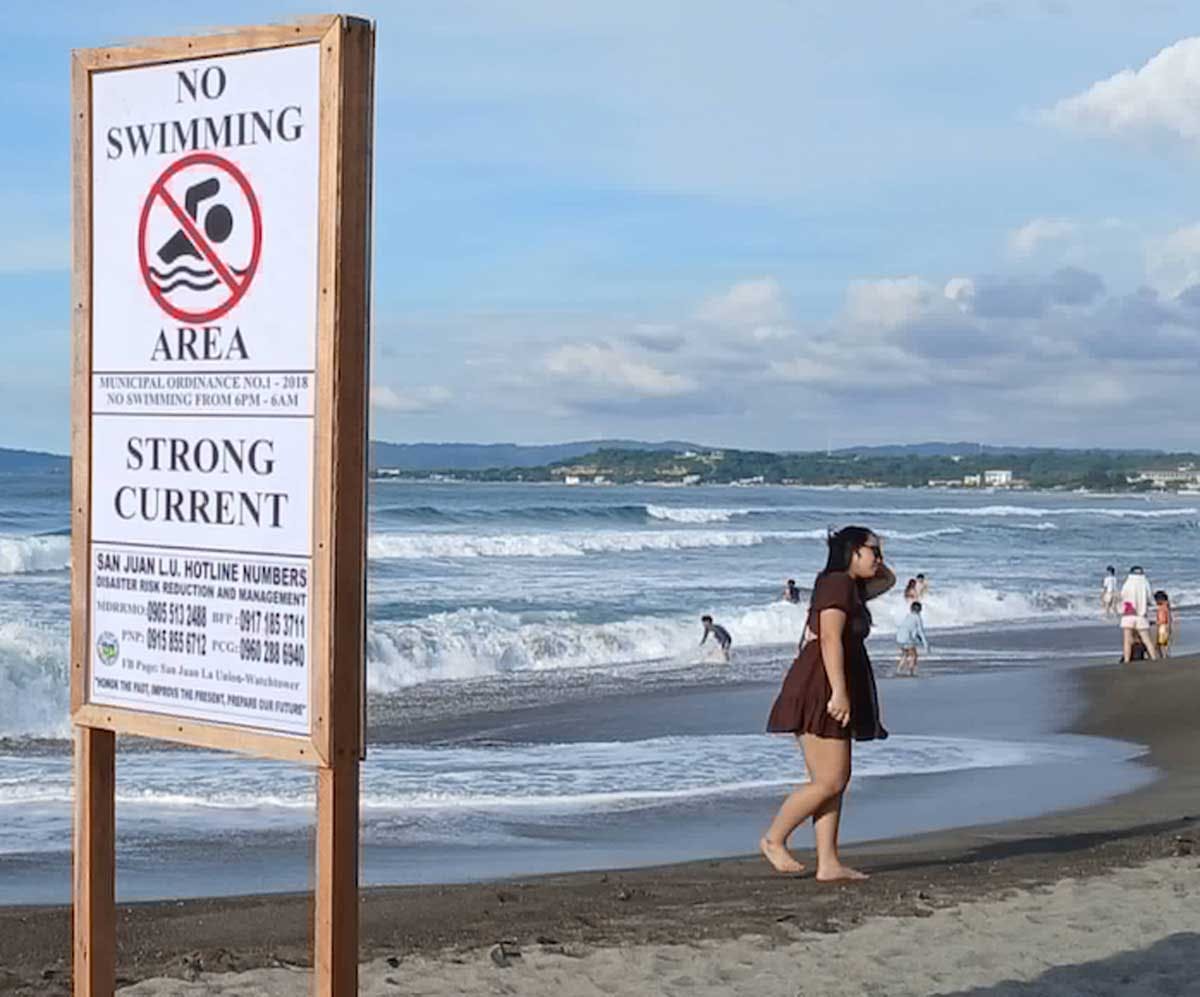
Images of warning signs posted throughout Dipaculao beach were circulated widely online, signs describing the beach as "unprotected," with rip currents and the absence of lifeguards.
Aurora police chief Pineda said the basketball team had allegedly ignored the resort management’s warning about unpredictable sea conditions, citing the resort owner’s sworn statement that the team conducted their team-building activity 300 meters away from the facility, despite being advised to stay on the shore with a lifeguard stationed.
On June 12, the local government of Dipaculao ordered the temporary closure of the resort pending an inspection of the establishment.
The story struck a chord with Annee del Rosario Buen. In a social media post, she called for accountability and action as she shared how she lost two friends in the same waters in 2019.
Her friends Dax and Ramon, also known as Bage, died when they were caught by powerful waves while in the shallow waters of the beach.
According to information shared by a friend of Dax, two other people had died under similar circumstances in Dipaculao just two months earlier.
Buen said accountability should also extend to the local government units (LGUs) and resort operators, while clarifying that she was not excusing the Ateneo basketball team’s coaches, management and administration, which she described as a “separate matter altogether.”
In her post, Buen said that “the LGU and local resorts cannot continue to hide behind a few ‘Swim at your own risk,’ ‘No lifeguards,’ or ‘Wear life vests’ signs.”
“How can an area aggressively promote itself as a beach resort destination, profit from tourism, and then expect visitors to only look at the water or walk on the sand?
“If a destination is inherently unswimmable, operating a beach resort there without stringent, active safety measures is a tragedy waiting to happen,” she said.
Beyond 'Swim at your own risk’: The case for drowning prevention
Buen added that the Dipaculao LGU should transition from “passive and largely verbal warnings” to active coastal management, similar to measures in high-surf destinations worldwide.
These include visible beach flag systems, mandatory lifeguard corps, detailed mapping of hazardous areas, educational signage explaining specific risks, designated zero-entry zones during dangerous conditions, and linking business permit renewals for beach resorts to strict compliance with safety standards.
“‘Swim at your own risk’ is an outdated cop-out. It is time for the Dipaculao LGU, local resort owners and other similar beach destinations to step up, take responsibility, and implement modern ocean safety standards before the sea claims another life,” Buen said.
Her call echoes a broader public health perspective that drowning deaths are not inevitable tragedies but preventable ones.
Department of Health (DOH) spokesperson Undersecretary Albert Domingo said, “Drowning can affect anyone – including children, adults, athletes and experienced swimmers. The DOH calls on families, schools, sports organizations, LGUs and communities to work together in promoting a culture of water safety and drowning prevention.”
While the DOH considers drowning prevention a priority under its Violence and Injury Prevention Program, only three provincial and city-wide health systems have adopted the World Health Organization (WHO)-backed guide on drowning prevention, with other local government units pursuing their own drowning prevention initiatives.
Domingo said the program focuses on safer aquatic environments, community-based interventions, and public education on water safety.
Yet recurring drowning deaths and other water-related incidents point to persistent gaps in implementation.
Where are the drowning prevention policies?
The deaths have prompted lawmakers to examine the safety protocols governing school-sponsored athletic activities. But few legislative measures directly address drowning prevention.
The WHO, which describes drowning as a neglected public health issue that claims more than 300,000 lives globally each year, has urged governments to strengthen water safety policies, improve early warning systems, and develop national water safety strategies.
Senators Bam Aquino, chair of the basic education committee, and Robinhood Padilla filed separate resolutions seeking a legislative inquiry into the incident.
Pinoy Workers party-list Rep. Karl Legazpi and Agusan del Sur Representatives Alfel Bascug and Eddiebong Plaza separately filed similar resolutions.
Amid the investigations and legislative inquiries, the bereaved families are still searching for answers.
Adili's mother, Ifeoma, appealed for a full accounting of what transpired, saying, “The only thing I want is that they should please explain to me, let me understand. Because, as I'm here now, I cannot even tell exactly what happened to my son.”
La Viña wrote: “He (Baterbonia) won a national title for his region. Then he did what Mindanao’s brightest have always had to do: he got on a plane to Manila, because the opportunities, the league, the exposure, the scholarship, and the pathway to the professional ranks are all there, never here (in Mindanao).”
The promise of a better life through basketball was something Baterbonia himself spoke about shortly before his death.
Coach Jess Evangelio, who mentored Baterbonia in regional competitions, recalled receiving a message from the young athlete, who said he did not plan to return home for the next five years because he wanted to help lift his family out of poverty.
“Gusto nako pag madato ko ma ahon nako ako pamilya sa ka pobre,” Baterbonia said in his message. ("When I become successful, I want to lift my family out of poverty.")


