



‘Maid In Malacañang’ Premieres July 29 Amid Controversy
Film director Joel Lamangan is demanding to extend some degree of moral and cultural sensibility to the story of “Maid in Malacañang,” whose director Darryl Yap wants to exercise more flexibility in his approach.
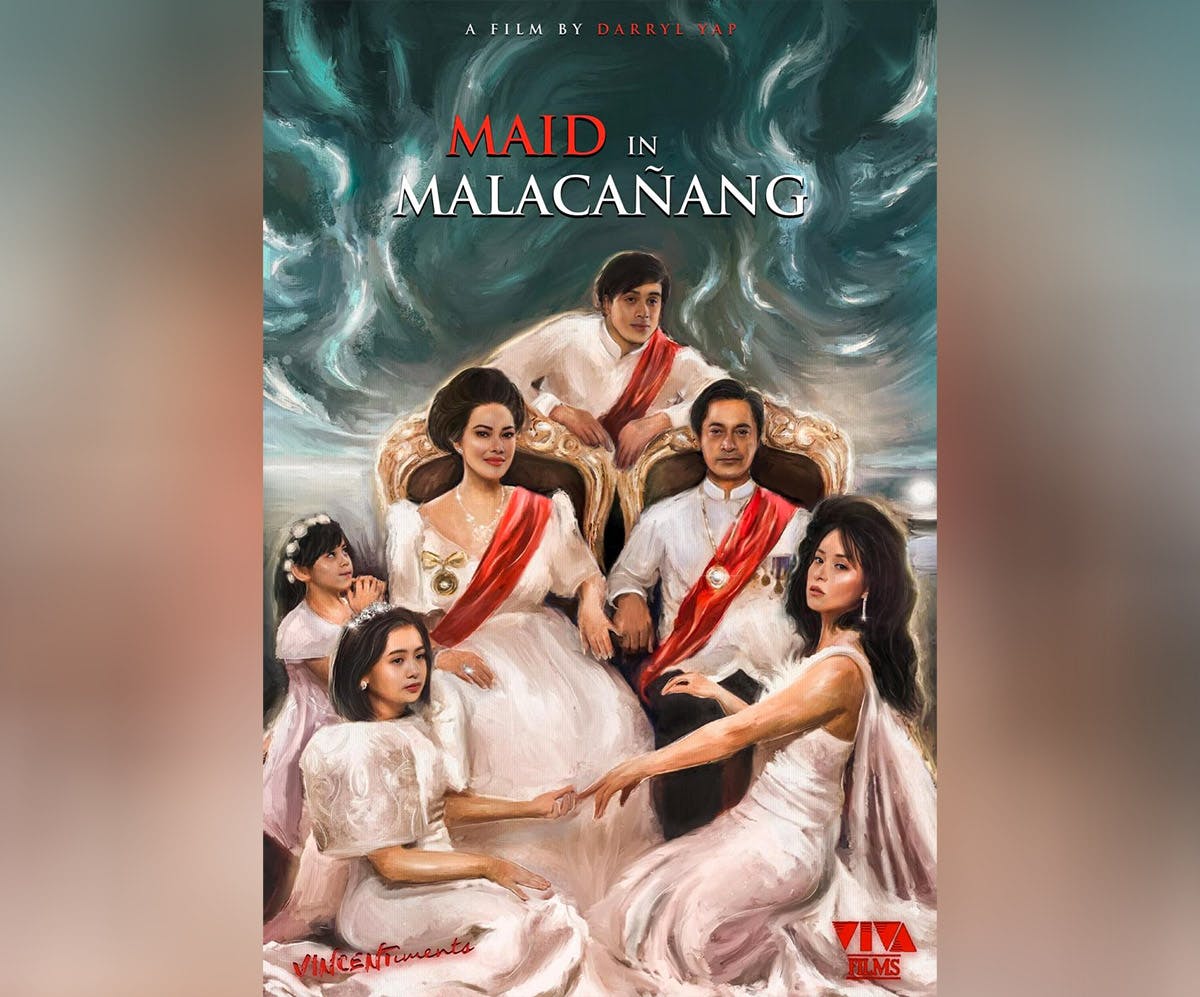
Two directors belonging to different generations, but working for the same production company, could not help but engage in public debates over how certain events in Philippine history should be translated on the big screen for the information and entertainment of a wider audience.
One is demanding to extend some degree of moral and cultural sensibility to the story that is about to be told, while the other wants to exercise more flexibility in his approach, choosing to focus instead on a singular perspective instead of considering other conflicting yet insightful narratives.
This was how the recent conflict between veteran filmmaker Joel Lamangan and controversial newcomer Darryl Yap unfolded over the latter’s upcoming movie “Maid in Malacañang,” which depicts the last 72 hours of the Marcos family from the Palace amid the 1986 EDSA people power revolution.
Anyone who is well-versed in film studies would probably consider this development as nothing out of the ordinary because, in the language of cinema, distorting reality and manipulating truths are par for the course. The decision is always left to the audience whether to believe a story or not.
But the 69-year-old Lamangan lived as an activist and political prisoner during the first Marcos administration. He naturally has a different version of events and appreciation of history fueled by his own personal experiences.
At the “ML@50” campaign launch held at the Quezon City sports club last July 21, which commemorated the 50th anniversary of the declaration of martial law by the late dictator Ferdinand Marcos, Sr., Lamangan heavily criticized the movie over its alleged lame attempt at historical distortion.
"Hindi totoo ang sulo. Ano ‘yon? Lamay? Puro kahunyanguan, puro katarantaduhan. (It’s not true that torches were lit. What was that? A wake? That’s pure chameleonism, utter foolishness),” the multi-awarded filmmaker said.
Lamangan’s reaction was based on the official trailer of the movie that was released online that week. In one scene, political activists were shown carrying tiki torches outside Malacañan Palace to demand for the ouster of the Marcos patriarch and put an end to his brutal regime.
As expected, Yap fired back in defense of his directorial choices by citing “creative liberties” because he said he was not making a documentary. He claimed his movie is about a “family in crisis” and asked everyone, including Lamangan, to refrain from judging without seeing it first in its entirety.
“Maaari siguro na magbigay siya (Lamangan) ng kritiko o opinyon kapag napanood na niya (Perhaps he can give his critique or opinion once he already saw the movie),” he told ONE Balita Weekend on One PH last July 23 in response to the comments of the seasoned director.
The 35-year-old content creator, who transitioned into making commercial movies for Viva Films in 2019, never lived under martial law and opted to rely on the account of the Marcoses or those sympathetic with them to shape the events of his latest project.
Yap said he did not do “intensive research” when he wrote the script for his new movie but denied allegations of historical revisionism. He argued that it was never his style to be “very scientific” in his filmmaking process and neither did he intend to make a movie that would appeal to historians or critics.
And therein lies the problem, according to Lamangan, as he believes that the social responsibility of an artist is lost on someone like Yap.
“Anong drama 'yun? Drama ng pagtatakip para kaawaan ng tao 'yung pamilyang 'yun. Dapat tingnan ulit natin ito bilang distortion ng katotohanan (What kind of drama is that? A coverup drama to generate public sympathy for that family. We should see it as a distortion of truth),” Lamangan said.
Lamangan and other martial law victims are trying to lead a public backlash against the movie, hoping that people would think long and hard before going to the theaters to waste their time and money on it. He also signified his interest to make another film debunking Yap’s pro-Marcos narrative.
“Dapat mulat tayong lahat…Sasabihin ko sa mga tao na hindi totoo ang lahat ng ito at gagawa ako ng pelikula laban dito (We must all be aware… I will tell the people that this account is not true and I will make another film against it),” he said of the movie.
Yap, for his part, welcomed this challenge. He even offered to finance the veteran director’s planned film project out of the potential earnings of his controversial new movie, which is scheduled to hit the theaters nationwide on Aug. 3.
“Kung kaya ba naman ng budget at kung tanggap niya (Lamangan) na ‘yung perang meron ako ay hindi naman galing sa taumbayan, walang problema sa akin (If the budget can cover it and if he can accept that the money I have did not come from public funds, no problem with me),” Yap said.
Lamangan is also working for Viva Films, the same production company behind his long list of critically-acclaimed and commercially successful movies, especially in the 1990s, some of which are based on true stories like “The Flor Contemplacion Story” (1995) and “The Sarah Balabagan Story” (1997).
Reached for comment, the Movie Television Review and Classification Board (MTRCB) chair Lala Sotto-Antonio said “Maid in Malacañang” is currently still being evaluated by its members. The movie is expected to premiere in selected theaters in Quezon City on Friday, July 29, according to Yap.
“Should the agency along with its board furnish a permit to exhibit by (Thursday, July 28), possible early screenings may be allowed—depending on the discretion and booking of the distribution company and cinema exhibitions,” Sotto-Antonio said in a text message sent through her assistant.


