



‘Navy Sailor’s Thumb Reattached’
Seaman First Class Underwater Operator Jeffrey Facundo lost his thumb after a China Coast Guard vessel rammed a Philippine rubber boat during a resupply mission on June 17.
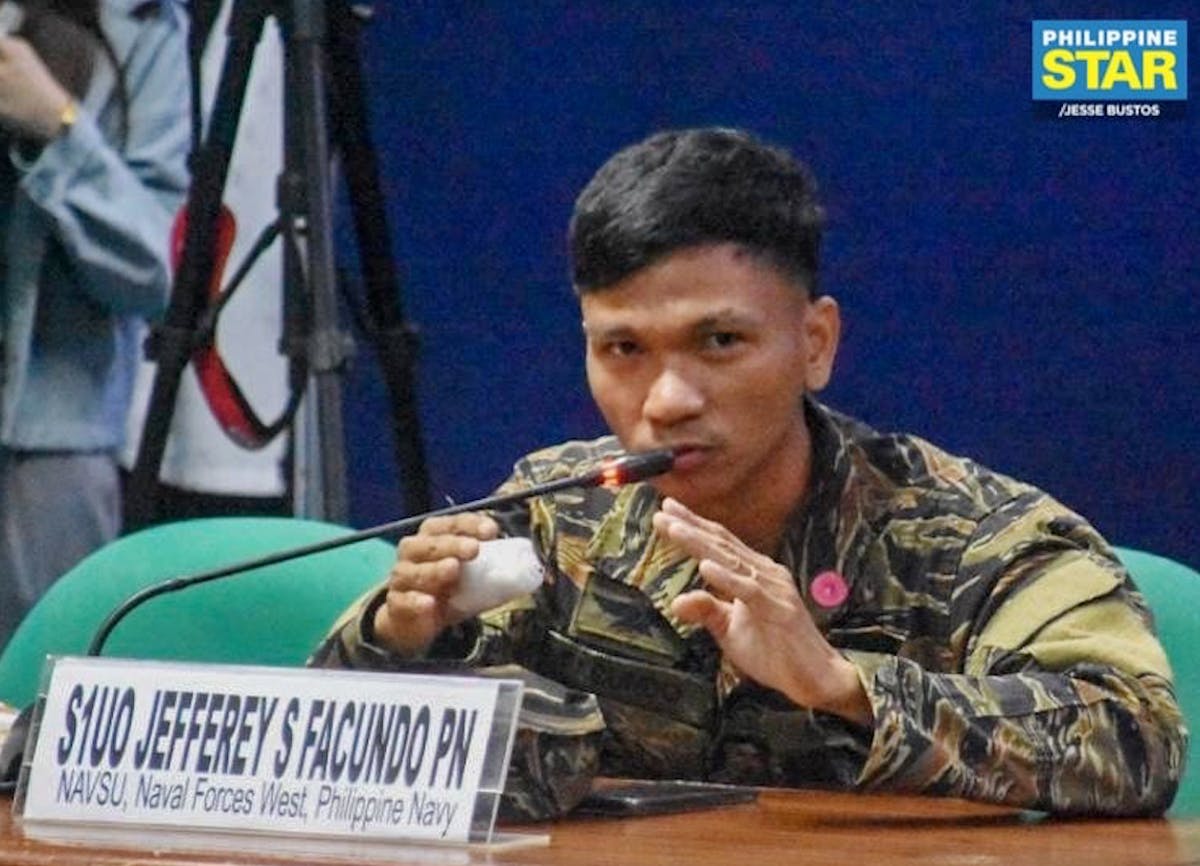
Following a June 17 confrontation with the China Coast Guard (CCG) in Ayungin Shoal, a Philippine Navy service member’s thumb has been reattached, Armed Forces of the Philippines (AFP) chief Gen. Romeo Brawner Jr. said on Monday, Nov. 4.
“His finger has been restored. It is now functioning well, normally. I think it was two months ago when it was reattached,” Brawner said.
“With the help of our doctors and partners, such as the Makati Medical Foundation, the soldier’s thumb has been restored,” he noted.
Seaman First Class Underwater Operator Jeffrey Facundo lost his thumb after a CCG vessel rammed a Philippine rubber boat during a resupply mission.
Facundo has returned to duty in the West Philippine Sea after the surgery two months ago, Brawner said.
The AFP demanded China to pay P60 million in damages and losses and return stolen firearms.
The CCG punctured two rigid-hulled inflatable boats and damaged navigational and communications equipment.
“The P60 million doesn’t even include the damage caused to our Navy personnel who lost his finger,” Brawner noted.
China has yet to respond, he said.
“We sent a letter to the Department of Foreign Affairs so they could include this in our demands. We will continue to demand that it is our right. They are at fault. They stole our equipment. They should return it,” Brawner said.
China demanded the removal of the BRP Sierra Madre from Ayungin Shoal, supposedly as part of a “gentleman’s agreement” with the previous Duterte administration, in exchange for continuing dialogue with the Philippines.
China has no right to be in Ayungin Shoal, a low-tide elevation that lies within the Philippines’ exclusive economic zone and continental shelf, as per the 1982 UN Convention on the Law of the Sea and the 2016 arbitral award.
Meanwhile, the Philippines and the European Union reiterated their strong opposition to illegal, coercive, aggressive and dangerous actions in the South China Sea.
They urged parties to refrain from threat or use of force and adding uncertainty to the region through unilateral acts.
During the second Sub-Committee on Maritime Cooperation in Manila last week, the Philippines and the EU welcomed sincere diplomatic engagements.
They urged parties to refrain from threat or use of force and adding uncertainty to the region through unilateral acts.
Maritime disputes must be resolved through peaceful means, using dispute settlement mechanisms under UNCLOS, they said.
The Philippines and the EU echoed the International Maritime Organization and UN Security Council’s call for the immediate release of the Galaxy Leader and its crew in Yemen.
They highlighted UN Human Rights Council resolution A/HRC/56/L.4, which reaffirmed that safe and decent living and working conditions at sea are a human rights imperative.
The second SCM under the Philippines-EU Partnership and Cooperation Agreement is the second maritime dialogue built on the accomplishments of the inaugural SCM in Brussels in 2023.
The next subcommittee meeting will take place in Brussels in 2025.
No MDT changes
Regardless of who wins the US elections, implementation of the Mutual Defense Treaty will not change, according to Ambassador Jose Manuel Romualdez.
Defense agreements with the US remained in place in past US administrations, Romualdez told radio dzBB on Monday.
“The defense establishment here is very much aligned with the way they want our lives to continue,” he said.
“The interest of the US aligns with ours to keep the area (Indo-Pacific region) free and to ensure that territorial sovereignty is respected,” he noted.
If US Vice President Kamala Harris wins the presidency, Romualdez said Filipinos could expect a continuation of the same kind of defense and diplomatic relations under US President Joe Biden.
There may be changes in the economic front if former president Donald Trump wins the election, but there will be no changes in the defense relations between the two countries, Romualdez said.
In 2022, Harris visited the Philippines and reaffirmed the strength of the US-Philippine alliance and Washington’s commitment to upholding the international rules-based order in the South China Sea and the broader Indo-Pacific.
Harris also reaffirmed US defense commitments under the mutual defense treaty with the Philippines and support for the 2016 arbitral ruling that rejected China’s expansive maritime claims.
Military exercise
The AFP joint exercise Dagat-Langit-Lupa, or AJEX DAGITPA, will focus on strengthening external defense capabilities, Brawner said.
“This year’s exercise will adopt an operationally focused framework enabling us to simulate our territorial defense plan Bantay Kalayaan alongside a comprehensive archipelagic defense concept,” Brawner said on Monday during the AJEX DAGITPA opening rites at Camp Aguinaldo.
The eighth iteration of AJEX DAGITPA, which runs until Nov. 15, shows the AFP is ready to “confront real-world challenges.”
Over 3,000 soldiers are expected to take part in the exercises, which will be held at the Western Command headquarters in Puerto Princesa, Palawan and Northern Luzon Command headquarters in Tarlac City.
“We have done the contingencies in the planning and we expect that our Chinese counterparts will be monitoring us and doing some things maybe,” said AJEX DAGITPA exercise director Maj. Gen. Marvin Licudine.
The exercise is not aimed at any country, he said, as it is conducted to “improve our combat readiness and to guarantee that our joint forces are fully competent and proficient to carry out their mandate.”


