


Leni Ready To Be Among First To Get COVID-19 Vaccine To Prove Its Safety
President Duterte said in August that he is willing to serve as guinea pig but authorities clarified that the safety of the COVID-19 vaccine must be ensured first.

Vice President Leni Robredo on Sunday, Dec. 6, said she is ready to be among the first to get the vaccine for coronavirus disease 2019 to allay Filipinos’ fears on its safety.
In August, President Duterte also volunteered to serve as a guinea pig as he announced that the Philippines would conduct large-scale human testing of Russia's COVID-19 vaccine. The President said this was to prove his full confidence in the vaccine developed by Russia.
However, presidential spokesman Harry Roque said Duterte would not receive the inoculation until regulators guarantee its safety.
In her weekly program over radio station dzXL, Robredo was asked by her co-anchor broadcast journalist Ely Saludar whether she is in favor of a proposal to give the COVID-19 vaccine to the country’s top officials first to increase the people’s trust in it.
“To me, if the purpose of getting the vaccine first is to increase the people’s confidence in it, that is OK,” the Vice President said in Filipino.
Robredo recalled she did the same thing in 2014 when she was a representative of Camarines Sur to encourage her fellow Bicolanos to drink water from a filtering system developed by the University of the Philippines.
“When Typhoon Glenda hit us (Bicol), many had no access to drinking water. UP provided us a water filtration system. Every time we give this to communities, we have demonstrations and I am the first to drink,” she said.
Robredo, however, stressed the government must prioritize the healthcare workers once the vaccine is available.
She also urged the government to start listing down the names of those prioritized to receive the expected COVID-19 vaccine.
On Saturday, Sen. Christopher “Bong” Go urged National Task Force Against COVID-19 chief implementer and vaccine czar Carlito Galvez Jr. and Health Secretary Francisco Duque III to be the first to try the vaccine to assure the public of its safety.
“I’m challenging Secretary Galvez, once the vaccine is available, along with Secretary Duque to be the first to be injected with the vaccine to encourage the public,” Go said.
In her radio program, Robredo lamented how the Dengvaxia controversy had affected the government’s immunization program. Dengvaxia is an anti-dengue vaccine developed by Sanofi Pasteur.
“We saw the impact of the noise during the Dengvaxia controversy, and it affected the diseases that were already eradicated in the country. For example, polio. It was already eradicated but emerged again after people doubted vaccines,” she said.
Lulu Bravo, executive director of Philippine Foundation for Vaccination, said conducting a massive information campaign would be critical in building vaccine confidence in the country.
The government stopped its nationwide dengue vaccination program and pulled Dengvaxia off the market in late 2017 after Sanofi Pasteur admitted that the vaccine might cause severe symptoms if injected to those who did not have a prior dengue infection.
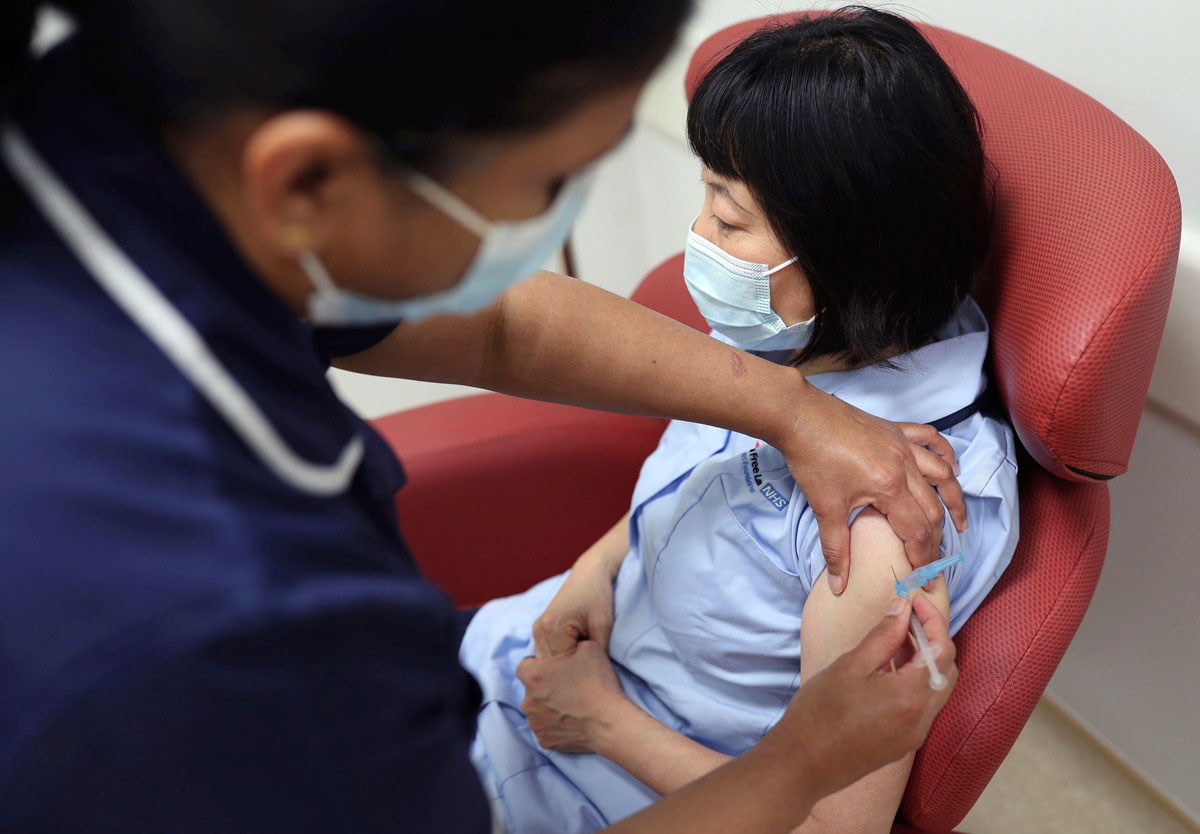
On Thursday, Dec. 3, Food and Drug Administration (FDA) director general Eric Domingo said the Philippines may have the vaccines for COVID-19 as early as March next year if pharmaceutical companies secure emergency use authorizations (EUAs) from local authorities in January.
Duterte has allowed the FDA director general to issue EUA for vaccines and medicines for COVID-19 under Executive Order (EO) No. 121 dated Dec. 1.
The EO permits the use of COVID-19 medicines and vaccines pending approval by health authorities provided there are credible data suggesting that these can stop, diagnose, or treat the disease.
Among the first vaccines to become available the country, Domingo said, are those produced by pharmaceutical companies that were able to secure EUA from their countries of origin like Pfizer Inc., Moderna Inc. and Sinovac Biotech Ltd.
Domingo stressed nobody will be forced to get the vaccine if they do not want to. Those who will be vaccinated should be well informed of the benefits and the possible risks of the vaccine, he said.
Thus, he said the Department of Health (DOH) is mounting a campaign to make the people understand the risks and benefits of the vaccine so they could make an informed decision.
He said the FDA and the DOH will also be closely monitoring those who have been vaccinated so that possible adverse effects can be immediately investigated to determine whether the immunization should push through.
"One of the basic requirements for vaccine is a strong surveillance system," Domingo noted.
He disclosed that an adverse events committee will be formed to monitor the condition of those who will be vaccinated.
But in an interview with "The Chiefs" on One News / TV 5 on Wednesday, Dec. 2, DOH Maria Rosario Vergeire said the agency is coordinating with the Department of Justice (DOJ) on the implementation of the vaccination.
"We are coordinating with the legal services as well as of course the DOJ, (to) bring this forward so we will be guided on how we can be able to implement this without violating the rights of any individuals, but at the same time push the objective of public health," Vergeire explained.
"We will be getting informed consent, but if people will refuse to accept the vaccine it might defeat the purpose. If we try to look at the very objective of immunization, we would want to have the herd immunity so we can protect the whole population," she said.
Vergeire added mandatory vaccination is not new because there is an existing law requiring immunization of all children less than a year old.
"Based on the law, mothers are mandated to bring their children to health facilities for vaccination, but of course there is still the consent because they won’t bring their children if they really do not like," Vergeire stated.
Vergeire said a recent survey indicated that almost 60 percent of respondents were interested and willing to receive the COVID-19 vaccine.
But passage of a legislation mandating COVID immunization, Vergeire said, would be welcomed by the DOH.
She noted a clear implementing guidelines on the COVID vaccination program is essential.
At this time, Vergeire said the DOH and all other concerned government agencies are exerting efforts to meet the timeline set by the Duterte to provide COVID-19 vaccine to the Filipinos.
She said the regulatory process is already being expedited while the government negotiates with partners and manufacturers for the purchase of the vaccines.
Vergeire assured the public that financing and storage facilities for the vaccines as well as their distribution are also being prepared at this time. – With Mayen Jaymalin