



Philippines-China Tensions Resurface At The Close Of Asean Defense Gathering
Defense Secretary Gilberto Teodoro Jr. did not directly address the Chinese allegation of obstruction but said Beijing had been given the opportunity to present its views .
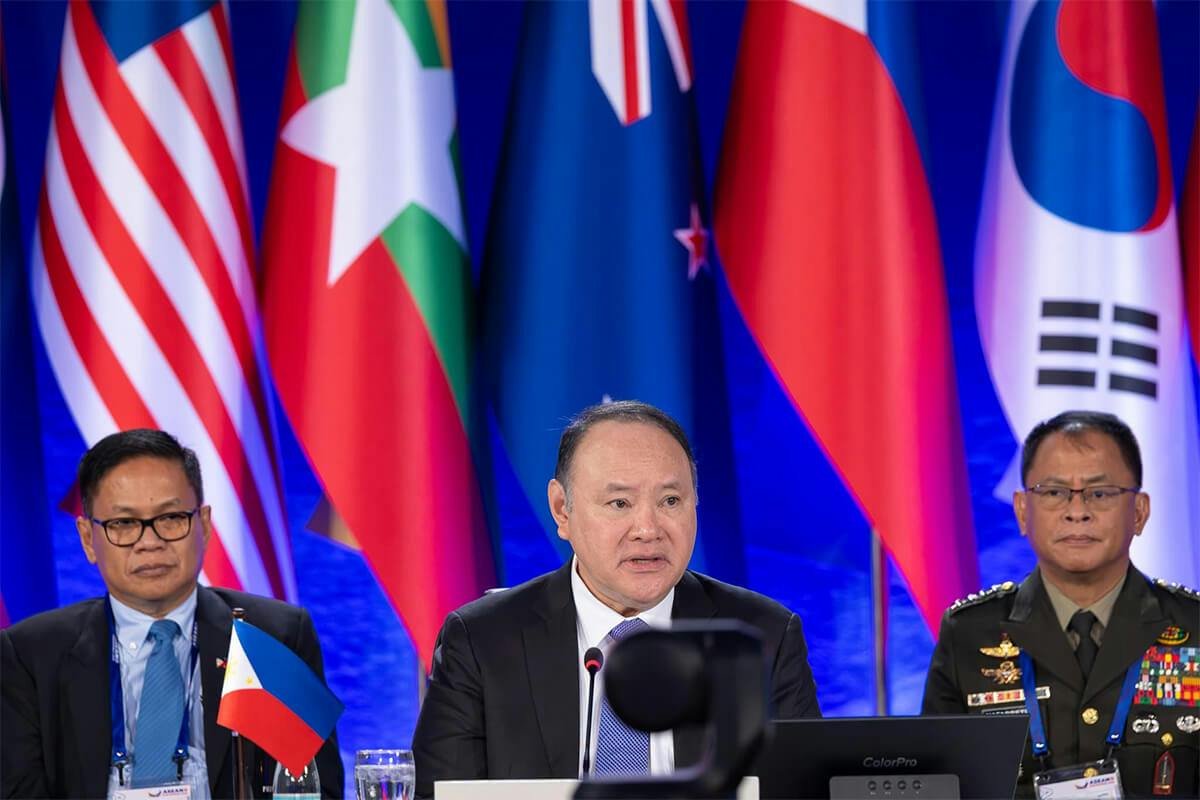
BEIJING/CEBU – Tensions between the Philippines and China resurfaced at the close of a two-day Association of Southeast Asian Nations’ defense gathering on Thursday, Oct. 29, with Beijing accusing an unnamed Philippine ?politician of obstructing its participation and Manila saying China had been given an opportunity to state its position.
China’s defense ministry said the “self-serving” politician had “imposed obstacles to China’s participation” in the expanded ASEAN defense ministers' meeting in Cebu, without identifying the person.
Its spokesperson Zhang Xiaogang said at a press conference the actions ran counter to the meeting’s open and inclusive spirit, violated diplomatic norms, and undermined China’s rights as a dialogue partner.
China was represented at the meeting by a military attache in the absence of Defense Minister Dong Jun, who was likely attending a key Chinese Communist Party meeting in Beijing this ?week.
Philippine Defense Secretary Gilberto Teodoro Jr., who chaired the meetings, did not directly address the Chinese allegation of obstruction but said Beijing had been given the opportunity to present its views and that no ASEAN member raised similar concerns.
“The important fact is they were able to articulate their position on regional maritime security with little additions,” Teodoro said at his closing press conference. The Philippines has said its defense ministry sent notice to its Chinese counterpart with an invitation to join the forum.
“We allowed the exchange of views to be robust, and I think that was the important thing, the opportunity to be heard,” Teodoro said.
Relations between Beijing and Manila have soured amid repeated confrontations in the disputed South China Sea and, more recently, Chinese sanctions imposed on Teodoro.
The exchange put the spotlight back on that increasingly fraught relationship after defense officials at the annual gathering stressed practical cooperation and sought to find areas of agreement despite differences over the South China Sea and other ?regional security ?issues.
Philippines defends growing network of defense partnerships
Washington used the gathering to reaffirm its commitment to the region, with US Defense Secretary Pete Hegseth on Wednesday, Oct. 28, pledging the US would defend its interests and those of allies and partners while proposing greater defense cooperation with the 11-member bloc.
China claims sovereignty over almost the entire South China Sea via a nine-dash line on its maps that cuts into parts of the exclusive economic zones of Malaysia, Vietnam, the Philippines, Brunei and Indonesia. An international arbitral tribunal ruled in 2016 that China’s sweeping ?claims have no basis under international law, a decision Beijing rejects.
During bilateral meetings with several counterparts, including from other South China Sea claimant states, Teodoro stressed the importance of the 2016 ruling, arguing that its underlying principles were part of international law and not solely a Philippine matter.
In talks with Japanese Defense Minister Shinjiro Koizumi, the two expressed serious concerns over ?the increasing scale and frequency of what they described as China's coercive activities in disputed waters.
Teodoro also defended his country’s growing network of defense partnerships and rejected suggestions they undermined regional stability, saying the Philippines faced “unilateral and illegal claims made by China over its maritime domain.”
“If other ASEAN countries were subjected to the same ?kind of action in the magnitude the Philippines is experiencing, I am sure that they would resist this to the best of their ability,” Teodoro said as he reiterated the country’s commitment to peace and security.


