



‘No Classes’ Also Applies To Blended Learning
Although more schools have already implemented full in-person classes this school year, at least half are still implementing blended learning or a combination of face-to-face classes and distance learning modalities.
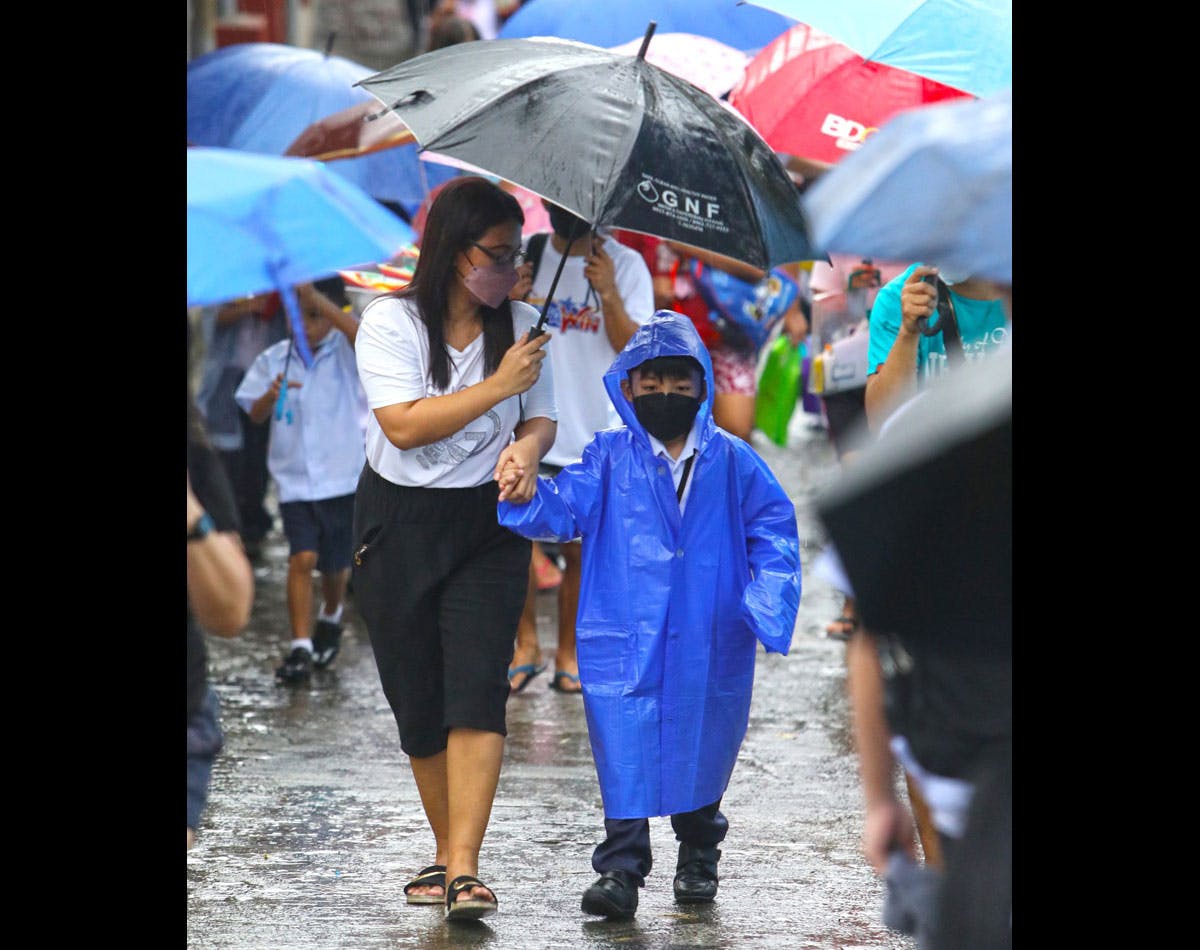
Even schools implementing blended learning modalities are covered by the suspension of classes declared due to Severe Tropical Storm Florita, according to an existing policy of the Department of Education (DepEd).
On Tuesday, Aug. 23, President Marcos suspended classes in public schools and work in government offices in Metro Manila, Cavite, Laguna, Rizal, Bulacan, Zambales and Bataan until today, Aug. 24.
Several provinces not covered by Marcos’ order also announced suspension of classes in all levels on Tuesday, including Albay, Camarines Sur, Ilocos Norte, Ilocos Sur and La Union.
Meanwhile, classes from kindergarten to senior high school were suspended in Aurora, Bataan, Kalinga, Mountain Province and Quezon.
Classes in areas placed under Tropical Cyclone Wind Signals were also automatically suspended: pre-school when Signal No. 1, up to senior high school when Signal No. 2 and all levels when Signal No. 3 and above.
Last year, the DepEd issued a revised policy on class suspensions to take into account distance learning modalities and alternative work arrangements.
Although more schools have already implemented full in-person classes this school year, at least half are still implementing blended learning or a combination of face-to-face classes and distance learning modalities.
Under the DepEd policy, automatic class suspensions cover schools “regardless of learning delivery modality in the affected areas.”
When an area is under Signal No. 1 or 2, teachers handling cancelled or suspended classes “are not required to report for work, regardless of working arrangement adopted by the school in consideration of the work/service that they have to render during make-up classes.”
Meanwhile, work in all DepEd offices is suspended when an area is placed under Signal No. 3 or higher.
Aside from automatic class suspensions, local chief executives such as governors, mayors and barangay captains are allowed to suspend classes in their capacity as chair of the local disaster risk reduction and management council.
Marcos, as the country’s chief executive, may also issue such declarations upon the recommendation of the National Disaster Risk Reduction and Management Council.
Heads of schools and community learning centers may also “suspend classes done through face-to-face learning and on-site work when urgent action is needed to prevent loss of life or bodily harm.”
Adjustments
DepEd policies issued at the height of the pandemic “suggested that learners may not be asked to engage in any school-related activities during class suspensions, unless by and through their own initiative.”
But it recommended several “adjustment options” to be done by teachers to ensure that the most essential learning competencies are conveyed to the students.
These include designing flexible assessment tools that respond to shortened time allotment, updating of the weekly homework plan, planning remediation strategies and other enhancement activities for the students.
The DepEd has yet to announce if it will mandate the conduct of make-up classes to catch up with the missed lessons. The school calendar often has buffer days to take into account class suspensions during the school year.
Last year, the agency mandated that “those who missed distance learning classes shall be accorded due consideration in the accomplishment of their learning tasks by extending the timeframe for their completion and submission within the duration of the current quarter.”
Armchair shortage
Meanwhile, the Division of City Schools in Manila denied the reported shortage of armchairs at a public high school.
Photos circulated online showing students sitting on the floor during the opening of classes last Monday, Aug. 22, with the teacher reportedly confirming the lack of armchairs in their school.
The division office, however, claimed that the teacher “deliberately rearranged the chairs to suit a group activity for orientation and psychosocial support tasks.”
“According to the school’s property custodian, the school has the following: 1,859 armchairs; 1,200 chairs with desk; and 120 laboratory chairs, 3,179 in total. Having 62 instructional class-rooms and the number of chairs available, it is appropriate to note that the school has an average of 51 chairs per classroom, which is more than enough to accommodate the learners,” the statement read.
The reported shortage of armchairs in the school in Manila, however, was not an isolated report, according to the Alliance of Concerned Teacher (ACT).
ACT chairman Vladimer Quetua said they have received reports of armchair shortages in La Union, Bataan, Tarlac, Camarines Norte, Iloilo, Panay, Cebu City and Davao City.
He reiterated their call to Congress on the issue, noting that aside from shortage, some schools also have no choice but to use dilapidated ones due to slow procurement.
“In the spirit of accountability, the Department of Education should report on how many armchairs and desks it has procured in recent years to prepare for the resumption of face-to-face classes,” said Quetua, noting that the DepEd received P1.833 billion and P1.115 billion for school desks, furniture and fixtures in 2021 and 2022, respectively.
Fraud audit results
In another development, the DepEd is awaiting results of the fraud audit being conducted by the Commission on Audit (COA) on the procurement of “pricey” and “outdated” laptops for public school teachers.
During an interview with “The Chiefs” over Cignal TV’s One News last Monday night, DepEd spokesman Michael Poa said they will react accordingly and abide by the recommendations of COA once it finishes its fraud audit.
Earlier, Duterte said the fraud audit she requested from COA chair Jose Calida will help the DepEd plan its way forward with regard to the laptop procurement.
State auditors earlier flagged the agency over the procurement of laptops worth P2.4 billion, which was handled by the Procurement Service of the Department of Budget and Management (PS-DBM).
In addition to a very high price tag, COA said the laptops also had outdated processors that resulted in slow performance.
While waiting for the results of the fraud audit, Poa said the DepEd is also reaching out to those who received the laptops to verify reports regarding its performance.
He confirmed reports that some of the laptops were really slow during initial boot up, although the performance improved once the operating system is updated.
“Now, whether this is true for all cases, we’re not sure,” he said.
“That’s why we want to check all the laptops. That’s on the operational side because aside from the COA, we need to address also the operational side because our teachers are using these laptops,” he added.
Poa said they have submitted to COA the procurement documents from PS-DBM.
DSWD assistance
During the same interview, Poa expressed the DepEd’s readiness to support the DSWD in the implementation of the educational assistance for indigent students.
“On the part of the Department of Education, if the DSWD needs anything, we will be happy to coordinate with them and we can offer whatever they need to help in the problem of crowding,” he said in a mix of English and Filipino.
The DepEd noted an increase in the number of parents requesting for enrollment certificates, which is a requirement for those who want apply for the assistance.


