



Military Wants Facebook Advocacy Pages Restored; PNP, Privacy Body Conduct Deeper Probe
Officers of the Armed Forces of the Philippines, who say they are out to win hearts and minds in counterinsurgency, have lamented that Facebook appeared to be targeting content and is showing bias in its actions.
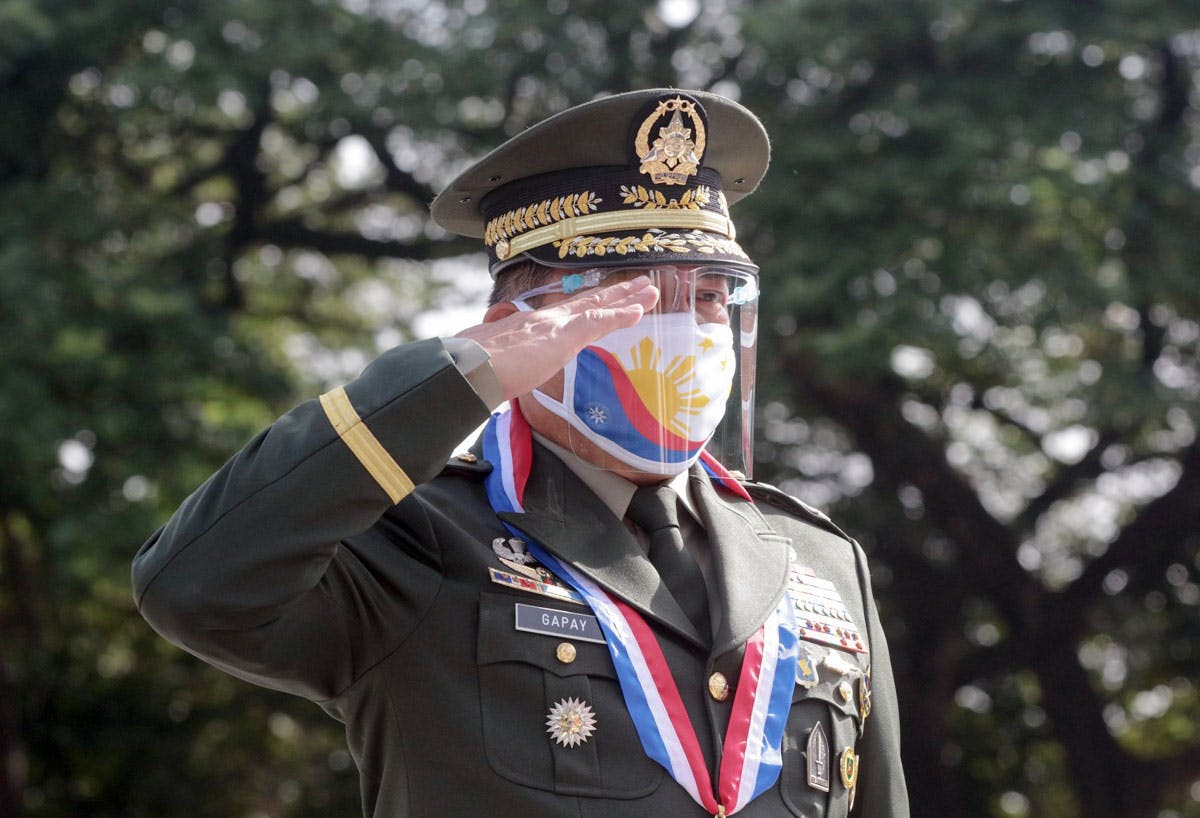
Even as it distanced itself from the network that Facebook found to have violated its rules, the Armed Forces of the Philippines nevertheless asked the social media giant to restore disabled pages of organizations with which the AFP shares “similar advocacies.”
AFP chief Gen. Gilbert Gapay sought the reinstatement of advocacy pages such as that of Hands Off Our Children during an online meeting with Clare Amador, head of the policy team for Facebook Philippines.
Gapay virtually met with Amador shortly after Facebook took down a military-linked network that the company said was engaged in malicious activity on the online platform, although reports said that the courtesy call on Wednesday, Sept. 23, was scheduled weeks ahead of the network takedown.
As this developed, the National Privacy Commission (NPC) said it has invited Facebook officials as part of its “deeper probe” in relation to the recent takedown of two networks engaging in malicious behavior.
“We are initiating a deeper probe on Facebook’s proposed preventive actions regarding the proliferation of suspicious accounts, as such activities on the platform continue to threaten the personal data privacy and other security-related rights of its Filipino users,” said privacy commissioner Raymund Liboro.
It is unclear if the investigation will focus on the removal of the accounts, including those linked to the military, or the actual existence of networks engaging in malicious activities.
Liboro called on Facebook to comply with laws, rules and regulations in the country, noting previous incidents involving data privacy of users.
“This ensures that responsible social media platforms shall elevate their community standards to a level that adequately protects the data privacy rights of Filipino data subjects and rights to free speech and expression,” Liboro said.
“It is incumbent on us at the National Privacy Commission to step up our action especially on platforms like Facebook that is considered as one of the biggest holders and processors of personal data,” he added.
On Wednesday, Facebook disabled over 200 accounts across two networks for violating its policy “against foreign or government interference which is coordinated inauthentic behavior on behalf of a foreign or government entity.”
One network was linked to the Philippine military and the police, while the other was traced to China and targeted users in the Philippines, the rest of Southeast Asia and, to a limited extent, those based in the United States.
Read More: Facebook Takes Down Fake Phl, Chinese Accounts; AFP, PNP Deny Social Media Misuse
PNP probe
Philippine National Police (PNP) chief Gen. Camilo Cascolan has ordered an investigation into the fake Facebook accounts supposedly being used by some of their personnel in spreading misleading information to the public.
Cascolan has directed the Anti-Cybercrime Group (ACG) to conduct the probe, vowing that those who are proven involved would be sanctioned.
“We will never tolerate this. This is actually under investigation right now by the ACG,” he said in an interview with “The Chiefs” on Cignal TV’s One News/TV 5 on Wednesday, Sept. 23.
As part of their probe, Cascolan said they will coordinate with Facebook to get specific details about the spurious social media accounts.
Cascolan has disowned the comments on the Facebook accounts which he described as personal opinions that do not reflect the policies of the PNP.
He warned police officers maintaining fake accounts to stop their activities or face administrative charges from their Internal Affairs Service or IAS.
“There is gross neglect of duty. That's not good,” Cascolan pointed out.
While they are also open to an independent probe from the National Bureau of Investigation, Cascolan said they want to tackle the issue internally.
Military link
An independent report released by the Digital Forensic Research Lab (DFRLab) of Washington-based Atlantic Council provided details on the supposed link of the Philippine-based network to the military.
It based its report on the 23 pages, 42 Facebook accounts and 28 Instagram accounts that comprised a subset of the total number of assets involved in the supposed network.
According to DFRLab, there was open-source evidence of coordination among some of the pages in the form of simultaneous posting.
There was also evidence supporting Facebook’s attribution of this operation to individuals linked to the military, noting that multiple user accounts in the set belonged to individuals who appeared to be serving in the Philippine military.
It added there was proof that several military-linked user accounts were coordinating social media campaigns in private Facebook groups, “although the exact nature of what they were discussing within those groups could not be determined.”

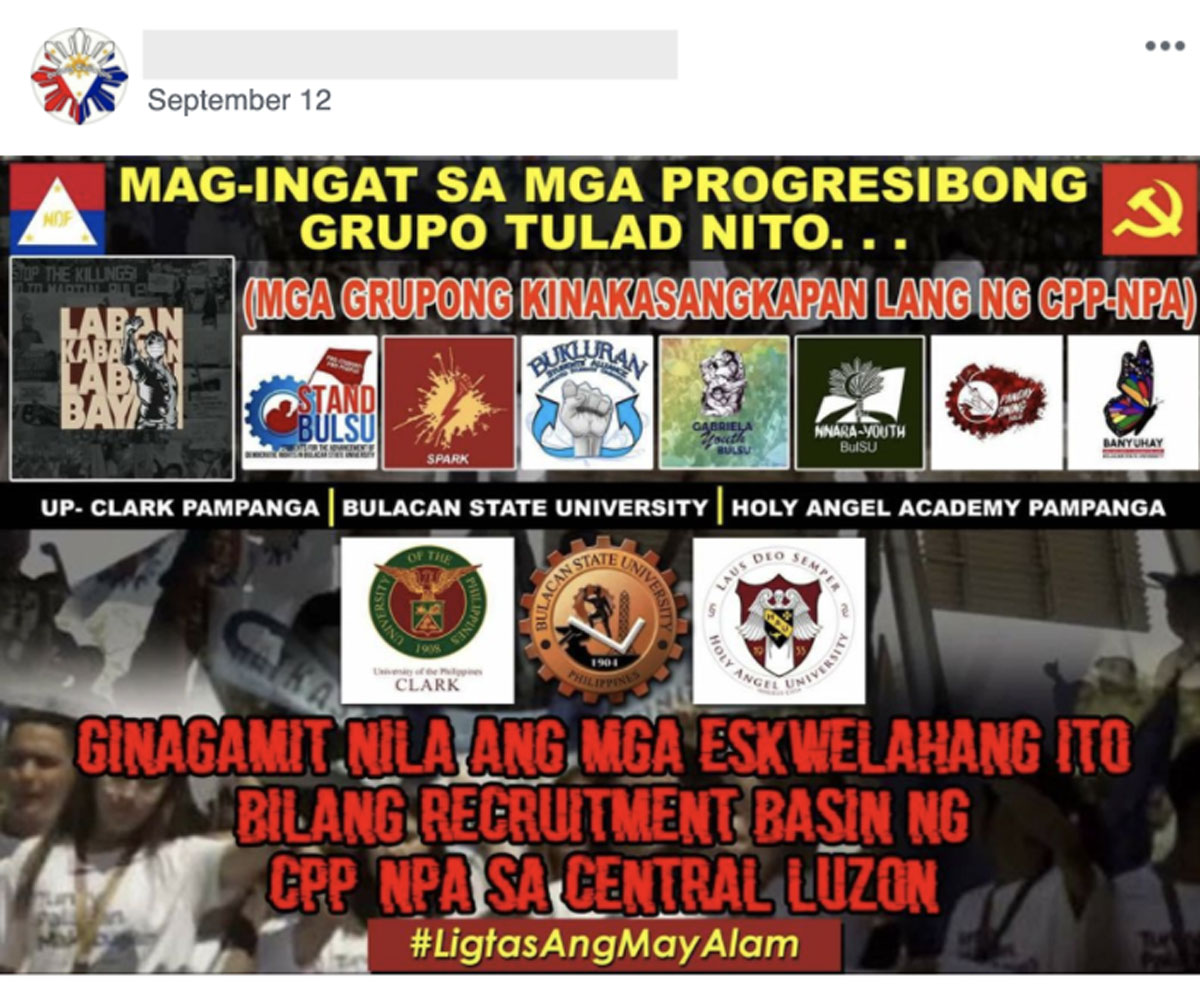
The report specifically identified Capt. Alexandre Cabales, which the AFP later confirmed to be the head of the social media center of the Philippine Army’s Civil Military Operations Regiment.
Cabales’ primary task, according to his LinkedIn profile, is to conduct activities on social media “that will manage and enhance public perception of the Philippine Army as well as facilitate the delivery of information to the Filipino people about the Army and the government in general.”
The report said open-source traces indicated that Cabales played a key role in the administration of the network, including the page Kalinaw News that is openly owned by the military.
The DFRLab noted that Cabales is one of the administrators of the private Facebook group linked to Hands Off Our Children, which is supposedly an independent group of parents advocating against the recruitment of children by organizations including those linked by the AFP to communist rebels.
“His role in administering this group suggested that while the Hands Off Our Children movement presents itself as an independent organization led by concerned parents, it may be more closely linked to the Civil-Military Operations Regiment than it publicly lets on,” the report read.
“There was also additional evidence to suggest that Cabales and several other military-linked accounts in the network were indeed running some sort of social media operation on behalf of the military and were coordinating with one another in closed Facebook groups,” it added.
The military claimed that Cabales’ involvement in Hands Off Our Children is personal and has nothing to do with his official role.
Nevertheless, none of the previous reports about the organization indicated involvement of military personnel, whether on official or personal capacity.
Such case may be seen as a violation of Facebook’s community standards, which prohibits inauthentic behavior such as the use of accounts, pages or groups to mislead others about “the identity, purpose or origin of the entity that they represent.”
Legitimate group?
During his meeting with Facebook’s Amador, Gapay urged the social media company to look into their processes in unilaterally removing accounts that it deems to have violated its community standards.
“We hope that we look on to a new partnership with Facebook Philippines, that similar legitimate advocacies will be respected, if not uplifted, to prevent the spread of violent extremism and protect every Filipino child from the communist terrorist group,” Gapay said in a statement.
He asked Facebook to give due regard to advocacies being forwarded by groups such as Hands Off Our Children, which he said has legitimate concerns that are similar to those of the AFP.
The AFP leadership downplayed the supposed involvement of Cabales and other personnel in the network, stressing that none of the military’s official accounts were affected by the takedown.
AFP spokesman Maj. Gen. Edgard Arevalo also stressed that the military is not involved in any fake propaganda account or network.
“The AFP maintains that it does not subscribe to or espouse fake news. It is the rule that the AFP uphold the truth and exercise accountability of network and social media managers with regard to postings to websites, pages and accounts,” he said in an online press briefing.
Arevalo explained that Cabales was acting on his personal advocacy when he agreed to help in the administration of the Hands Off Our Children group.
“If he is involved here, we are inclined to believe this is not official. This was being managed by Captain Cabales that is within and treated as a personal account,” Arevalo stated.
“Let us consider the fact that the Hands Off is a group of parents whose advocacy is similar to that of the AFP,” he said in a mix of English and Filipino.
As for accountability, Arevalo maintained that they do not see any violation on the part of Cabales, maintaining that he followed the spirit of the AFP’s policy on the use of social media.
Online strategy
The AFP spokesman said they would again meet with the local Facebook policy team to discuss issues related to the takedown.
Arevalo said they are still waiting for official information on the other accounts that were tagged by Facebook to be linked to the military. He said the AFP wants to know how it can use the social media platform in its activities.
“The social media presence of the AFP is primarily an approach to use Facebook and other social platforms as a tool for strategic communications to advance the interest of the AFP to win the support of the people,” he stressed.
AFP officers, who say they are out to win hearts and minds in counterinsurgency, have lamented that Facebook appeared to be targeting content and is showing bias in its actions.
In its report on the takedowns, Facebook said those behind the Philippine-based network attempted to conceal their identities but were later found to have links with the military and the police.
In addition to the cluster linked to Cabales, the DFRLab also noted two clusters that “coordinated with one another, posting identical content within one minute of each other on numerous occasions.”
“These pages posted the same photos accompanied with identical text within under a minute from each other on a systematic basis, a pattern that betrays a strong degree of technical coordination,” read the report, referring to one cluster consisting of pages Enlightened Youth, ITO KAMI, Pinoy Ako and Masang Pinoy.
DFRLab said the second cluster of pages concentrated on amplifying a page called Ang Akin Bayan, which posted content attacking the New People’s Army and linked certain politicians to communist rebels.
Facebook earlier said that the network posted Filipino and English content about local news and events including domestic politics, military activities against terrorism and the then pending anti-terrorism bill.
The content also focused on criticism of communism, youth activists and the opposition, the Communist Party of the Philippines and its military wing the New People’s Army, and the National Democratic Front of the Philippines.