


Facebook Takes Down Fake Phl, Chinese Accounts; AFP, PNP Deny Social Media Misuse
The military and police disowned the fake account networks that Facebook said were engaged in malicious behavior to mislead people.
Social media giant Facebook has taken down more than 200 accounts belonging to two networks engaging in coordinated activities to mislead users, primarily in the Philippines and in the region.
Nathaniel Gleicher, head of security policy at Facebook, said one of the networks was based in China, while another was linked to the Philippine military and the police.
Gleicher announced that they took down the two networks for violating Facebook’s policy “against foreign or government interference which is coordinated inauthentic behavior on behalf of a foreign or government entity.”
Coordinated inauthentic behavior is defined as the use of multiple accounts, pages and groups to mislead people, such as about the identity and purpose of the entity they represent, popularity of content or assets, and source or origin of content.
Facebook specifically prohibits the use of multiple Facebook accounts or sharing accounts between multiple people. It is also against the platform’s policy to conceal a Page’s purpose by misleading users about its ownership or control.
“In line with our commitment to authenticity, we don’t allow people to misrepresent themselves on Facebook, use fake accounts, artificially boost the popularity of content, or engage in behaviors designed to enable other violations under our community standards,” the company said.
“This policy is intended to create a space where people can trust the people and communities they interact with,” it added.
Gleicher clarified that the removal of the networks was based on behavior that violated the social media platform’s community guidelines and not based on the content posted by the involved accounts.
Online army?
According to Facebook, the network linked to the Philippine military and the police involved 57 Facebook accounts, 31 Pages and 20 Instagram accounts that focused on domestic audience.
“We see specific accounts and assets engaged in this that are linked to individuals associated with both the military and the police,” Gleicher said in a press briefing on Tuesday night, Sept. 22. “We also see open source corroboration that confirms this analysis.”
Both the military and police have disowned the accounts. Philippine National Police chief Gen. Camilo Pancratius Cascolan told “The Chiefs” on One News/TV5 on Wednesday night, Sept. 23, that the PNP is launching an investigation on the issue raised by Facebook.
He also said while the PNP monitors public posts on social media, mostly related to the pandemic, it does not “snoop” into private accounts.
According to Gleicher, the network had 276,000 followers on Facebook and about 5,500 people on Instagram. It was taken down early Wednesday, Sept. 23.
“This network consisted of several clusters of connected activity that relied on fake accounts to evade enforcement, post content, comment and manage Pages. This operation appeared to have accelerated between 2019 and 2020,” he bared in a blog post.
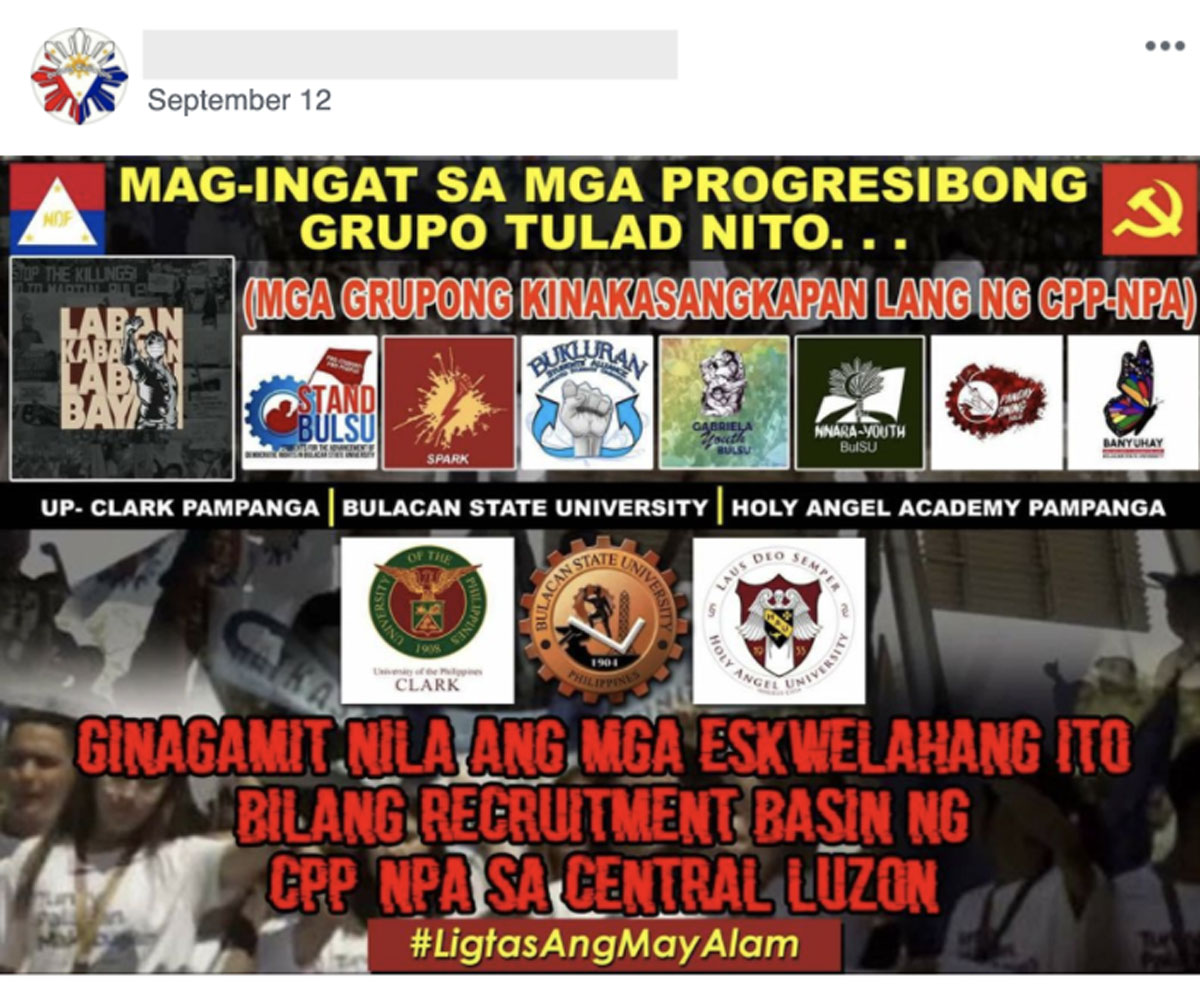
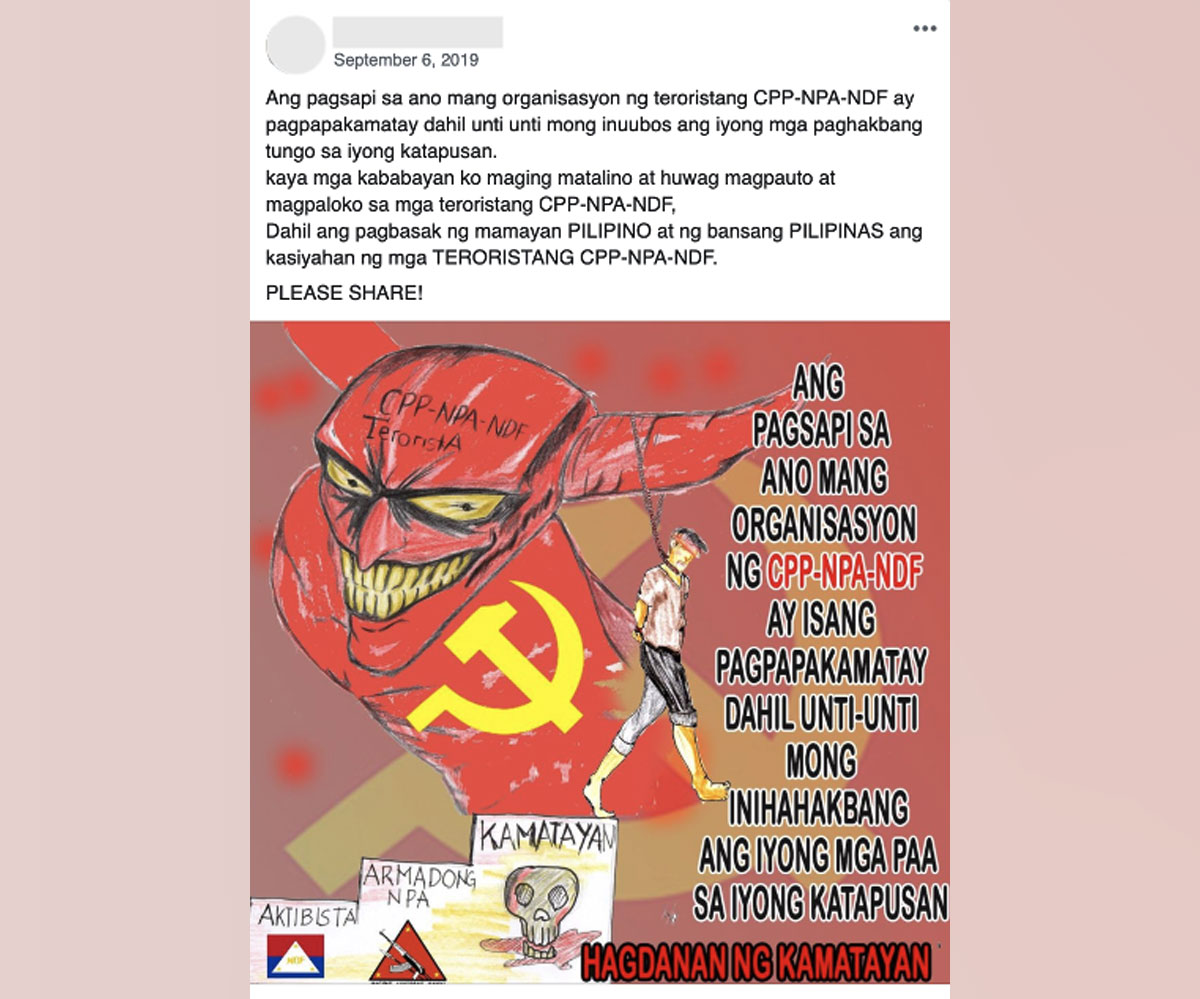
“They posted in Filipino and English about local news and events including domestic politics, military activities against terrorism, pending anti-terrorism bill, criticism of communism, youth activists and opposition, the Communist Party of the Philippines and its military wing the New People’s Army, and the National Democratic Front of the Philippines,” he said.
Among the accounts taken down included those that posted content red-tagging activities and linking progressive groups to the communist insurgency.
Gleicher disclosed that they found the full scope of the activity after investigating information about a portion of this network brought to its attention by civil society in the Philippines and Rappler.
“Although the people behind this activity attempted to conceal their identities, our investigation found links to the Philippine military and Philippine police,” he maintained.
Gleicher said they have not shared the information in advance with the Philippine government, noting that they have to be cautious about how they engage, considering the supposed role of the police and military.
“In a situation where we see… an organization that is linked to this behavior, we are very careful and cautious about how we engage with them,” he said. “If they want to engage further, we will talk to them…We are going to be very careful because we would not want to… provide them a map on how to evade our enforcement.”
China-based network
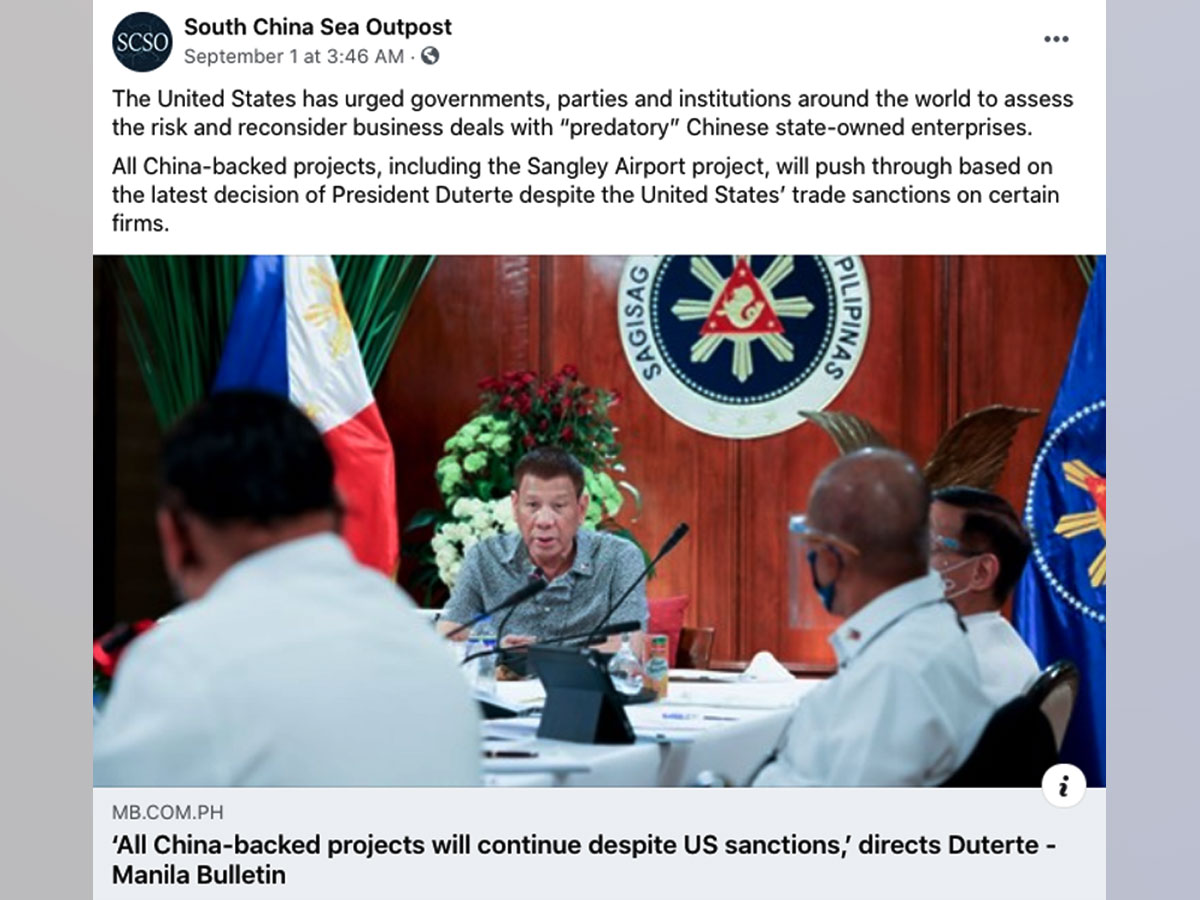
Meanwhile, Facebook also took down another network based in China for employing similar strategies focused primarily on the Philippines and Southeast Asia more broadly, and also on the United States.
The network – supposedly originating in Fujian province in China – included 155 accounts, 11 Pages, nine groups and six Instagram accounts. There were around 200,000 people following or engaging in this network.
Gleicher said they have identified several clusters of connected activity that relied on fake accounts to pose as locals in countries they targeted.
It also used fake accounts to post in Groups, amplify their own content, manage Pages, like and comment on other people’s posts particularly about naval activity in the South China Sea.
“This campaign took operational security steps to conceal their identity and location including through the use of VPNs (virtual private networks). Some of this network’s Pages were previously removed for violating our inauthentic behavior and spam policies,” the Facebook official declared.
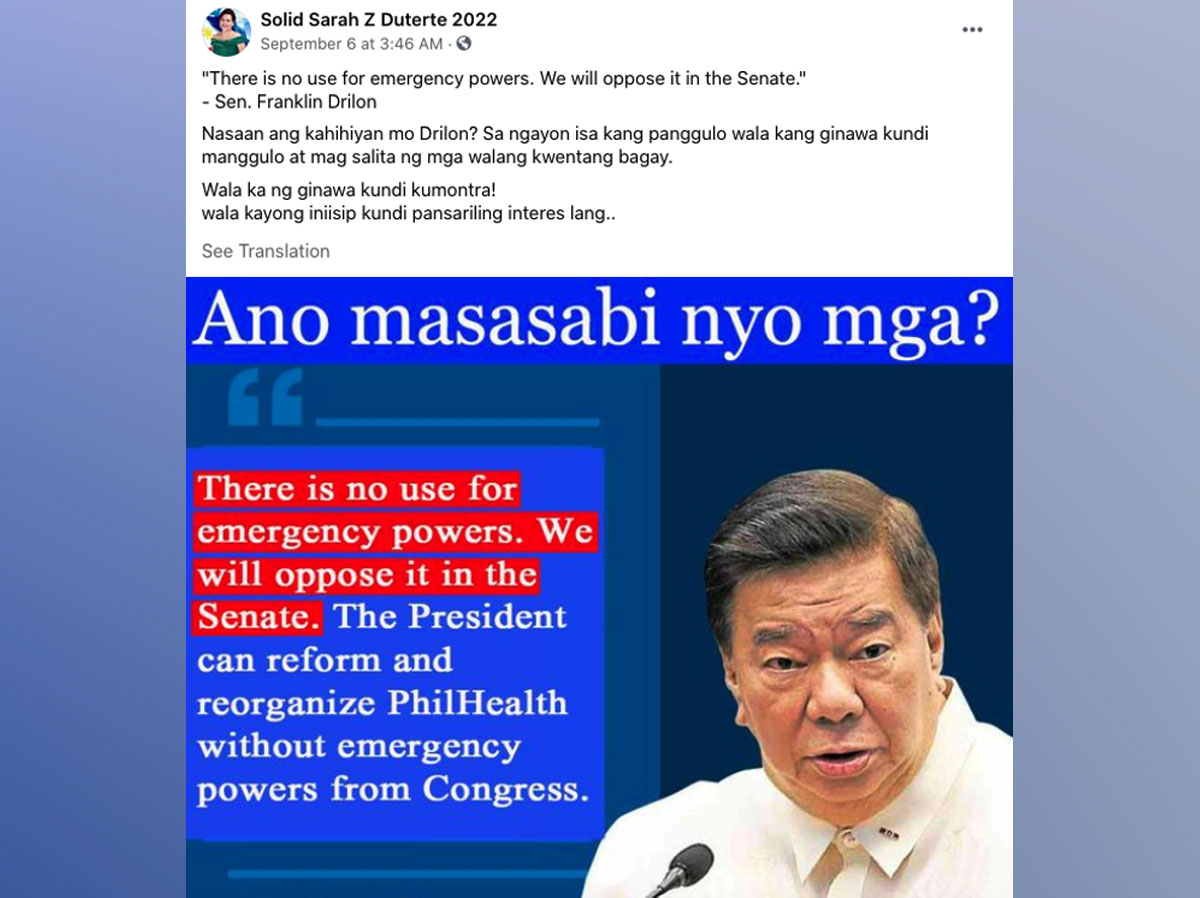
The network posted content about various issues in the region, including support for President Duterte and the potential presidential bid of his daughter, Davao City Mayor Sara Duterte-Carpio.
Other content included Beijing’s interests in the South China Sea, Hong Kong, criticism of Rappler and the opposition, issues relevant to overseas Filipino workers, and praise and some criticism of China.
“In the US, where this network focused the least and gained almost no following, they posted content both in support of and against presidential candidates Pete Buttigieg, Joe Biden and Donald Trump,” Gleicher said.
He added they found this network as part of their internal investigation into suspected coordinated inauthentic behavior in the region.
“Our security work on this case is ongoing. We know that there will continually be actors trying to exploit this behavior, trying to target public debate. We know that they’ll continue to try to improve their tactics and so will we,” he stressed.
Facebook earlier took down similar networks in the Philippines for violating the community standards of the platform.
Gleicher, however, said they have not seen technical links between the previous networks removed from the site and the new ones that were taken down.
He underscored that the new ones are also not related to the reported spate of fake accounts involving Filipino users recently, saying they have investigated those reports extensively and they have not seen evidence of coordinated deception.
On the removal of the networks for engaging in coordinated inauthentic behavior, Gleicher said they looked at “activity coordinated with one another and used fake accounts as a central part of their operations to mislead people about who they are and what they are doing.”
“When we investigate and remove these operations, we focus on behavior rather than content, no matter who’s behind them, what they post, or whether they’re foreign or domestic,” he added.
AFP, PNP deny use of fake accounts
The Armed Forces of the Philippines (AFP) and the PNP disputed the claims of Facebook and insisted they are strictly observing guidelines on cyber etiquette set by the social media giant following its decision to take down several accounts tied to state forces for spreading misinformation.
“We follow the rules. Parang kalsada rin ’yan, you can use it whenever you want, but as long as you follow traffic rules,” AFP chief Gen. Gilbert Gapay said during a joint press briefing of the AFP and PNP at Camp Crame in Quezon City.
Gapay said they are checking the personal Facebook accounts of their personnel as it is possible that these were the ones maintaining the accounts that the social media platform took down. He vowed to sanction soldiers who are using Facebook to mislead the public.
“The AFP does not tolerate the uploading of fake news and fictitious social media accounts,” he assured the public.
Cascolan also stressed they are observing proper decorum when using their Facebook accounts in all their public engagements.
“As far as we are concerned, the official Facebook pages of the PNP and those in the lower units remain compliant with the standards,” he noted.
Cascolan cited the importance of using Facebook and other social media platforms properly especially when the public needs accurate information during the coronavirus disease 2019 pandemic.
In a separate statement, PNP spokesman Col. Ysmael Yu said that “all comments and opinions of individual personnel, associations and sectoral groups on matters that are not related to the organization’s activities are hereby disowned by the PNP as unofficial and unauthorized.”
“We recognize social media as an effective tool that technology can offer, especially at this period of health emergency, to establish pro-active information and awareness activities as well as to build harmonious relationship with the community,” Yu added.
The Philippine Army’s Public Affairs Office chief Col. Ramon Zagala argued Facebook should be the one to “explain” its actions.
“We do not do that, masyadong sweeping. We do not tolerate. It is not our policy to use fake accounts,” Zagala said in a phone interview.
A report released by Digital Forensics Lab Atlantic Council, an independent group tapped by Facebook, specifically identified a certain Alex Cabales as part of the network taken down by the social media giant.
Zagala confirmed Capt. Alex Cabales is the chief of the Army Social Media Center and manages the Kalinaw News Facebook page that delivers news from different units nationwide.
“We hold him in high regard and his efforts to inform the public on important issues that matter to the security of our country,” Zagala said in a statement.
Following the report, Zagala said the AFP would not tolerate any behavior that erodes public trust and would not hesitate to sanction any personnel who commits violations.
He emphasized the AFP holds its personnel to the highest standards of discipline and professionalism, even on social media platforms.
“We impose our own social media policy internally to ensure that our official accounts as well as the personal accounts of our personnel only release accurate information to protect our people, especially the youth,” Zagala said.
He stressed: “In so far as the AFP is concerned, there are no accounts that the AFP maintains that were shut down or removed by Facebook. All of them are up and running.”
AFP spokesman Maj. Gen. Edgard Arevalo said the military has a meeting with the policy head of Facebook Philippines that was scheduled long before the issue and “not as an offshoot of this report.”
He said the meeting had been postponed twice mainly due to scheduling conflicts.
“We will take the opportunity to ask for details na rin about that report,” Arevalo, who is also commander of the military’s Education, Training and Doctrine Command, said.
“The AFP upholds truth and accountability of network and social media account managers as to the contents of postings in our websites, pages and accounts,” he stressed.
Presidential spokesman Harry Roque said in a statement the government will defer to the “sound judgment and discretion” of Facebook with regard to the takedowns.
Roque said “we are one in advocating the truth and dismissing disinformation, lies or hatred.” – With Emmanuel Tupas, Romina Cabrera, Michael Punongbayan