


Facebook Meme Prompts 18-Year-Old Student To Develop An App That Translates Filipino Languages Using ChatGPT
“Translata” currently interprets 12 local languages and even English, Jejemon (with emojis) and Bekimon. The creator said he added the last two options “for some extra fun.”
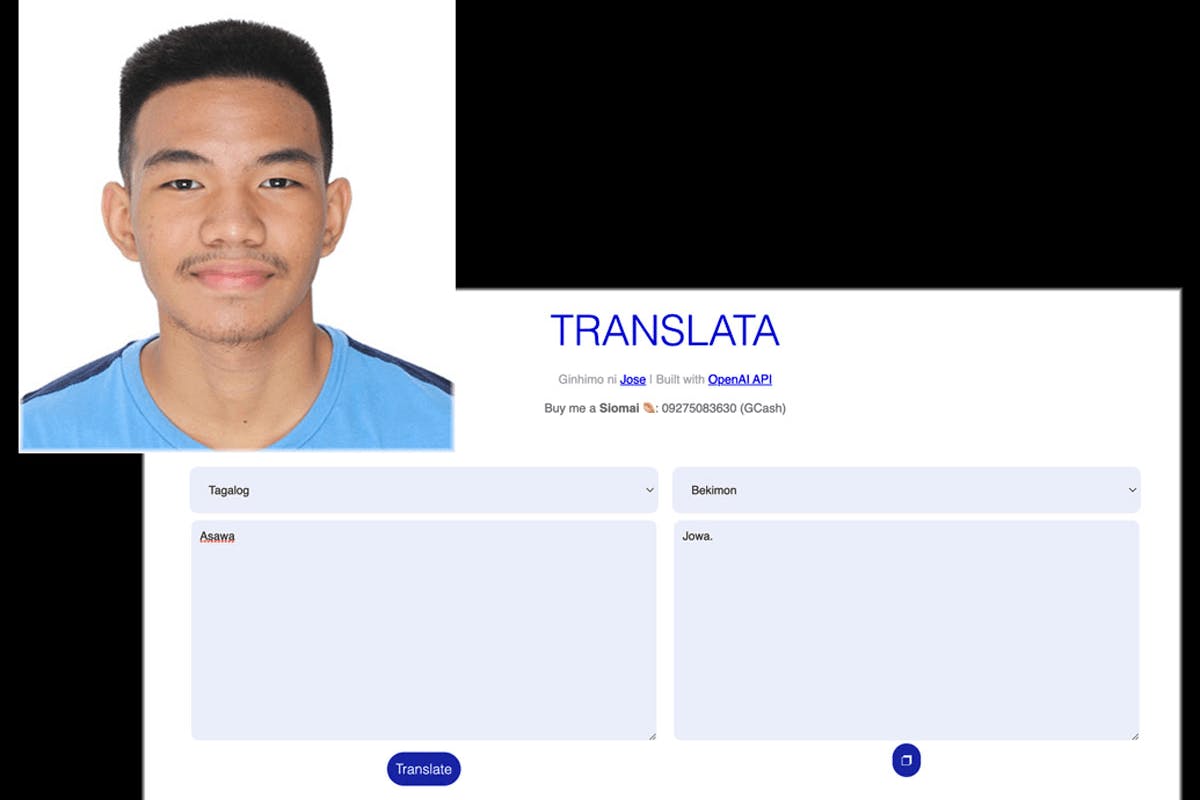
It was the most spontaneous moment for 18-year-old Jose Arron Franz Suoberon. An incoming computer science major, he only wanted to create projects so he would not be left behind by his peers in college.
Suoberon has been learning technology for three years now. But it was not until he saw a Facebook meme about ChatGPT, the popular generative artificial intelligence (AI) chatbot, which spurred him into creating his own website that can translate 12 Filipino languages at the moment.
“It is essential to remember that human interpretation and context play a crucial role in achieving accurate translations,” said Suoberon, a senior high school student from Iloilo who is behind the new web-based language interpretation app called “Translata.”
“It started when I was still in school. It was free time and we could do anything. So, I was casually scrolling on Facebook, then I saw a meme where ChatGPT was conversing in Cebuano. I thought to myself, ‘Is this actually possible?’” he told The Philippine STAR / OneNews.PH last Monday, May 29.
Little did he know there would be people who would notice Translata when he released it online last May 25.
“Lost in translation? I made a web-app designed to help you translate between Philippine languages… Note that there may be inaccuracies in translations. This web-app utilizes a language model for its translation capabilities,” Suoberon wrote on Facebook with a link to the website.
Translata currently interprets 12 local languages including Tagalog, Bicolano, Cebuano, Chavacano, Hiligaynon (Ilonggo), Ilocano, Kapampangan, Pangasinense, Waray, English, Jejemon (with emojis), and Bekimon. Suoberon said he added the last two options “for some extra fun.”
The aspiring computer scientist initially thought ChatGPT was only trained for Western cultures. Upon trying it himself, however, he found out that the program was able to “casually” translate Hiligaynon phrases into Tagalog and English.
Suoberon worked on Translata for about three days once his classes ended. He used the GPT-3.5 version of the chatbot, which was available at the time, to develop the app. The student learned it could translate at least 12 Filipino languages and that’s where he decided to focus on.
After determining the overall look and function of the website, Suoberon researched the documentation for the application programming interface (API) of ChatGPT, so he could use and integrate it into Translata. This enabled the website to perform translations.
In software development, API is what allows two or more computer programs to communicate with each other. It is often made up of different parts, which act as tools or services that are available to the programmer, according to Wikipedia.
Suoberon wrote his own codes when he integrated the GPT-3.5 API into Translata. These were the final steps he took before finalizing the “simple and straightforward” interface of the app and placing it on Netlify, a website development platform, for server hosting.
As a tech newbie, Suoberon described his coding process as “not smooth sailing” because he made errors along the way, which were “time consuming” on his part. “I think a lot of developers can do it a lot better than me,” he said.
Regardless, he believes his project is still “a good thing” as it essentially streamlined some functions of ChatGPT for Filipino users looking for translation services with its API integrated into the Translata website.
Suoberon coded prompts such as “translate this input language into this output language” or “translate this string of text from this input language into this output language” on his app, which “eliminates the need for users to log into ChatGPT” for similar instructions.
“Instead, they (users) can simply access the web app's user-friendly interface, enter their text in the desired Philippine language, and receive the translated output quickly and conveniently,” he explained. “Translation happens because of the API.”
Suoberon understood that OpenAI, the company behind ChatGPT, uses large language models (LLM) to extrapolate information. LLM is a “deep-learning” algorithm, which allows AI to recognize, process, and generate content based on knowledge gained from big data.
But the tech student was quick to point out that the system is far from perfect. “There are still inaccuracies (with some dialects),” Suoberon said, noting that interpretations from Translata remain flawed for the Ilocano and Kapampangan languages.
Thus far, only minor refinements have been done to the web-based app, according to Suoberon. He revealed that experienced web developers have already reached out to him about security errors in the app, which he tried fixing.
At the moment, Suoberon has no definite plans for Translata beyond working on bug fixes and the like to keep it running. Although he is thinking of adding other Visayan dialects such as Aklanon and Capiznon, as well as Batad – the spoken language in Ifugao – should he gain access to the latest GPT-4.
Suoberon, however, disclosed that he might cease operations if the bills for the maintenance of the website pile up. API calls currently cost him around P750 a month. He is also open to transferring the project to more financially and technically capable designers.
“For now, I’m planning to discontinue (Translata) once the bills for the API I use increases. But if it booms, it would be alright for me to pass it on to someone who can handle the finances and manage the technical aspects (well),” Suoberon said.
Whatever happens to Translata, Suoberon is already grateful for what he has accomplished. This is as columnist Tonyo Cruz featured the website in a recent tweet that generated nearly 15,000 likes and 3,000 retweets as of writing, much to the delight of its creator.
“It’s just a simple project I did for fun and learning. I think this sets a nice precedent that even if you are a beginner, you should not be afraid of doing something that can benefit you or executing an idea that is novel,” the 18-year-old said.
“I think more and more people will start building similar things, but even better, especially considering the rate at which tech today continues to improve and become more accessible,” Suoberon added. He “feels great” that people are using Translata to overcome language barriers.
“It’s just so cool to be able to connect people who speak different dialects,” said Suoberon, who has his own firsthand experiences when it comes to the challenges and frustrations of interacting with people who do not share the same language.
Suoberon also hopes that people would understand the limitations of his app. He underscored he has no control over the translations as it relies on AI trained on big data. He acknowledged that Translata must not be taken as an accurate “alternative translator.”
“I'd have to say that they (critics) are right, though. It's far from (being) an alternative to a translator because human interpretation and context play a crucial role in achieving accurate translations,” Suoberon said.