



Very Relatable: Analysts Believe Carton Signs, Basic Goods Make Community Pantries A Hit Among The Masses
It’s consumerism that is possibly drawing the attention of people to the community pantries, which offer food and other basic necessities. The use and reuse of carton signs, for instance, can also be found everywhere in the country.
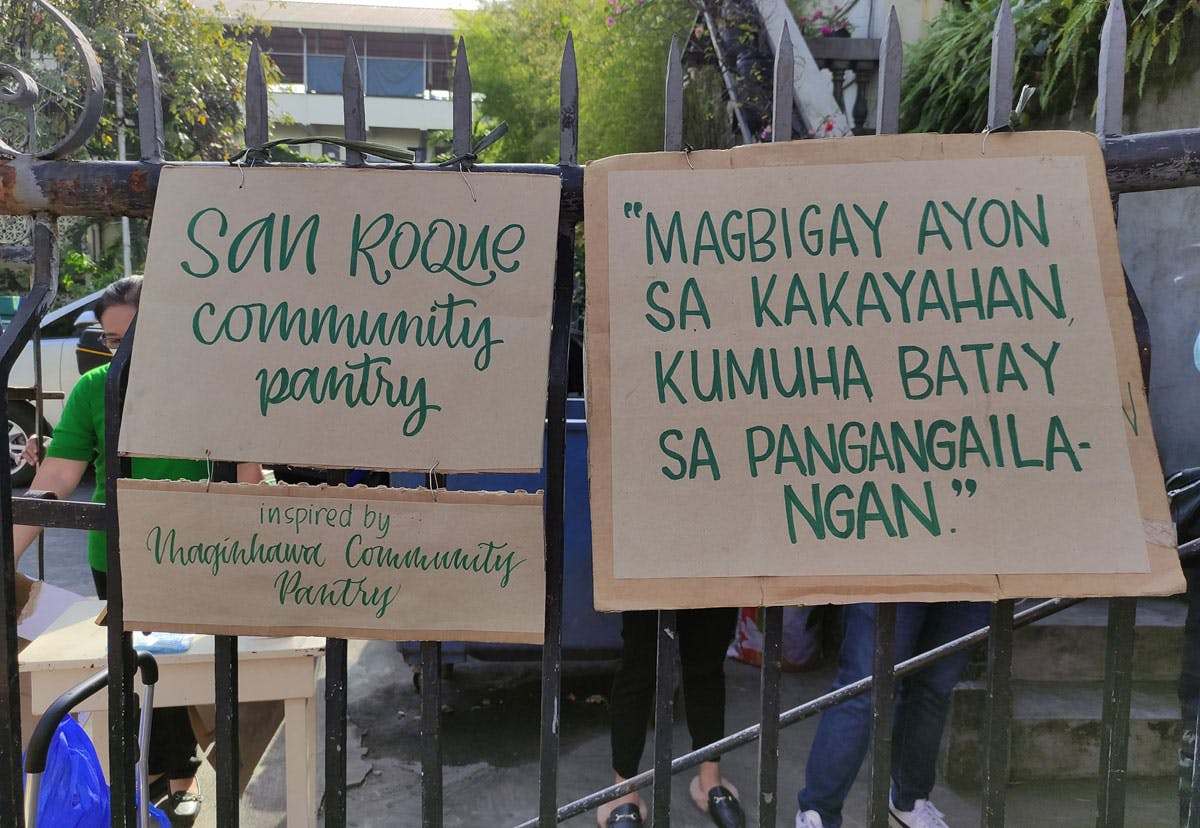
The community pantry on Maginhawa Street in Quezon City has been lauded for sparking the civic spirit of residents willing to share their goods to others amid the lockdown due to the COVID-19 pandemic.
But the bayanihan spirit that made the movement possible could not have happened without the crude everyday items used to set up the pantry.
Ana Patricia Non first set up the Maginhawa Street pantry with nothing but a bamboo cart placed beside a street lamp to display the food items for sharing with the community.
Passersby could have easily missed the pantry if not for one thing – the simple carton sign bearing the name of the pantry and the Filipino translation of the Marxist slogan, “From each according to his ability, to each according to his need,” or “Magbigay ayon sa kakayahan, kumuha batay sa pangangailangan.”
The carton sign taped on the streetlamp along Maginhawa Street has evolved into jeepney signs – another popular image of the masses – as well as into elegantly styled signboards with cursive fonts.
But the other pantries also utilized carton signs and retained the simple message that analysts said embodied the community spirit as the masses lined up to get their equitable and rightful share of the goods donated.
For popular culture expert and professor Mykel Andrada, who teaches Philippine studies at the University of the Philippines Diliman, the image of the carton sign encapsulated consumerism because of the products that are placed on carton boxes, as well as the community because of how the carton has been reused in everyday lives.
“Cardboard boxes have a long history both of consumerism and community. Businesses use cardboard boxes to store and ship products, but the working class handle them. In the Philippines, the masses tear up the folds of cardboard boxes to make signages. You can see these in market places, hanging in posts, and even on the windshields of public utility vehicles especially jeepneys,” Andrada told The Philippine STAR in an interview.
The use of the carton signs for the community pantries continued this image of everyday lives of the masses, who are the beneficiaries of the communal pantries, Andrada said.
Carton boxes have also been used by advocacy groups in expressing their grievances – through slogans written on the cardboard signs during mass demonstrations.
The cardboard signs in the community pantries transcended its simple role of marking a location along the street into a medium to express grievances to authorities amid rising inequality and poverty, Andrada said.
“Human rights activists and the masses have inked on these cardboard signages their grievances and aspirations, always a call to unite for genuine social change,” Andrada noted.
“Drastically though, cardboard signs were also utilized during reigns of terror by fascist governments, just like what the Philippines experienced during the 'Tokhang' nightmares,” Andrada said.
Andrada was referring to the “Oplan Tokhang, ” the house-to-house “knock and plead” operations conducted by policemen, which is the government’s main strategy to curb the drug menace. The campaign has turned bloody, with alleged extrajudicial killings perpetrated by the police, vigilantes or hit men and those involved in the illegal drug trade themselves.
Andrada also expressed belief that the “bayanihan” spirit emerged because of the government’s failure to provide sufficient aid since the community quarantines were imposed.
It’s a communal political act, too even as the government and the likes of presidential spokesman Harry Roque tried to co-opt this by labeling the community pantry as “bayanihan” or communal spirit.
The message of simplicity and community in the pantry was not lost among the residents who lined up to get the items.
According to sociologist Ash Presto, the masses adhered with the Marxist slogan of getting what they need, so that the others would have something to take home as well.
In a dzMM interview on Monday, April 19, Presto, who teaches sociology at UP Diliman, contrasted the equitable sharing of goods at the pantries to the hoarding and panic buying that happened at grocery stores when the lockdown was first imposed last year.
The masses knew more people like them were in need at this time, leaving goods at the pantry for others to have. Presto described this as the spirit of trust among people and being conscientious.
“Dito sa community pantry napakalakas ng spirit ng tiwala ng pakikipagkapwa… ‘Yung sense ng konsensiya, mas doon siya sa iniisip mong may ibang tao pa…. Mayroong sense ng pakikipagkapwa, kasi alam mong may mga kukuhang iba na parehas mo ring nangangailangan,” Presto said.
“Nakita natin sa community pantry, hindi naman sila umaabuso eh. Basta accessible lang sa kanila ‘yung ayuda,” she added.
The pantries popped up everywhere in Metro Manila and other provinces precisely because of the government’s lack of aid amid the lockdown, the sociologist said.
Under the national government’s P22.9-billion aid for residents of the National Capital Region, Cavite, Laguna, Bulacan and Rizal or NCR Plus who were affected by the lockdown, each individual would receive P1,000 or a maximum of P4,000 per family.
The financial assistance was sourced from unused Bayanihan To Recover As One Act or Bayanihan 2 funds.
Roque said the aid was meant to tide affected residents over and would really not be sufficient to address their needs.
“Maraming nangangailangan, maraming nagugutom. It just shows malakas ang ating community values, ‘yung ating sense ng pakikipagtulungan…We’re hoping itong condition na nagtulak sa pagkakaroon ng community pantry ay matapos na rin – pandemya, kakulangan ng ayuda, kahirapan,” Presto noted.
The sociologist said the community pantry was not intended to solve the root causes of poverty. But although it is also band-aid solution to the lack of aid, it is a good start to keep the people’s sense of community alive.
“Mahirap din naman labanan ganitong klaseng mga inequalities. Pero ‘yung mga community pantry, hindi siya meant to be in the long run. Hindi meant to be na ma-roll out institutionally. Kasi kung gusto natin ma-roll out institutionally, dapat mag-step in ang pamahalaan at i-integrate sa mga institution natin,” Presto said.
The community pantry on Maginhawa Street put up by temporarily stopped operations on Tuesday because of profiling and red-tagging.
Andrada said this was not the first time law enforcement authorities red-tagged community efforts to give relief goods, citing the arrest of members of progressive groups behind feeding programs and distribution of aid in the communities before the community pantry initiative.
The red-tagging may have also stemmed from the use of the Marxist slogan.
But for Andrada, the activist maxim is most relevant now amid a pandemic, because it “puts at the center the values of unity, equity and sharing, malasakit (concern), and love.”
“It is also a rage against the greed of the few who are atop the social and political bureaucracy. The community pantry’s use of the maxim tugs at the heart of the community – it takes a community to raise each other, feed each other, protect each other, and fight for the rights of everyone,” Andrada told The STAR.
Authorities red-tagging the community pantry only shows that the government “discriminates against what it perceives to be its enemies,” Andrada said.
“If the government red-tags the community pantry because of the use of the activist maxim, it will only further show the government’s fascism,” Andrada added.
Bureaucratic red tape, UP Diliman sociologist Herbert Docena stated, should not hamper the operations of the community pantries around the country.
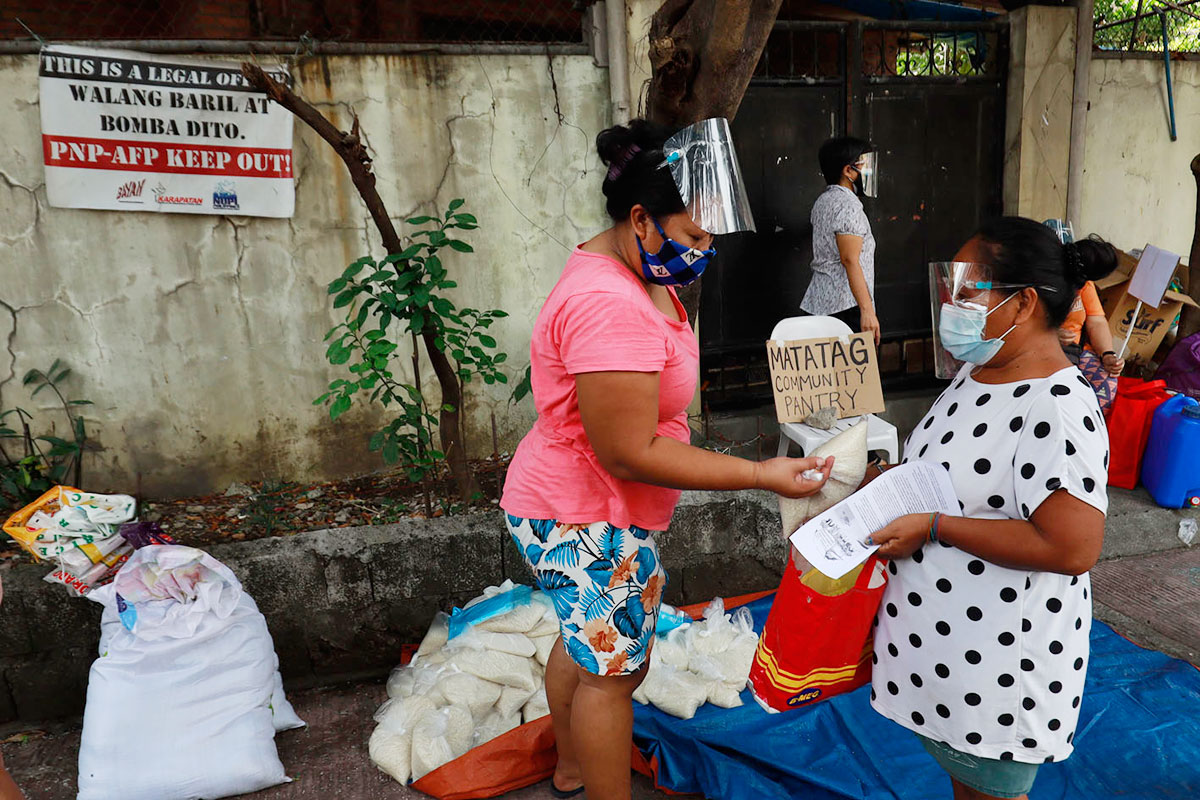
Docena, who is a coordinator of another community pantry along Matatag Street in Quezon City, said this as Department of the Interior and Local Government (DILG) Undersecretary for Barangay Affairs Martin Diño announced that organizers of community pantries may need to secure barangay permits now that the movement has inspired others to set up communal kitchens in their communities.
Diño took back his statement after a few hours as the DILG Secretary Eduardo Año disowned it.
Docena said the community pantries are just a “stopgap”
measure to the lack of aid, and that a “caring government” is needed to step in
and provide relief to lockdown-weary residents.


