



Public Warned Against Outdoor Protests On June 12; Clarity On Mass Gatherings Sought From Gov’t
Members of Movement Against Tyranny are planning to hold a “mañanita” protest on June 12 to voice out their rejection of the anti-terrorism bill, a measure that various sectors fear will be used to silence government critics.
Because of quarantine restrictions, “mañanita” protesters may have to hold their Independence Day activities online.
Presidential spokesman Harry Roque said cause-oriented groups managed to hold virtual protests on Labor Day so they can do the same on June 12 to ensure social or physical distancing.
“For those in areas with high COVID-19 (coronavirus disease 2019) risks, do not violate our quarantine rules like social distancing,” Roque said in a virtual press briefing on Monday, June 8. “You can hold protests online. We are not suppressing that.”
Members of Movement Against Tyranny are planning to hold a “mañanita” protest on June 12 to voice out their rejection of the anti-terrorism bill, a measure that various sectors fear will be used to silence government critics.
The protest was named after a gathering held in honor of National Capital Region Police Office chief Maj. Gen. Debold Sinas on May 8 despite a ban on public gatherings. “Mañanita” – a serenade at dawn to wake up a birthday celebrant – has become a tradition in the Philippine National Police.
The group calls participants of the protest “ka-mañanita” – a mockery of what was widely seen as a breach of public health protocols by police officials who are supposed to enforce quarantine rules. Sinas is facing charges over the gathering, but President Duterte has refused to fire him, prompting opposition Sen. Francis Pangilinan to advise protesters to call their mass actions “mañanita” so they can also avoid sanctions.
“Mga ka-mañanita, muli tayong magsama-sama at yanigin ang gobyernong nagtatangkang supilin ang ating mga batayang karapatan. Kitakits sa June 12 (Let us gather and disturb the government that is trying to suppress our basic rights. See you on June 12)!” a Facebook post by the Members of Movement Against Tyranny read.
Details of the "mañanita" protest have not been released. The Philippine National Police, nevertheless, has vowed to exercise maximum tolerance on those who would join the Independence Day protest.
The “mañanita” event will not be the first mass demonstration to be held during the quarantine. Militant groups and student organizations held rallies at the University of the Philippines (UP)-Diliman in Quezon City last week to demand the scrapping of the proposed Anti-Terrorism Act. Rally organizers claimed the participants complied with health and social distancing measures.
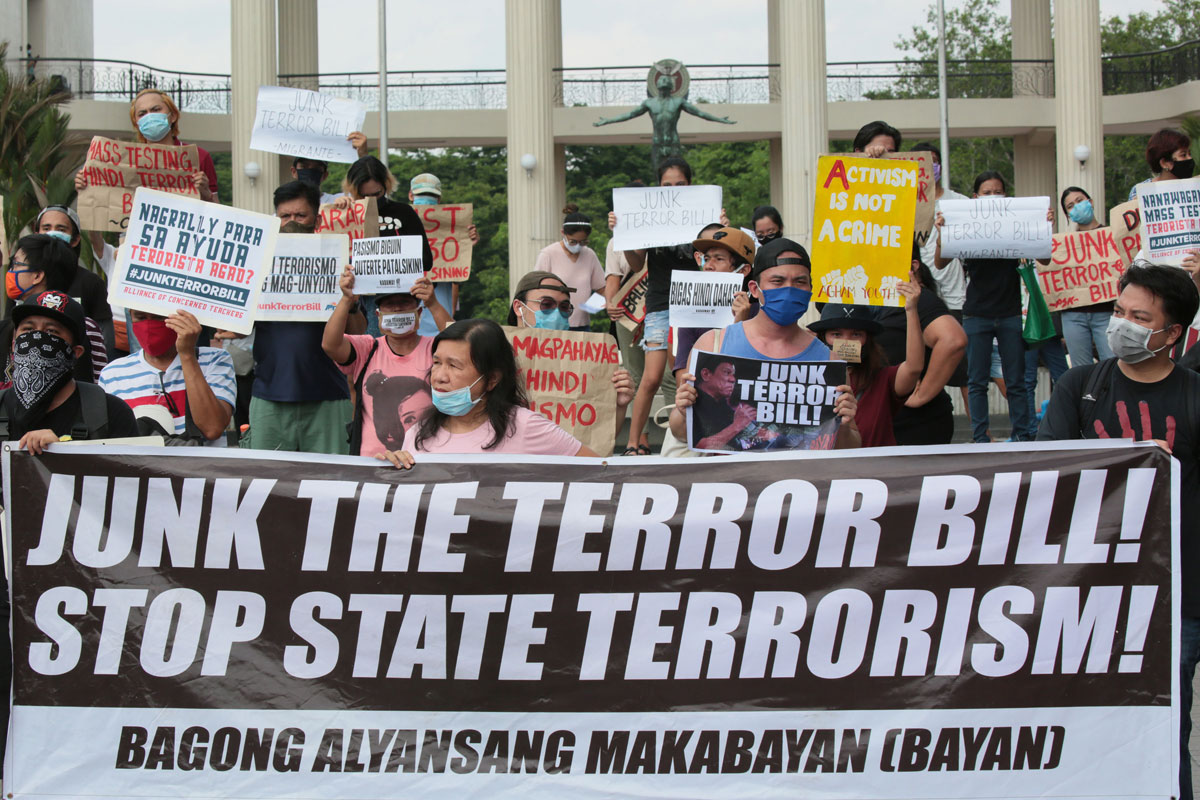
The following day, a mass demonstration also against the Anti-Terrorism Act was held in UP Cebu – an event that ended with the arrest of four members of militant groups, three students and a bystander. The UP Cebu administration has said it was “deeply disturbed” by the dispersal of the protesters and has criticized the police for its supposed failure to coordinate with school officials. Police said the rally participants had violated the ban on public gatherings.
Asked to react to the Cebu incident, Roque said the southern city has a high number of coronavirus disease 2019 (COVID-19) cases.
“May 1 has passed. Workers held protests online. The number of cases in Cebu is high,” the Palace spokesman noted.
“There was an appeal to place Cebu City under GCQ (general community quarantine), but the original decision of the IATF (Inter-Agency Task Force) was to place Cebu under MECQ (modified enhanced community quarantine) from ECQ (enhanced community quarantine),” he added.
Quarantine restrictions in Cebu City have been relaxed since June 1.
Based on the IATF guidelines, only up to 10 people can form part of a mass gathering in areas under GCQ while venues can be filled up to 50 percent of their capacity under modified GCQ or MGCQ to prevent the spread of COVID-19.
There are no guidelines yet for the new normal after the MGCQ, although a day before adjourning its session on June 4, the House of Representatives approved on second reading House Bill No. 8684, or the proposed Better Normal for the Workplace, Communities and Public Spaces Act of 2020.
How exactly should outside protests be treated especially since the COVID-19 pandemic is expected to last long?
Among others, HB 8684 seeks to prohibit public gatherings, but left its definition and exceptions up to the implementing rules and regulations to be crafted by the involved government agencies. People attending public gatherings permitted by local government units must observe physical distancing of at least one meter. Body temperature readings must be done in areas where two or more people gather.
Read more: No Conscience? ‘Commuters’ Woes Must Be Addressed In Plans For New Normal’
National Union of People’s Lawyers president Edre Olalia said the provision could be used to crack down on protest actions even if participants stay away from each other. He cited how the police used quarantine measures to justify the detention of the eight persons arrested in UP Cebu.
“It turns things on its head by making the legitimate exercise of freedom of assembly the exception rather than the general rule,” Olalia told The Philippine STAR. “It is not the other way around. Otherwise, you do not regulate, much less encourage, the exercise of the right but restrict or restrain and even criminalize it.”
“It is arguably acceptable to regulate the right on real grounds of public health or safety, but not limit them in such a way as to prohibit them or use these as excuses or guises, because the burden is on those who will exercise them, and the discretion to allow it, as abundant experience has palpably demonstrated, can and is being misused or abused,” he added.
Under the bill, holding prohibited public assemblies is punishable by one to two months’ imprisonment or a fine of P1,000 to P50,000. The same penalties apply for violations of the proposed public transportation standards.
Tribute to frontliners
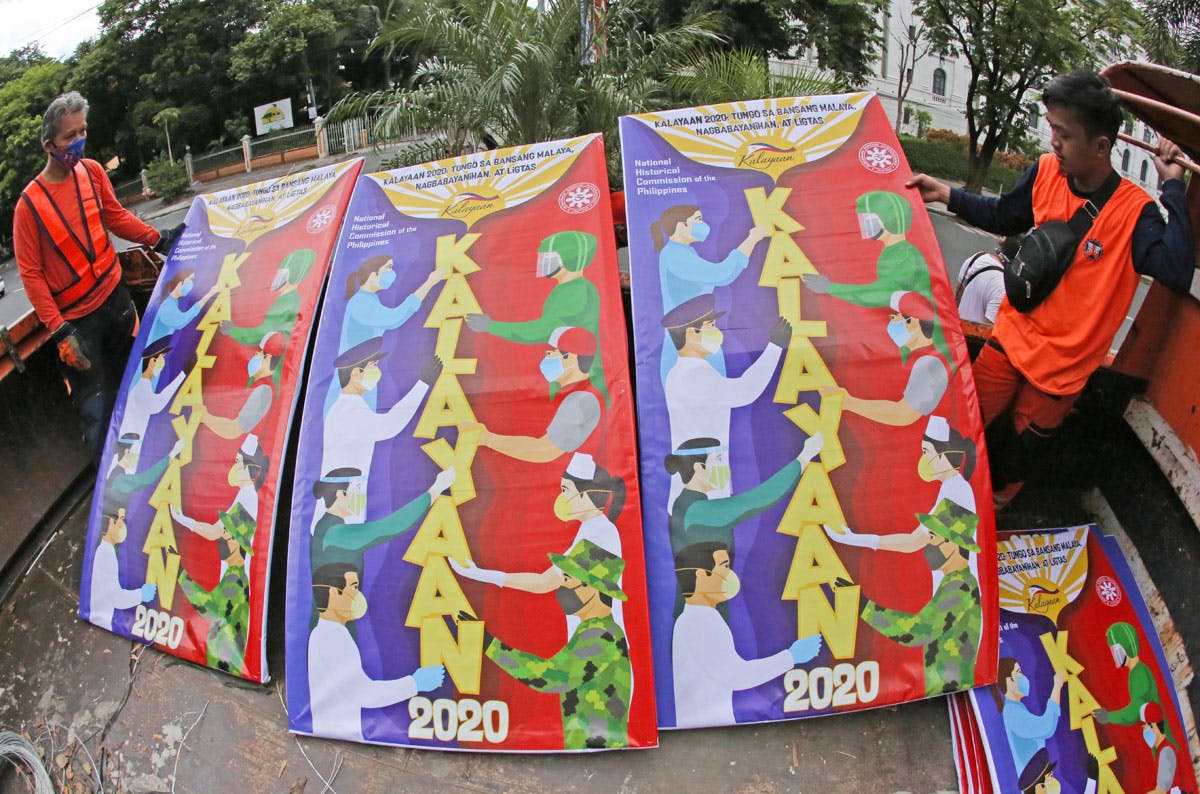
While critics of the anti-terrorism bill plan to commemorate Independence Day by holding protests, the government aims to celebrate the event by paying tribute to frontliners.
The theme of the 122nd anniversary of the declaration of Philippine Independence is “Kalayaan 2020: Towards a Free, United and Safe Nation.”
While the usual Independence Day rites are canceled because of the pandemic, the public can still honor the sacrifices of Filipino heroes while staying home.
The National Historical Commission of the Philippines (NHCP) is encouraging the public to raise the flag in their homes, offices and other buildings and to take photos of themselves while holding a flaglet and a sign that reads: “Thank you, frontliners.”
“Through these simple acts, we can celebrate our freedom even while staying at home. As we have said before, this pandemic will not stop us Filipinos from celebrating our freedom, freedom won and defended by our heroes past and present,” the NHCP said in a Facebook post.
The NHCP said this year’s celebration would focus on “building cooperation and trust as we push for a COVID-19 free country, safe and secure for all.”
“While the enemy is an invisible virus, it behooves us to look back at our history and see that we have had similar situations where our resolve and faith in our country proved to be our greatest strength. As 122 years ago when the nation was united to grasp freedom through sacrifice, so is the same call resounding today,” the commission said.
“We urge every Filipino, that amidst the challenge posed by this ‘new normal,’ to #RaiseOurFlag in solidarity with our frontliners who form our line of defense against the virus. We look forward to the day with fervent hope, that we will go through this more united, exhibiting the Bayanihan spirit as one nation, that we have always possessed.”
Luneta rites
On Tuesday, June 9, Roque said the IATF approved gatherings marking Independence Day in Manila’s Rizal Park as long as the number of guests will be limited to 10.
Duterte is likely to mark the occasion in Davao City where he has been staying since last week, Roque said.
“We’re checking po, kasi binigyan po ng permiso ng IATF na magkaroon ng celebration sa Luneta but limited to 10 people only. So we’ll have to check on that,” Roque said when asked where Duterte would be celebrating the event.
Roque said the President would hold another meeting with the IATF on Thursday, June 11 in Davao City, where he is likely to announce the next steps for the residents of Metro Manila and other areas that are under GCQ until June 15. The first meeting in Davao City was held on June 4.
Last year, Duterte skipped the Independence Day rites in Manila when he opted to visit troops in Lanao del Sur. In 2018, Duterte was heckled at the Aguinaldo Shrine in Kawit, Cavite where he celebrated the occasion. He skipped the ceremonies in 2017. – With Christina Mendez


