



Number Of New Corruption Cases Down Under Martires
The Office of the Ombudsman’s prosecutors brought only 198 new cases to the Sandiganbayan in 2019, according to data by the anti-graft court’s Judicial Records Division.
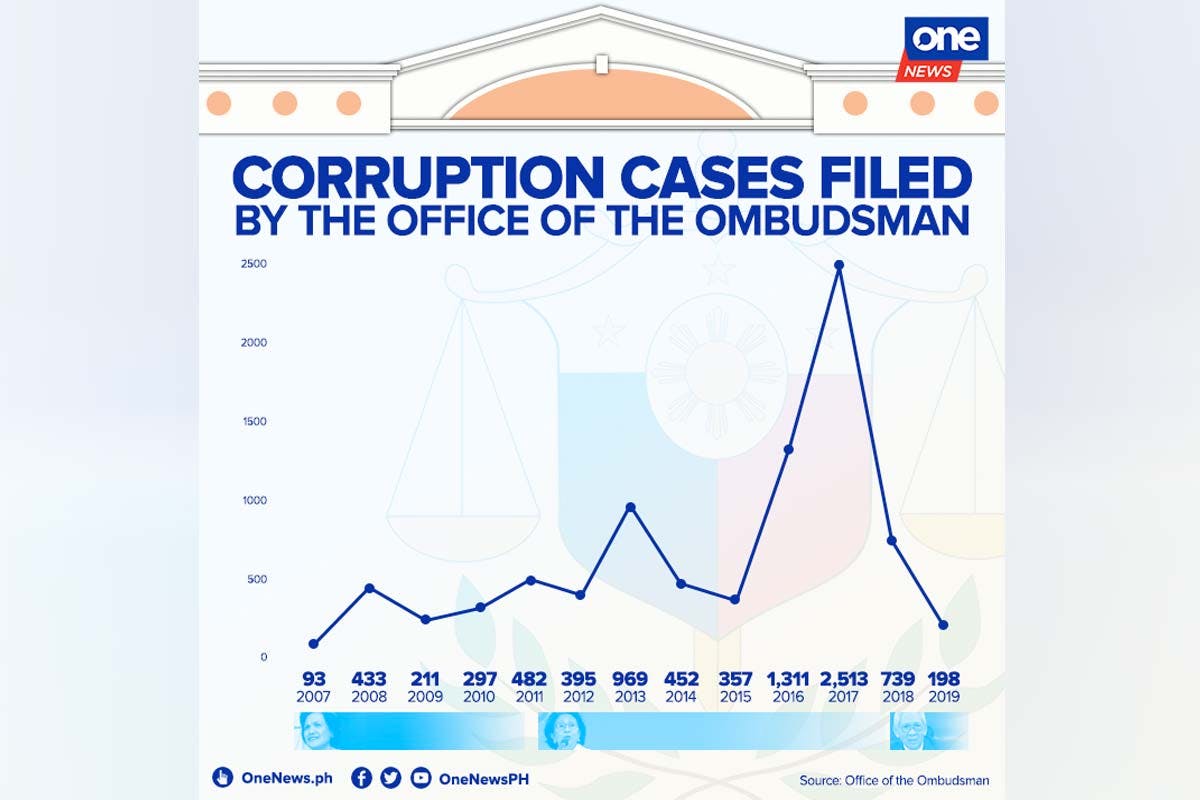
The number of new cases filed before the Sandiganbayan against erring officials fell to a 12-year low during the first full year of the tenure of Ombudsman Samuel Martires.
In fact, the workload of the Sandiganbayan as of the end of 2019 is the lightest it has been in four years. The anti-graft court’s increased productivity played a big role in thinning the pile, but prosecutors also appeared less eager to bring new cases.
The Office of the Ombudsman’s prosecutors brought only 198 new cases to the Sandiganbayan in 2019, according to data by the anti-graft court’s Judicial Records Division.
This was a drastic 273-percent drop from the 739 cases filed in 2018. And, of the 739, only 178 were actually filed from August to December 2018 under Martires’ watch; the vast majority of the indictments were made during the last seven months of his predecessor Conchita Carpio-Morales from January to July 2018.
In comparison, prosecutors during Morales’ time filed 1,311 cases in 2016 and 2,513 in 2017, the year when the court received the second highest number of new cases in its 40-year history (the peak was in 1981, when 2,661 cases were filed).
The last time the court received so few cases was in 2007, when Merceditas Gutierrez was the ombudsman, when only 93 were filed.
The downtrend under Martires’ watch helped reduce the workload of the Sandiganbayan. As of Dec. 31, 3,981 cases were pending – a sharp 31.5-percent decrease from the 5,237 recorded at the end of the previous year.
The court’s workload amounted to an all-time high of 5,493 cases just a year ago in 2017.
To the court’s credit, it was able to dispose of more than a thousand cases annually since 2017. (Disposing of the case means dismissing them over defects or rendering a conviction or an acquittal after a full-blown trial.) In 2019, it resolved 1,114 cases.
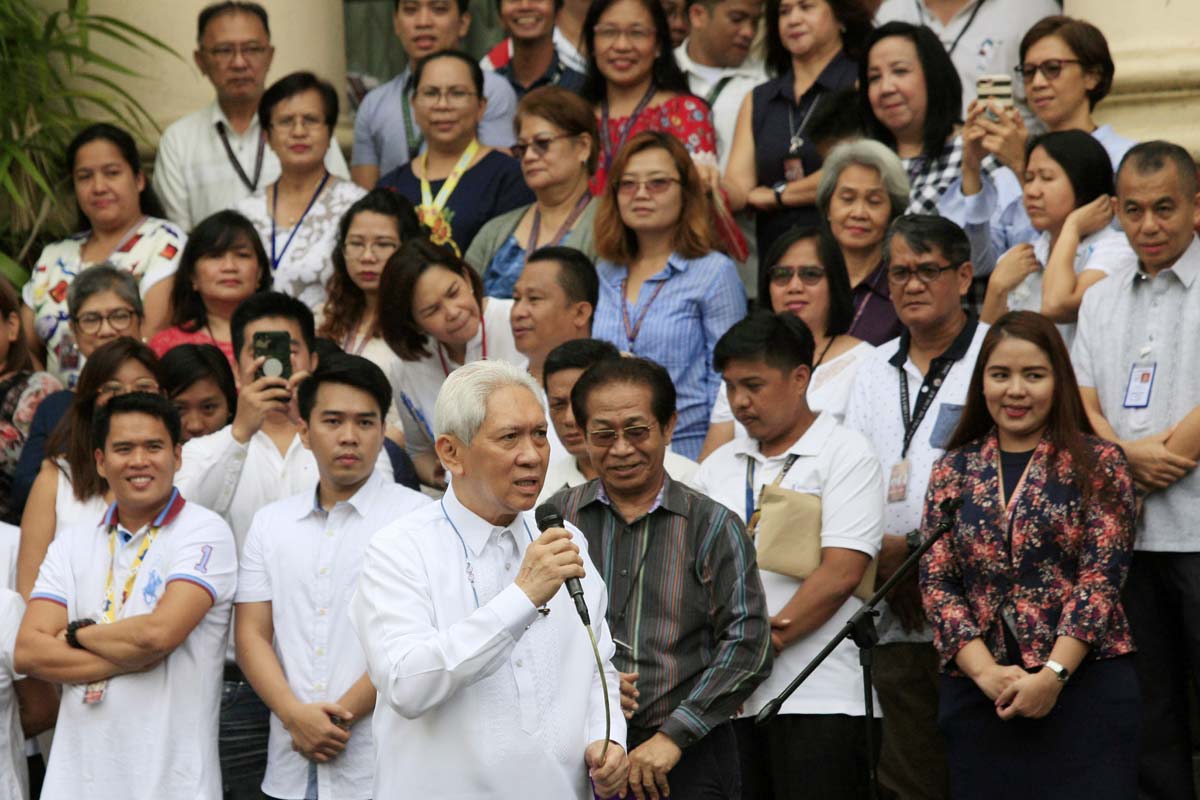
This coincided with the effectivity of the Supreme Court’s Revised Guidelines for the Continuous Trial of Criminal Cases in September 2017. Prior to that year, annual disposal rates were sluggish at a range that never reached four digits for 21 years straight, from 1996 to 2016 (the number of court divisions was increased to seven, from five, only in 2015).
The release of the updated statistics came around the time that the Philippines was reported to have ranked 113th out of 180 countries in the 2019 Corruption Perceptions Index – a 14-notch drop from 99th place in 2018.
Chief Presidential Legal Counsel and spokesman Salvador Panelo denied that the Duterte administration’s anti-corruption efforts have been a failure, pointing out that “erring government officials have been charged in the Ombudsman and in courts.” But Panelo admitted that gathering evidence to support corruption allegations was a persistent challenge.
Panelo said President Duterte could fire more corrupt officials due to the Philippines’ lower ranking in the latest Corruption Perceptions Index. The Philippines slipped 14 notches in the 2019 index. The CPI, which was released by Transparency International, evaluated the countries from a scale of zero, which means highly corrupt, to 100 or very clean.
Martires, who was appointed by Duterte as the country’s chief graftbuster on July 26, 2018, did not respond to The Philippine STAR’s requests for comment sent through his contact number or the agency’s Public Information and Media Relations Bureau.
In one of his first interviews with reporters on Aug. 6, 2018, however, he had emphasized the need to protect government officials from public scrutiny, and went as far as saying the ombudsman should refrain from making it appear that the officials should be convicted.
One of his first policy shifts was to stop the disclosure of the results of its corruption investigations and the release of press statements concerning officials facing indictment before the Sandiganbayan. Martires said such announcements “would be like us saying they should be convicted.”
He also expressed a somewhat different view on prosecuting officials accused of corruption: “We should reduce the hatred in our hearts. One day, we will understand: this is not just an issue of corruption; it is an issue of values formation.”
The following year, Martires stopped releasing copies of the statements of assets, liabilities and net worth of public officials, including Duterte.
When the Philippine Center for Investigative Journalism zeroed in on this secrecy, Martires accused veteran journalist Malou Mangahas of violating the anti-wiretapping law by recording their conversation without informing him. The conversation took place in a public area with Mangahas using her cell phone.