


No More Large-Scale Lockdowns As Phl Shifts To New Normal
The government believes the spike in COVID-19 infections are caused by the lack of health and safety measures, not by the reopening of the economy.
The third phase of the government’s plan to deal with the coronavirus disease 2019 pandemic aims to jumpstart the pandemic-hit economy and prepare the country for the “new normal” by avoiding large-scale lockdowns and boosting risk management efforts.
Carlito Galvez Jr., chief implementer of the National Action Plan Against COVID-19, said the third phase is anchored on managing health risks while opening the economy and learning to live with the virus until a vaccine becomes available.
“During this phase, we assure the public that there would be no more tradeoffs. Phase three will be our transition plan to the new normal, from the last quarter of this year rolling down the road toward the first quarter of 2021,” Galvez said in a press briefing on Thursday, Oct. 8.
Citing data from the National Economic and Development Authority (NEDA), Galvez said about 0.10 to 0.28 percent is shaved off the potential annual economic growth of 6.5 percent for every week that community quarantine is imposed in the National Capital Region. The NCR accounts for more than a third of the Philippines’ gross domestic product, has been under quarantine since March.
“Meaning, every 0.1 percent is equal to P19.5 billion in lost value-added, or (about) P63.4 billion in lost sales,” Galvez noted.
About 0.07 to 0.22 percent of potential economic growth is lost for every week that Central Luzon and Calabarzon are under quarantine, according to NEDA. The potential loss is 0.11 to 0.34 percent for the rest of the country. For every week that the entire Philippines is placed under community quarantine, potential growth is reduced by 0.28 to 0.84 percent.
“What we are doing is granular (lockdowns), because a large-scale ECQ (enhanced community quarantine) is not sustainable. We have seen the presentation of NEDA and the effect would be huge if we impose what we call draconic lockdowns,” Galvez said.
“If we place the entire BGC (Bonifacio Global City) in Taguig under lockdown, P16 billion to P19 billion would be lost in 14 days,” he added.
Galvez stressed that the spike in infections are caused by the lack of health and safety measures, not by the reopening of the economy.
“Once people become aware (of the risks), they can go out now with confidence that they will not be infected by the virus. That’s the most important, the (change in) behavior. The spikes (happen) not because we open the economy, but (due to) the consciousness of the people, the lack of safety (measures),” Galvez said.
“We are continuously working with the private sector and the public sector so that we will inform the public... that they should observe the minimum health standards,” he added.
The third phase of the action plan is anchored on the government’s “prevent, detect, isolate, treat, recovery” strategy, with prevention and containment as its main components.
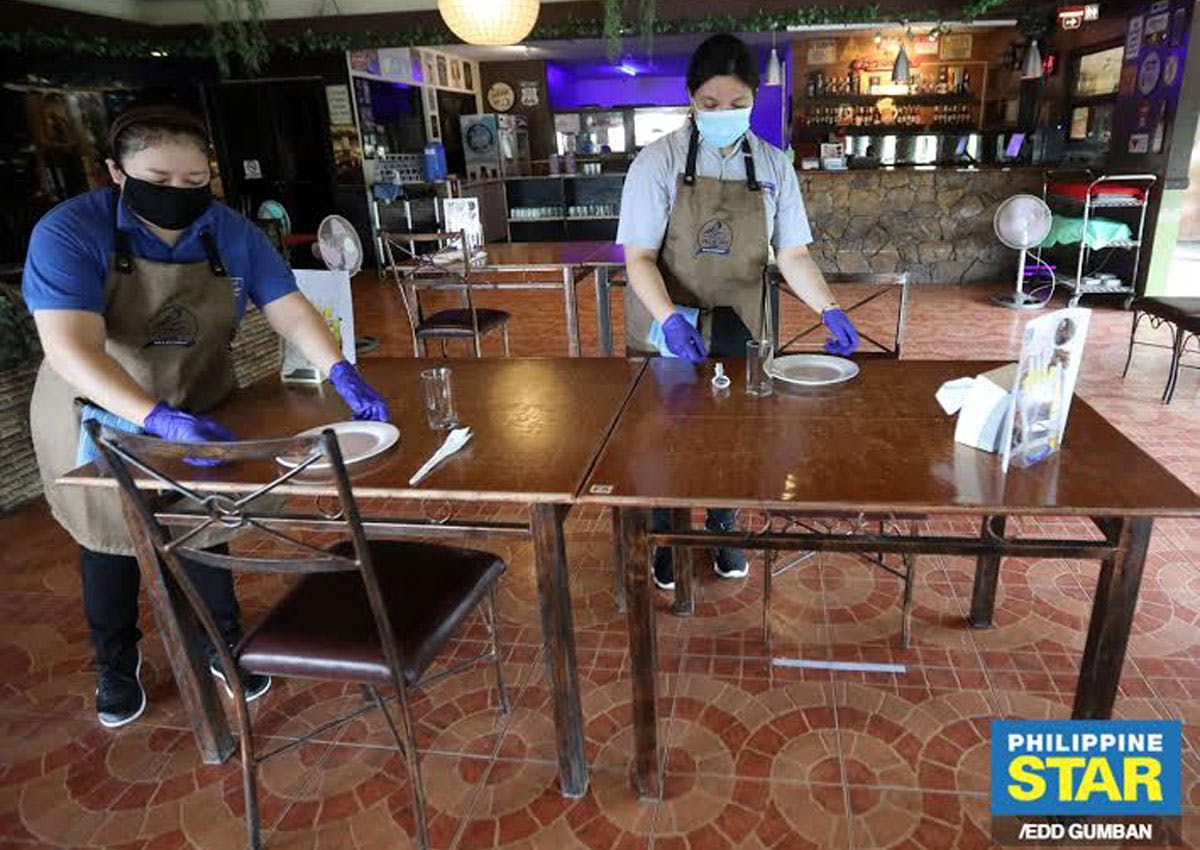
– “Prevent” involves washing of hands for 20 seconds, physical distancing, wearing of face masks, observing personal hygiene and community lockdowns.
– The measures under “detect” are active case finding and syndromic surveillance, aggressive contact tracing and expanded community testing.
– “Isolate” entails setting up of isolation facilities for mild and asymptomatic cases, implementing community protocols for positive cases, providing construction support for government hospitals, enforcing the policy against home quarantine, and expanding Oplan Kalinga or the isolation of persons infected with COVID-19.
– “Treat” entails the implementation of the One Hospital Command, a program that seeks to ensure the availability of medical assistance for all patients; setting up of mega temporary treatment and monitoring facilities; working with public and private referral hospitals, and increasing hospital capacities.
– The elements under “recover” are implementation of minimum health standards, awareness of possible reinfection, social healing and economic recovery.
Galvez explained that the plan’s third phase “will provide us the necessary strategic systems and mechanisms that will enable us to jumpstart our economy, but at the same time continue to lower active cases until a vaccine is available.”
“I would like to remind everyone again that we cannot afford to be complacent. We have seen that if we lower our guard, cases would go up.T second wave is just around the corner. Let us continue to observe the minimum health standards,” he said.
According to Galvez, the government is continuously sending teams to high-risk areas to find active cases, determine trends and gather information about the frequency of the virus. He said the administration is also supporting the expanded Oplan Kalinga to address the lack of quarantine facilities in some areas. Because of the lack of isolation facilities, about 50 to 60 percent of infected persons in some areas are undergoing home quarantine, Galvez said.
He cited the case of Batangas, where about 2,000 people who caught the virus are undergoing home quarantine.
“We are pulling them out of home quarantine and now, more than 600 have been placed in hotels and quarantine facilities,” Galvez said. “We are also increasing their testing capacity.”
He said the strategy “is to intensify active case finding so we can see the magnitude of contamination and at the same time, we isolate immediately all the positives and also increase the capacities of their hospitals.”