



‘Go Outside’: Gov’t, Brands Encourage Consumption, Push Safe Restarting Of Economy
The “Ingat Angat Tayong Lahat” campaign is an unprecedented collaboration among 30 brands, many of them competitors, and the government. They believe the economy can’t be revived if people continue to stay at home due to fear of COVID-19.
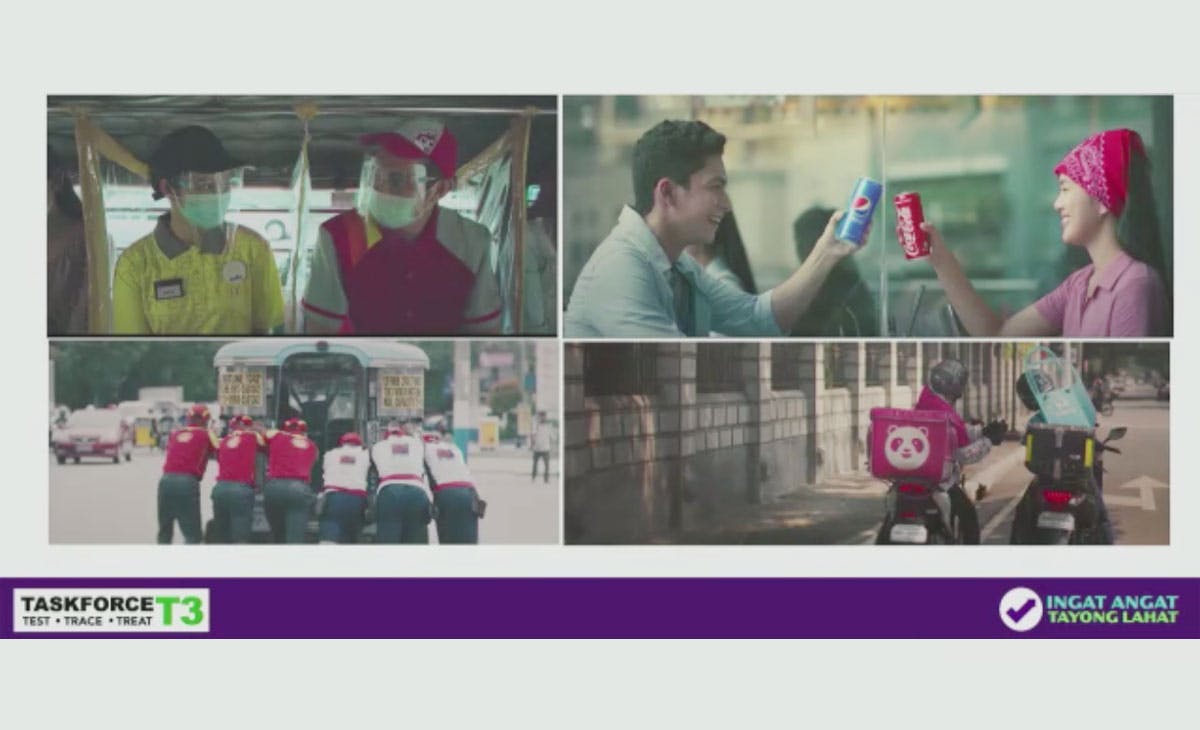
In a turnaround from its hardline tack of commanding people to stay home, the Duterte administration has a new message amid sputtering economic recovery and tepid consumer demand: go outside, get back to work, buy stuff, return to old habits, keep safe.
The private sector got behind this message. In an unprecedented collaboration, 30 brands have embarked on a publicity campaign to encourage people to patronize businesses struggling amid the coronavirus disease 2019 (COVID-19) pandemic.
The “Ingat Angat Tayong Lahat” campaign will consist of commercials to be rolled out starting today, Oct. 9, featuring competing brands side by side like fast food chains Jollibee and McDonald’s, soft drinks Coca-Cola and Pepsi, gas station chains Petron and Shell, and courier services Angkas and Food Panda.
The commercials seek to encourage consumers to eat out and shop around by showing people doing various activities outdoors while observing minimum health and safety protocols like wearing of face masks and face shields, washing of hands and observing physical distancing.
Messages like “Pwede ’yan, mag-ingat lang (You can do it, just be careful)” and “Kapag isinapuso natin ang pag-iingat, aangat tayong lahat (If you take carefulness to heart, we will all rise)” were conveyed by the commercials.
The information dissemination campaign will “run until the end of the year” and will be featured on television and in the corporations’ social media pages, McDonald’s Philippines managing director Margot Torres, one of the campaign’s proponents, said during the campaign’s launch on Thursday, Oct. 8.
The admission that economic demand has not been strong because of consumers’ unwillingness to leave their homes seems to contradict the government’s previous messages implying that Filipinos have been “pasaway (bullheaded)” and insistent on going out.
The World Bank Group recently revealed that a survey of 74,031 firms from July 7 to 14 showed that 15 percent have permanently closed amid the pandemic, with another 39 percent saying they did not know how much longer they could remain open under the circumstances.
Meanwhile, the Philippine Statistics Authority recorded a 10-percent unemployment rate for July, which declined from the all-time high of 17.7 percent during the middle of the enhanced community quarantine in April. But joblessness in Metro Manila actually worsened to 15.8 percent in July from 12.3 percent in April.
‘We must not live in fear’
Several government officials graced the campaign’s launch, highlighting their desire to shore up public confidence as the business atmosphere remains in a slump despite the relaxation of community quarantine measures since June.
Presidential spokesman Harry Roque said reviving the economy “cannot be done if people continue to be in fear and hide in their homes, refusing to go to work.”
Roque said the private sector’s “Ingat Angat Tayong Lahat” campaign would “send a message that we must not live in fear, that we can work if we protect our lives and we can do so by wearing masks, washing hands and observing distancing.”
He noted that the government already launched its “Ingat Buhay Para sa Hanapbuhay” campaign with similar goals in mind. He added that this was the first time President Duterte appeared in a commercial since the elections, to promote the message “Mask, Hugas, Iwas (Mask, Wash Hands, Stay Away).”
Peace adviser and chief of the National Task Force Against COVID-19 Carlito Galvez Jr. said “we cannot have any more the tradeoffs” of restricting people to their homes at the expense of the economy.
Trade Secretary Ramon Lopez also stressed: “The virus will be here to stay and we know we just have to manage the risk, not avoid it… We need to get back to our work, our life.”
He admitted that it had been “quite difficult” to bring back consumer confidence, even after the community quarantine measures were loosened and more sectors were allowed to reopen at limited capacity.
“Marami pa rin pong mahinang negosyo kahit ina-allow na nating magbukas (There are still many weak businesses even if we allow them to open),” Lopez said.

Bases Conversion and Development Authority president and chief executive officer Vivencio Dizon, deputy chief implementer of the National Action Plan Against COVID-19, pointed out that these publicity campaigns would show that “what sets the Filipino apart” in terms of responding to the pandemic is “resiliency.”
“Kailangan na natin paandarin ang ekonomiya, kailangan na nating bumalik sa ating trabaho, kailangan na nating bumalik sa mga dati nating kinagawian (We have to restart the economy, we have to return to work, we have to go back to the way we were before),” Dizon said.
“Nandiyan pa rin ang COVID. Kailangan pa rin nating mag-ingat para umangat tayong lahat (COVID is still there. We have to be careful so we can all rise),” he added.
Targeting the upper and middle classes
To spur sales and inject more energy into the economy, Torres said the executives of the country’s leading businesses hatched a plan to target the “reclusive” upper to middle-class Filipinos who hold the “most purchasing power.”
Torres, one of the proponents of the campaign, expressed belief that upper and middle-class people have been “enveloped by fear” and have “settled comfortably at home” to avoid the virus.
“The campaign needs to transform the mindset of the consumer from learned helplessness to empowered vigilance,” she said.
Angkas chief transport advocate George Royeca, another proponent of the campaign and a participant in the public-private initiative Task Force T3, emphasized the “need for collaboration to help our nation live with the virus instead of cowering in fear of it.”
He said bringing back the confidence of the public is “not just the job of the government, it’s the responsibility of the private sector as well.”
Torres noted that the commercials would emphasize the message of resilience, “appealing to how Filipinos have always overcome a crisis” like flash floods, earthquakes and volcanic eruptions.
She said the commercials wanted to stress that “it is malasakit (concern) through collective vigilance that we need and cautious optimisim that we embrace to move forward.”
“The brands will only serve as a backdrop to the story,” she added.
Other sponsors of the campaign include Aboitiz, Alaska, Ayala Malls, Banco de Oro, Bank of the Philippine Islands, Century Tuna, Champion, Emperador, Filinvest, Globe, Goldilocks, Megaworld, Metrobank, Oishi, P&G, PayMaya, Resorts World Manila, RFM Corp., Robinsons Malls, San Miguel Corp., SM Supermalls, Smart and Unilever.


