



Cebu Quake Likely Caused By Fault That Had Not Moved For 400 Years; More Than 900 Aftershocks Detected – Phivolcs
Winchelle Ian Sevilla, Philippine Institute of Volcanology and Seismology’s Seismological Observation and Earthquake Prediction Division head, said the fault had not shifted for hundreds of years, which contributed to the strength of the tremor.
The Philippine Institute of Volcanology and Seismology traced the 6.9-magnitude earthquake that struck Bogo City, Cebu on Tuesday, Sept. 30, to an offshore fault that has not moved for 400 years.
Winchelle Ian Sevilla, head of PHIVOLCS’ Seismological Observation and Earthquake Prediction Division, said on Wednesday, Oct. 1, the fault had not shifted for hundreds of years, which contributed to the strength of the tremor.
Sevilla added that the fault, currently referred to as an “offshore fault,” has yet to be formally named.
A quick response team has been dispatched to study its characteristics.
PHIVOLCS also said Cebu and nearby provinces lie within one of the country’s seismically active zones.
Apart from the Bogo Fault, Daanbantayan Lineament, and Cebu Fault System, several inland and offshore faults remain capable of generating quakes of varying intensity.
The epicenter of the quake, which was set off by movement in an undersea fault line at a dangerously shallow depth of five kilometers, was about 19 km northeast of Bogo, a coastal city of about 90,000 people where about half of the deaths were reported, officials said.
Schools and government offices were closed in the quake-hit cities and towns while the safety of buildings were checked.
PHIVOLCS director Teresito Bacolcol told “Sa Totoo Lang” on One PH on Wednesday night the quake’s movement was vertical or up and down since it was near the epicenter.
More than 600 aftershocks have been detected after Tuesday night’s temblor, Bacolcol said.
As of 3 p.m., Sevilla disclosed there were already 900 aftershocks detected following the powerful quake.
Rain-soaked mountainsides were more susceptible to land- and mudslides in a major earthquake, Bacolcol warned.
“This was really traumatic to people. They’ve been lashed by a storm then jolted by an earthquake,” Bacolcol said. “I don’t want to experience what they’ve gone through.”
A desperate search
Workers were trying to transport a backhoe to hasten search and rescue efforts in a cluster of shanties in a mountain village hit by a landslide and boulders, Bogo City disaster-mitigation officer Rex Ygot told The Associated Press early Wednesday.
“It’s hard to move in the area because there are hazards,” said Glenn Ursal, another disaster mitigation officer, who added that some survivors were brought to a hospital from the mountain village.
Deaths also were reported from the outlying towns of Medellin and San Remigio, where three coast guard personnel, a firefighter and a child were killed separately by collapsing walls and falling debris while trying to flee to safety from a basketball game in a sports complex that was disrupted by the quake, town officials said.
The earthquake was one of the most powerful to batter the central region in more than a decade and it struck while many people slept or were at home.
A traumatized region
Phivolcs briefly issued a tsunami warning and advised people to stay away from the coastlines of Cebu and the nearby provinces of Leyte and Biliran due to possible waves of up to one meter (three feet).
No such waves were reported and the tsunami warning was lifted more than three hours later, but thousands of traumatized residents refused to return home and chose to stay in open grassy fields and parks overnight despite intermittent rains.
Cebu and other provinces were still recovering from a tropical storm that battered the central region on Friday, Sept. 29, leaving at least 27 people dead mostly due to drownings and falling trees, knocking out power in entire cities and towns and forcing the evacuation of tens of thousands of people.
The Philippines, one of the world’s most disaster-prone countries, is often hit by earthquakes and volcanic eruptions due to its location on the Pacific “Ring of Fire,” an arc of seismic faults around the ocean. The archipelago is also lashed by about 20 typhoons and storms each year.
State of calamity
The province of Cebu has been placed under a state of calamity following the damage caused by a magnitude 6.9 earthquake on Tuesday night.
The Cebu Provincial Disaster Risk Reduction and Management Office pegged the injured at 293.
Bogo City accounts for most of the deaths with 30 people, followed by the municipalities of San Remigio with 22, Medellin with 10, Tabogon with five and Tabuelan and Sogod with one reported death each.
Cebu Gov. Pamela Baricuatro conducted an aerial inspection and described the damage to roads, bridges and other infrastructure as “devastating.”
Collapsed bridges, cracked highways and ruined homes were reported across municipalities.
Even government facilities in Bogo City, including the city hall, bus terminal and port, sustained severe damage.
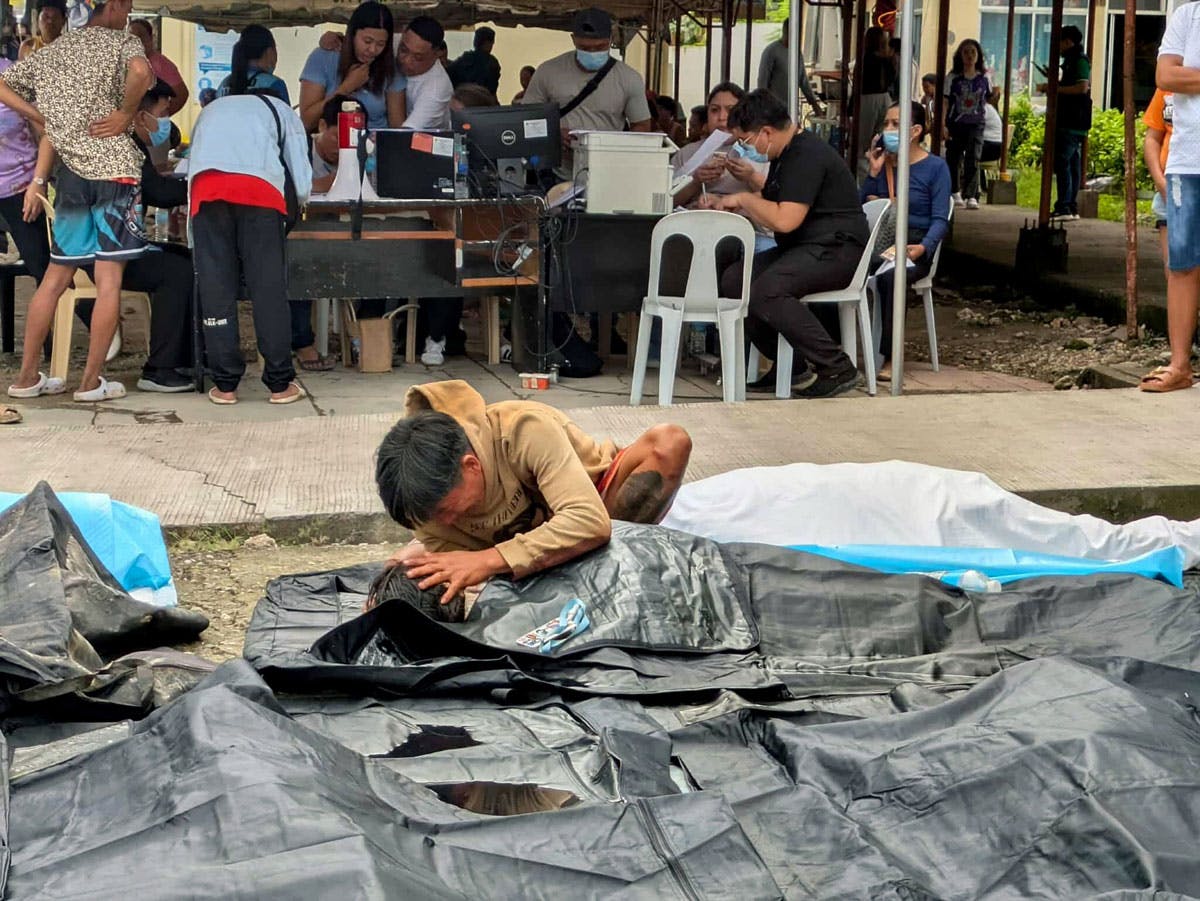
The Cebu Provincial Hospital in Bogo City was overwhelmed with casualties, as body bags were lined outside its compound.
To assist bereaved families, a booth for the issuance of death certificates was set up near the hospital.
Among the fatalities were a mother and her one-year-old daughter in Barangay Binabag, Bogo City, after a boulder rolled down and crushed the wall of their home.
Meanwhile, three personnel of the Philippine Coast Guard also died in the earthquake.
In a statement, the PCG identified the fatalities as Seaman Second Class Lawrence Palomo, Apprentice Seaman Jujay Mahusay and ASN Ert Cart Dacunes.
The three Coast Guard personnel reportedly died when the San Remegio Sports Complex in San Remegio, Cebu collapsed.
They were rushed to Bogo General Hospital for emergency medical treatment, but were all pronounced dead by the attending physicians.
“We extend our sincere condolences to the families of our fallen personnel. Their dedication to the service and camaraderie with our fellow uniformed men and women will always be remembered. The PCG stands in full solidarity with their loved ones and will ensure that they receive the utmost support,” PCG commandant Adm. Ronnie Gil Gavan said.
Power supply was also disrupted in the area. Transformer explosions in Asturias triggered widespread blackouts, while the Visayas Grid Authority raised a yellow alert on Wednesday morning.
In total, 27 power plants tripped, causing the loss of 1,444.1 megawatts, while 16 plants were offline and one was operating at reduced capacity. This left at least 1,654.7 megawatts unavailable in the Visayas grid, though Luzon and Mindanao grids remained stable.
Telecommunications were cut off in Bogo City, Daanbantayan and San Remigio, making rescue coordination more difficult.
Transportation was also affected, with at least 52 passengers stranded in the towns of Carmen and Consolacion after roadblocks and port closures.
Religious and cultural landmarks were not spared. The Archdiocesan Shrine of Santa Rosa de Lima in Daanbantayan collapsed following the strong quake.
The San Remigio Sports Complex and San Juan Nepomuceno Parish were destroyed, while the Capelinha de Fatima Replica suffered structural damage.
Hagnaya Port temporarily suspended operations due to quake-related damage, halting passenger and cargo movement in northern Cebu.
The Civil Aviation Authority of the Philippines reported no damage to the tower structure and runways at Mactan-Cebu International Airport. It has issued a Notice to Airmen advising flight operators to avoid flying close to the Taal Volcano, with vertical limits from the surface up to 11,000 feet effective until 9 a.m. today, Oct. 2.
In addition to public structures, numerous private homes also collapsed or sustained heavy cracks, forcing residents to seek shelter in evacuation centers.
At the national level, President Marcos directed government agencies to deliver immediate assistance to Cebu.
As of 10 a.m. on Wednesday, Phivolcs recorded at least 848 aftershocks, including four major tremors, the strongest at magnitude 4.8.
Instrumental Intensity I was recorded in Roxas City, Capiz; Asturias, Talisay City and Danao City in Cebu; Cebu City; and Abuyog, Villaba and Hilongos in Leyte.
Most aftershocks were clustered in and around Bogo City.
Except for minor cracks on the fourth and fifth floors of Cadiz District Hospital in Cadiz City, Negros Occidental, which was already vacated by patients, local authorities reported no structural damage reported in Negros Occidental following the earthquake.
Government response
The Philippine Air Force (PAF), through the Tactical Operations Wing Central, has deployed Disaster Response Task Units to support rescue and relief operations.
Several air assets were mobilized, including a C-130 cargo plane to transport additional rescuers from the 505th Search and Rescue Group, along with the Philippine Army (PA)’s Humanitarian Assistance and Disaster Relief team.
The PAF said Black Hawk helicopters from the 205th Tactical Helicopter Wing also carried out rapid damage assessment and needs analysis missions and airlifted rescue and medical teams, equipment and relief goods to the hardest-hit areas.
On the ground, personnel from the 560th Air Base Group, together with PA responders, conducted rapid assessments, search, rescue and retrieval operations, as well as relief distribution to affected communities.
“To augment these (local authorities’) efforts, almost 1,600 teams composed of active military personnel, CAFGU Active Auxiliary members and reservists are on standby for immediate deployment,” Armed Forces of the Philippines spokesperson Col. Francel Margareth Padilla said.
Meanwhile, over 1,356 police officers have been deployed in affected areas.
“Our personnel are on the ground not only to secure affected areas, but also to extend a helping hand to families in need,” acting Philippine National Police chief Lt. Gen. Jose Melencio Nartatez Jr. said.
The PCG also sent doctors and nurses from Manila to Cebu to help attend to those injured and in need of medical assistance.
To augment local response, trauma teams from the Vicente Sotto Memorial Medical Center, the Provincial Health Office and Emergency Rescue Unit Foundation were deployed. Neighboring provinces, including Bohol and South Cotabato, have also sent additional medical personnel and supplies.
The Department of Health announced that more emergency medicines and commodities are en route to Cebu via a C-130 plane on Wednesday afternoon. Supplies include emergency medical kits, family kits, face masks, vitamins, maintenance medicines for hypertension and diabetes and oral rehydration salts.
During a briefing with disaster agencies on Wednesday, Defense Secretary Gilberto Teodoro Jr. called for a unified and coordinated response among government agencies, uniformed personnel and local disaster management offices.
He tasked the OCD in Region 7 to lead regional coordination and provide situational updates for the swift delivery of assistance.
The Department of the Interior and Local Government (DILG) ordered affected LGUs to implement critical response and preparedness measures in light of aftershocks.
“Swift and decisive action is non-negotiable,” the DILG said.
The Department of Social Welfare and Development Region 7 said it has distributed an initial 10,000 family food packs and 2,000 ready-to-eat food packs to affected families.
Public Works Secretary Vince Dizon joined Governor Baricuatro in visiting patients at the Cebu Provincial Medical Hospital in Bogo City, underscoring the government’s commitment to deliver immediate aid.
The Department of Migrant Workers said it will provide food, accommodation, transportation and other necessary assistance to overseas Filipino workers whose flights may have been affected by the earthquake.
Energy Secretary Sharon Garin said a Department of Energy task force has been mobilized to Cebu, with power agencies set to assess and restore electricity systems by Friday, Oct. 3. – With Associated Press, Michael Punongbayan, Jonnavie Villa (The Freeman), Christine Boton, Emmanuel Tupas, Evelyn Macairan, Mayen Jaymalin, Neil Jayson Servallos, Rudy Santos, Gilbert Bayoran


