



Can The IRR Of The Anti-Terrorism Act Regulate Social Media and Ammonium Nitrate?
The massive explosion that flattened large swaths of Lebanon’s capital Beirut on Aug. 4, killing at least 100 and injuring thousands, has been blamed on 2,750 tons of ammonium nitrate improperly stored in a warehouse.

The proposal of the new military chief to regulate social media and agricultural products through the implementing rules and regulations (IRR) of the Anti-Terrorism Act (ATA) – a law that does not mention these matters at all – has drawn rebuke that even Malacañang agreed with.
For groups questioning the constitutionality of the law, the remarks of Armed Forces of the Philippines (AFP) chief of staff Lt. Gen. Gilbert Gapay only “justified” fears that it was meant to unduly restrict freedom of speech, allow officers to abuse their powers and crack down on legitimate dissent by critics of the government.
Social media personalities were among the sectors that cried foul over the enactment of the law. Other sectors that raised concerns specific to their situations were law professors, labor groups, youth groups, journalists and Muslims.
Gapay, in a virtual press briefing after officially assuming his position on Aug. 3, said regulating social media through the IRR of the ATA or Republic Act No. 11479 would curb the “radicalization” of the youth.
“We’ll be providing some inputs on countering violent extremism and likewise, maybe regulating, even regulating social media because this is the platform now being used by terrorists to radicalize, to recruit and even plan terrorist acts,” Gapay, who was joined by Defense Secretary Delfin Lorenzana in the briefing, said.
Agricultural products are another matter not mentioned in the law which Gapay wanted to insert in the IRR. He argued that ammonium nitrate, which is a component in producing fertilizer, has been used to manufacture improvised explosive devices.
The massive explosion that flattened large swaths of Lebanon’s capital Beirut on Aug. 4, killing at least 100 and injuring thousands, has been blamed on 2,750 tons of ammonium nitrate improperly stored in a warehouse.
Ammonium nitrate has been behind some of the largest accidental explosions and terrorist bombings on record, Forbes reported. The main use of ammonium nitrate is as an additive to fertilizer, for helping nitrogen-poor soil. Global production, in the form of a white crystalline solid, runs to over 20 million tons a year, so there is a lot of it around. A small proportion of the total production is employed in industrial blasting products.
Gapay argued that the military should have a say in how the IRR would be crafted because it is at the forefront of combating terrorism. He also proposed that the IRR provide for the creation of grassroots mechanisms, the enhancement of intelligence-sharing with foreign counterparts, and the strengthening of maritime security.
Justice Secretary Menardo Guevarra did not rule out Gapay’s idea outright. “Too early to say. We shall consult our law enforcement and military institutions as we go along. We shall also coordinate with intelligence agencies for inputs,” Guevarra told reporters.
On Wednesday, Lorenzana and Gapay assured the public that the proposal would not be used to curtail freedom of expression on social media.
How the law is worded
The phrases “social media” and “agricultural products” were not explicitly mentioned at all under RA 11479, which President Duterte signed into law on July 3 and which lawyers said took effect on July 22 (the day after the lapse of a 15-day period counted from its publication in the print version of the Official Gazette and a newspaper on July 6).
Sections 3(h) and 10 of the law broadly defines “recruitment” as “any act to encourage other people to join a terrorist individual or organization…” and the “recruit[ing] of another to participate in, join, commit or support any terrorism or a terrorism individual or any terrorist organization…”
Section 10 fleshes out the prohibition against recruiting and facilitating the travel of foreigners by, among others, “publishing an advertisement or propaganda for the purpose of recruiting persons to serve in any capacity in or with such an armed force.”
Section 9, which punishes “inciting to commit terrorism,” concerns the instigation of other people to execute terrorist acts “by means of speeches, proclamations, writings, emblems, banners or other representations tending to the same end.”
Section 16 enables law enforcers to ask the Court of Appeals (CA) for an order allowing them to wiretap and record “any private communications, conversation, discussion/s, data, information, messages in whatever form, kind or nature, spoken or written words” among individuals suspected of committing terrorist acts or belonging in designated or outlawed terrorist groups.
The section describes the following as surveillance tools: “any mode, form, kind or type of electronic, mechanical or other equipment or device or technology now known or may hereafter be known to science.” It also allows law enforcers to ask the CA for an order to “compel telecommunications service providers and internet service providers to produce all customer information and identification records.”
Law enforcers cannot just subject communications to surveillance on their own initiative without a written order from the appellate court.

Meanwhile, the word “chemical” was mentioned four times: twice in the context of weapons of mass destruction under Sections 3(f) and 3(n), once in reference to a “critical” industrial sector under Section 3(a) which may be targeted by terrorist acts, and once regarding the development of “chemical weapons” under Section 4(d).
Supreme Court (SC) decisions consistently hold that “the spring cannot rise higher than its source.” Cases like People versus Maceren stress that “the law itself cannot be extended” by mere regulations by the administrative agencies tasked to implement it.
“Administrative regulations adopted under legislative authority by a particular department must be in harmony with the provisions of the law, and should be for the sole purpose of carrying into effect its general provision,” the SC said in People versus Maceren.
“The power cannot be extended to amending or expanding the statutory requirements or to embrace matters not covered by the statute. Rules that subvert the statute cannot be sanctioned,” it added.
This would not be the first time that government officials tried to interpret and apply legal principles in unconventional ways to defend the constitutionality of the ATA.
The Office of the Solicitor General (OSG), in its July 17 comment on the first eight petitions against the law, argued against a literal reading of a provision questioned for allowing law enforcers to detain persons merely “suspected” of committing terrorist acts without the need for an arrest warrant.
The Constitution requires a warrant to be issued by a judge upon a finding of probable cause, a standard higher than mere suspicion.
The OSG discouraged the application of the general rule of verba legis, or reading non-technical words according to their ordinary meaning. It argued that lawmakers really intended to comply with the Constitution, even if their choice of the word “suspected” did not reflect it.
Palace, lawmakers disagree with Gapay
Still, Malacañang distanced itself from Gapay’s comments. Presidential spokesman Harry Roque even agreed that the ATA did not provide for the regulation of social media, adding that it falls under the purview of the Cybercrime Prevention Act of 2012.
“Unang-una po, opinion po iyan ni General Gapay. Dahil binasa ko naman po ang Anti- Terror Law, wala pong probisyon doon na magagamit laban sa social media (First of all, that is General Gapay’s opinion. Because I read the Anti-Terror Law and there is no provision there that can be used against social media),” Roque said in an Aug. 4 virtual press briefing.
“Ang mayroon po diyan ay iyong ating cybercrimes law… may probisyon po diyan, pero subject po iyan sa authority na ibibigay ng ating hukuman (What exists is our cybercrimes law; there is a provision there, but subject to the authority to be given by our courts),” added the former human rights lawyer.
Sen. Panfilo Lacson, the main proponent of the law, did not respond to requests for comment.
However, Senate Minority Leader Franklin Drilon said Gapay’s proposal would be “illegal and unconstitutional” because “there is nothing in the law which would allow enforcers to regulate or control social media.”
“That will go beyond the real intent of the law and, therefore, it is illegal and unconstitutional. Freedom of speech is a sacred and inviolable right of every human being. The Constitution guarantees freedom of speech,” Drilon said.
He stressed that “no law can be amended by a mere administrative rule issued for its implementation.”
He also deemed regulation of social media to counter terrorist acts to be a “means that unnecessarily sweep its subject broadly, thereby invading the area of protected freedoms.”
Drilon said that if Gapay pushed for powers exceeding those granted by the ATA, “then we justify the fears aired by the people against the passage of the law.”
“Let us not be so imprudent as to prove to the people that they are right in their distrust of the law’s implementer,” he added.
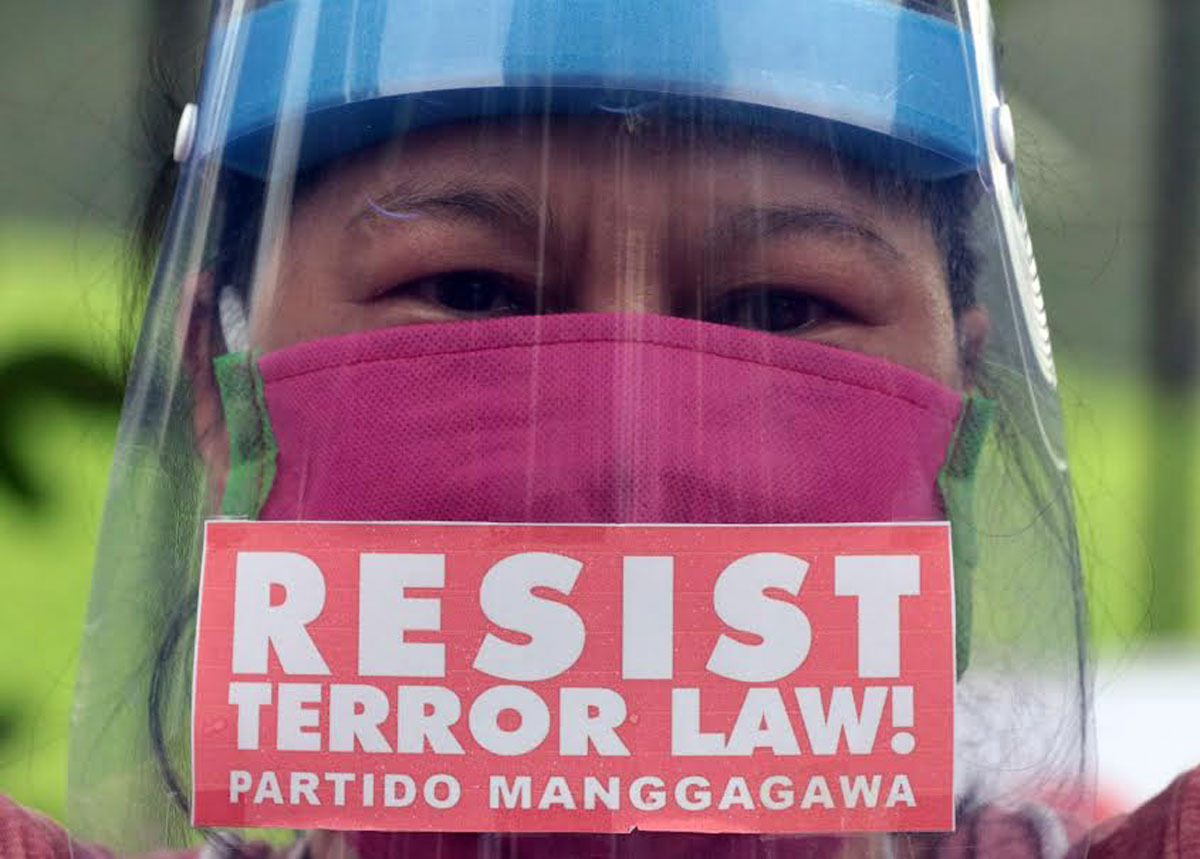
Muntinlupa City Rep. Ruffy Biazon – one of the authors who shepherded the law’s passage through the House but voted no to its approval on third and final reading in June – agreed: “From the beginning until the last minute, I can say it was not our intention that social media be regulated by the state through the (Anti-Terror Law).”
Biazon defended the measure during plenary deliberations in which House leaders refused to allow any amendment to the wording of the bill passed by the Senate in February. He said he changed his mind at the last minute because there “were refinements we wanted to do to make provisions clearer and avoid misinterpretation.”
Bayan Muna Party-list Rep. Ferdinand Gaite dubbed the suggestion “cyber martial law,” especially since the National Bureau of Investigation has already “harassed” social media users by issuing subpoenas over their posts critical of the government’s policies, and Philippine National Police local offices have made several posts that “vilify activist organizations and progressive leaders.”
“Expanding the reach of an already vague law to cover people’s social media activities would only end up in a martial law in cyber space. Clearly this is what the government aims as they see the potency of online collective action,” Gaite said. “General Gilbert Gapay is targeting online activism, we should not let him get his way.”
Overreach, free speech concerns may justify fear of law
Commission on Human Rights spokesperson Jacqueline Ann de Guia, in a statement on Aug. 4, expressed “grave concerns” over Gapay’s proposal and stressed that regulating social media would pose a “threat of restraint” against individuals who voice out their opinions and ideas.
De Guia echoed Drilon’s point that going beyond the legislative intent of the law would be “justifying instead the fears of the people already against the law.”
“Not only is the current proposal vague, it is also broad and susceptible to overreach in terms of guaranteeing the right to privacy and right of individuals to freely express their ideas,” De Guia said.
“In the end, the protection of the freedom of expression is not about protecting our sense and sensibilities from criticism. It is protecting the right of all individuals to freely express themselves without fear – with the goal towards a better tomorrow and dignity for all,” she added.
Bishop Marcelino Maralit Jr., chairman of the Catholic Bishops’ Conference of the Philippines Episcopal Commission on Social Communications, said the proposal “would just be another window for abuse in the already questionable law.”
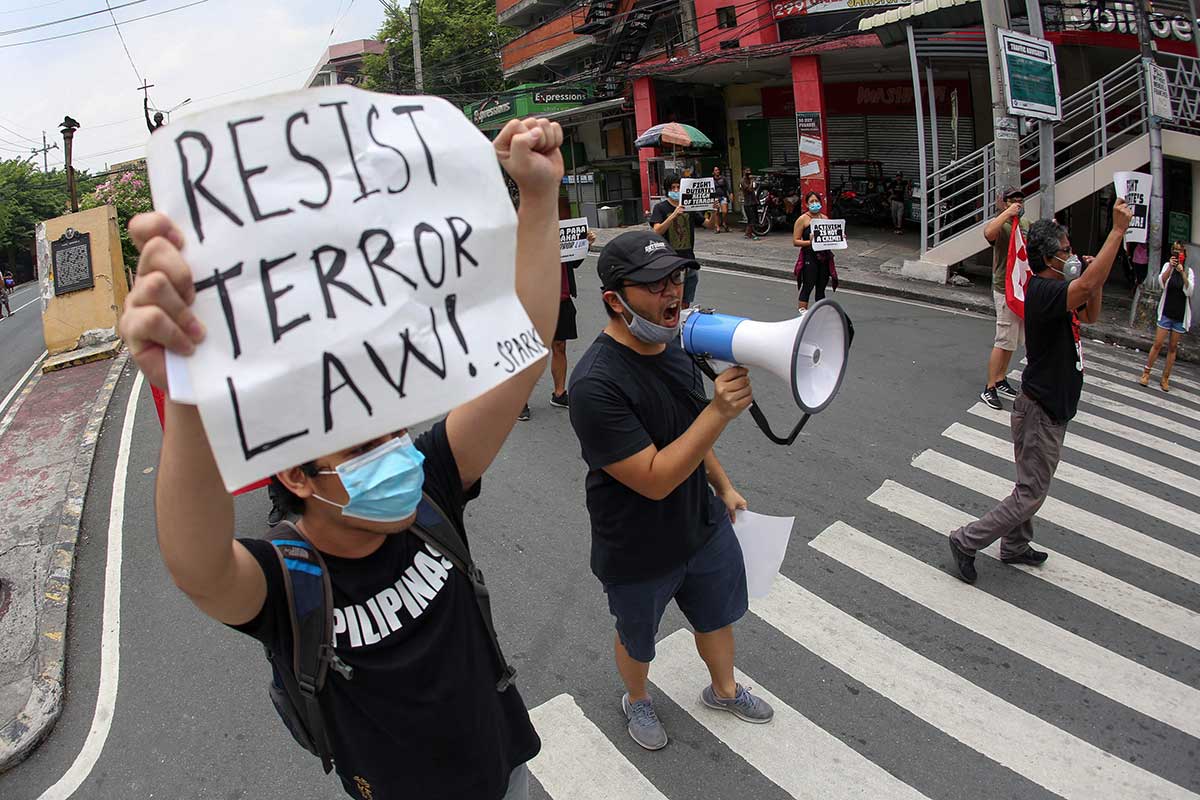
National Union of People’s Lawyers president Edre Olalia called Gapay’s remarks a “false start” and an “iron mask” for being “against basic constitutional and international law principles, let alone common sense.”
Olalia pointed out that what the military asked for was to conduct “fishing expeditions” that would be “actually on the lookout for legitimate dissent, criticism and alternative views and opinions that those in power do not like, approve or agree with.”
The National Union of Journalists of the Philippines – which led the filing of the 14th of the 22 petitions now pending before the Supreme Court against the ATA – said what Gapay really sought was “no less than the death of freedom of expression.”
It stressed that what is needed to combat terrorism is “more, not less, freedom” in order to refute extremist ideologies.
“Proposals like this are the perfect reason why the Supreme Court should declare unconstitutional what should more aptly be called the Terror Law,” NUJP said.
“We do not dispute the need to fight terrorism. But how, we ask, does stifling people's rights and liberties achieve that goal?” it added. “The only way to defeat an idea is with better ideas. To try forcing one out of existence amounts to terrorism and, more often than not, can only beget more terrorism. Besides, aren't we supposed to be a democracy, and is not one of the cornerstones of democracy the marketplace of ideas?”
Internet freedom advocate Marlon Anthony Tonson pointed out that Article 16, Section 10 of the Constitution requires the state to “provide the policy environment for the full development of Filipino capability and the emergence of communication structures suitable to the needs and aspirations of the nation and the balanced flow of information into, out of, and across the country, in accordance with a policy that respects the freedom of speech and of the press.”
Human rights watchdog group Karapatan said that if anyone’s use of social media should be policed, it should be that of law enforcement agents who “have been known for spreading malicious lies and violent, terroristic threats against the public without letup and with rampant impunity.”
Secretary General Cristina Palabay said “the government, its military and police do not have any moral authority to ‘regulate’ the use of social media under the guise of counterterrorism.”
“They have repeatedly weaponized social media to proliferate blatant and dangerous fabrications against activists and critics through red-tagging, or when local officials post violent ‘shoot-to-kill’ threats against the public — violent threats hewn directly from the president’s own violent and terroristic threats,” she said.
Palabay, who joined the 11th petition against the Anti-Terrorism Act together with Bagong Alyansang Makabayan secretary general Renato Reyes Jr., former social welfare secretary Judy Taguiwalo and around 40 others, said the AFP should sanction its own men first.