



Do Not Read The Provisions Literally: How The Solicitor General Defends The Anti-Terrorism Act
Despite the law providing for the detention of persons merely “suspected” of committing terrorist acts, the government denies that lawmakers intended to replace the constitutional requirement of “probable cause.”

Critics of the Anti-Terrorism Act (ATA) have argued that the measure will allow law enforcers to arrest people merely “suspected” of committing terrorist acts. The government’s response: do not take the words of the law, as written by lawmakers, by their literal meaning.
This was among the arguments raised before the Supreme Court (SC) by the Office of the Solicitor General (OSG) in defense of ATA or Republic Act No. 11479, which President Duterte signed into law on July 3.
The OSG’s defense follows the National Union of People’s Lawyers’ characterization of the ATA as a “bad law.” It came to the point that Sen. Panfilo Lacson was forced to write a letter to the Integrated Bar of the Philippines to explain that what legislators had in mind was not reflected in how the provisions were written.
Lawyers and human rights advocates have flagged vague and overbroad provisions whose loopholes are feared to be targeted at those who criticize the government or join protest actions. Opponents of the law have also questioned several provisions that exceed what is allowed under the Constitution.
Even if suspects can avoid conviction, they may suffer prolonged detention without charges, lose access to their assets or be placed under house arrest before being cleared of the allegations, seemingly going against the presumption of innocence.
The Catholic Bishops’ Conference of the Philippines, in its July 19 pastoral letter, pointed out: “We know full well that it is one thing to be actually involved in a crime and another thing to be merely suspected or accused of committing a crime.”
Justice Secretary Menardo Guevarra claimed that the law took effect on July 18, 15 days after it was signed by the President and immediately uploaded in the Official Gazette website.
However, the law was only published in the print version of the Official Gazette on July 6, which meant it should take effect on July 22. As pointed out by former SC Public Information Office chief Theodore Te, the “internet is not the medium for publishing laws, citing the SC’s 2008 decision on Garcillano versus House of Representatives.
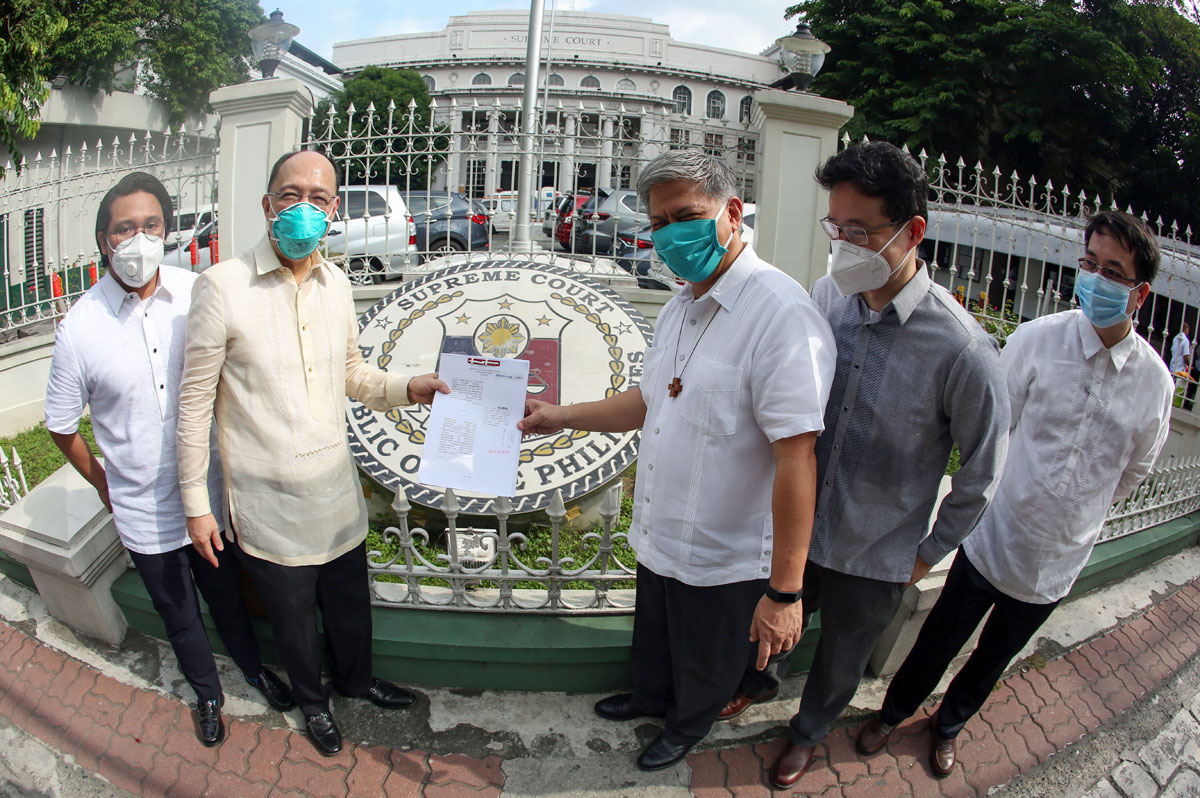
There were already 10 petitions filed before the SC as of this writing. The latest petition was electronically filed on July 19 by Bagong Alyansang Makabayan secretary-general Renato Reyes Jr., former Social Welfare Secretary Judy Taguiwalo and 42 others.
On July 17, the OSG filed a 233-page comment that asked the SC to dismiss the petitions for “utter lack of merit.” We list down all the issues and arguments below.
Facial challenge
Petitioners are seeking to mount a “facial challenge” against the law because of what they described as its “chilling effect” – the fear of prosecution that scares ordinary people from exercising their freedom of speech.
A “facial challenge” means there will be no need to wait for an actual case to be prosecuted before the constitutionality of a law can be questioned.
The OSG argues that a “facial challenge” is not allowed against penal statutes because they are meant to have an “in terrorem effect” – effectively threatening people not to commit unlawful actions.
It notes that the SC only allowed a “facial challenge” against the Cybercrime Prevention Act of 2012 because it involves “the novel and incomparable medium of cyberspace.”
Vague and overbroad provisions
Petitioners argue that the definition of terrorism under Section 4 and newly criminalized acts under Sections 5 to 12 (threat, planning, conspiracy, proposal, incitement, recruitment and membership, foreign terrorism, and providing material support) are vague and overbroad.
This means the terms used in the law are defined so poorly that men of common intelligence would have to guess the meaning and apply the law differently.
The government argues that the ATA cannot be challenged on the basis of having provisions that are “overbroad” and “void-for-vagueness,” because the law does not concern a freedom of speech issue.
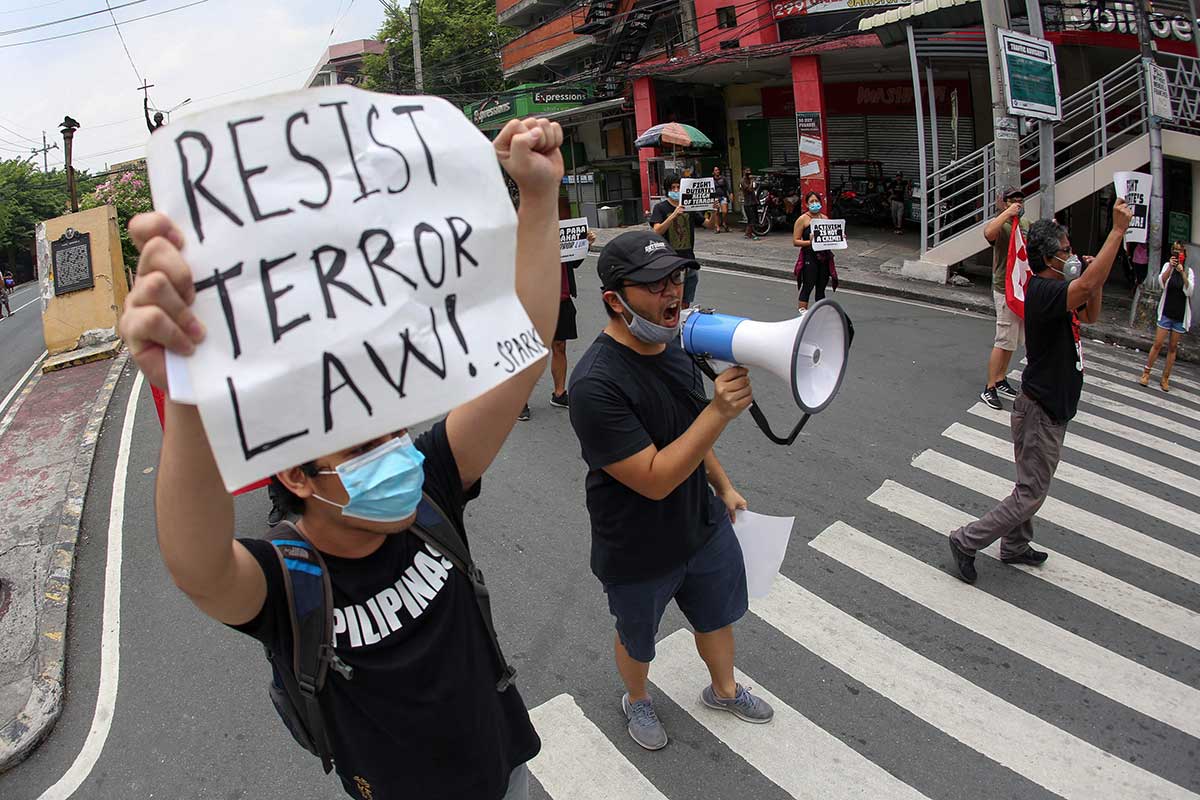
Section 4 specifically has drawn alarm. Proponents argue that the clause “shall not include advocacy, protest, dissent, stoppage of work, industrial or mass action, and other similar exercises of civil and political rights” should suffice as an assurance.
However, critics point to the caveat “not intended to cause death or serious physical harm to a person, to endanger a person’s life, or to create a serious risk to public safety” as a possible license for law enforcers to arrest protesters in case of accidents or even just being present outside during a pandemic.
The OSG describes this concern as “mere speculation, surmises, and conjecture, (which) must be rejected in order not to short-circuit the democratic process by preventing laws embodying the will of the people from being implemented in a manner consistent with the Constitution.”
It argues that the wording of Section 4 is “well-couched in international standards,” citing the United Nations Security Council Resolution No. 1566 in 2004 and the European Union’s 2002 Framework Decision on Combating Terrorism.
As for the new crimes punished under the ATA, the OSG argues that these all “refer to conduct and specific intent mentioned in Section 4.” It argues that threat, proposal and incitement to commit terrorism “deal with unprotected expression as they involve advocacy of imminent lawless action and danger to national security.”
The OSG also considers recruitment to or membership in a designated terrorist organization under Section 10 as conduct, and not speech that may be challenged under the “overbreadth” and “void-for-vagueness” doctrines. The OSG does not discuss its connection to the constitutional right to association.
Limitation on free speech
Petitioners argue that punishing the act of inciting to commit terrorism directly stifles free speech.
However, the OSG maintains that the ATA restricts “fighting words without regard to the message being communicated.” It argues that the law does not regulate speech, but acts that are “more likely to provoke conduct, than dialogue.”
The OSG says the ATA is “sufficiently important to justify the limitation on free speech,” because it seeks to protect individuals from terrorist attacks and to ensure respect for the right of life and right to security.
It also argues that the ATA’s provisions pass the “clear and present danger” test, because terrorism “poses an existential threat to the government and to the security of the people.”
Right to association
Petitioners argue that criminalizing recruitment and mere membership in organizations designated by the government to be “terrorist” violates freedom of association.
However, the OSG argues that the freedom to join organizations and associations is “not absolute,” as it can be permitted only when the purpose of the group is “not contrary to law.”
The OSG also relies on the stand of PBA party-list Rep. Jericho Jonas Nograles during House deliberations that the law will not be used in case mass actions and protests turn into riots, disorderly actions and looting if there is no proof that the acts are premeditated or coordinated.
Arrest on mere suspicion?
Petitioners argue that the creation of the Anti-Terrorism Council (ATC) usurps the authority of a judge to issue a warrant of arrest upon a finding of “probable cause.”
Instead, they say the ATA replaces the warrant requirement with a written authorization from the ATC allowing law enforcers to detain persons merely “suspected” of committing terrorist acts for a maximum of 24 days without filing charges.
This was based on the wording of Section 29 concerning “any law enforcement agent or military personnel, who, having been duly authorized in writing by the ATC has taken custody of a person suspected of committing” terrorist acts.
“Probable cause” is more than mere “suspicion.” It means the judge has reasonable grounds to believe, based on the affidavits of the complainant and witnesses, that a crime has probably been committed by a person.
The OSG says the petitioners reached the “conclusion based on a literal and truncated reading of the law.” Just because lawmakers chose to use the word “suspicion” instead of “probable cause” does not mean they intended to replace one with the other, the government lawyers say.
“Petitioners concluded that the law abrogated ‘probable cause’ as threshold and supplanted it with ‘suspicion’ just because Section 29 uses the latter instead of the former,” the OSG comment stated.
The government argued against the general rule of verba legis, or reading non-technical words of a law according to their ordinary meaning.
Expounding on the apparent lowering of the requirement for arrests, the OSG said: “It is an even paramount rule in statutory construction that every part of a statute must be read and interpreted with reference to its context.”
The OSG also argued that a person “suspected of” committing terrorist acts only refers to someone not yet “charged with” the crime before the court.
“The use of ‘suspected’ in Section 29 does not at all signify an abandonment of probable cause as threshold in warrantless arrest,” the comment read.
Mere suspicion is not among the exceptions allowed by the Rules of Court for warrantless arrests. Under Rule 113, Section 5, the only allowable instances are when the person is committing, has committed or is attempting to commit a crime in the presence of an officer, when the officer has personal knowledge that the person has just committed a crime, or when the person is an inmate who escaped from confinement.
The OSG also disagrees with the interpretation of petitioners that the ATC’s written authorization is akin to a warrant of arrest unconstitutionally issued by the executive branch of government.
It says that the authorization is only “a law enforcement tool that enables the arresting officer to detain a person who is arrested without a judicial warrant for a period of fourteen days without incurring any criminal liablity for arbitrary detention.”
24-day detention period
Section 29 allows the detention of a suspect for a maximum of 24 days without being charged before the court. Petitioners argue that this exceeds the three-day period provided by the Constitution even under the exceptional circumstances when the privilege of the writ of habeas corpus is suspended.
The OSG, however, argues that nothing in the Constitution specifically prohibits Congress from providing for longer detention periods without charges. “What the law does not prohibit, it allows,” government lawyers say.
They maintain that the prolonged detention is not arbitrary because it is “intended to address the need of law enforcement agencies for adequate time to obtain sufficient evidence that will hold against judicial scrutiny.”
Although Section 29 does not specifically mention that the prolonged detention period must be authorized by the court, the OSG again refers to records of Senate deliberations that were not reflected in the law.
The OSG disagrees with the argument of former government corporate counsel Rudolf Philip Jurado that the ATC’s written authority automatically waives the right against arbitrary detention without the suspect’s consent.
According to the OSG, the number of days for the detainee to sign such a waiver will be “simply extended.”
Designation of terrorist individuals and groups
Petitioners question the apparent lack of due process concerning the ATC’s designation of individuals or groups as terrorist.
They argue that individuals or groups could have their assets frozen and could be prosecuted for the crime of membership in a terrorist organization, with the ATC not required to hear their side or to let them disprove the allegations first.
To this, the OSG points out that “probable cause” for designation is “merely based on opinion and reasonable belief” and “does not require an inquiry into the sufficiency of evidence for conviction.”
The OSG also denies that the ATC’s designation powers violates the separation of powers. It says designation is an administrative function because it pertains to “regulation and control over the conduct of individuals.”
Since it sees designation as an administrative function reliant on the ATC’s technical expertise on matters related to terrorism, the OSG argues that it “does not entail an opportunity to be heard.”
The OSG says due notice and opportunity to be heard will be needed only in proscription proceedings, when the Department of Justice seeks a declaration from the Court of Appeals that an individual or group is terrorist.
Wiretapping and surveillance
Petitioners argue that the wiretapping and collection of private communication and data from suspected persons violates their right against unreasonable searches and seizures.
But the OSG argues that this remains based on the existence of probable cause as determined by a judge.
Even if the law uses the word “suspected,” the OSG says that this does not replace the standard of probable cause. It argues that the word simply refers to a “person who is not charged or under process issued by a court.”
The OSG also says “increased concern over terrorist activity” justifies a “lowered expectation of privacy” of communications.
It defends the deletion of the provision in the now-repealed Human Security Act of 2007, which required giving notice to the suspect being subjected to surveillance. It argues that the essence of wiretapping is to secretly overhear and listen to conversations.
The OSG likens surveillance to a search warrant proceeding whose validity may be questioned when the suspect is charged in court.
House arrest sans phones
Section 34 of the ATA allows the court to place a person under house arrest, even if the person is entitled to bail as a matter of right for lesser terrorism offenses or in the more serious cases where the evidence is weak.
Being placed under house arrest means an accused out on bail may not use telephones, computers, the internet or other means of communication until he is allowed by the court.
Petitioners argue that this would impair the right to bail and would be equivalent to an arbitrary, unreasonable and unjustified restriction on the right to communicate.
However, the OSG argues that solitary confinement is only outlawed by the Constitution when “done covertly.”
These provisions were in the repealed Human Security Act, and the OSG claimed that these were “not found by the Court to be unconstitutional.”
The SC dismissed petitions against the Human Security Act twice on procedural grounds and opted not to tackle the constitutionality issues.
Section 34 also provides for the forfeiture of bail when the suspect travels outside the municipality or city of residence without authorization by the court. The OSG says the right to travel is not absolute and may be impaired in the interest of national security.
Priest-penitent relationship
In their petition, the Makabayan party-list bloc raises a novel scenario: the law did not exempt the relationship between a priest and a penitent from secret surveillance. This supposedly violates the right to religion and belief.
The OSG notes that this issue was already declared “highly speculative and merely theorized” in the SC’s Sept. 24, 2013 resolution that dismissed a petition led by former human rights lawyer and now presidential spokesman Harry Roque against the Human Security Act.
Academic freedom
In their petition, Far Eastern University Institute of Law faculty members led by dean (and host of OnePH public affairs show Relasyon) Melencio Sta. Maria argued that the ATA may infringe on academic freedom.
They say their ability to teach students about revolutionary ideals like Jose Rizal’s El Filibusterismo, socialism, Marxism or liberation theology would be hampered.
The FEU Law faculty members also suggest that the inclusion of the Department of Education and the Commission on Higher Education as “support agencies” of the ATC would enable the council to dictate what academic institutions can and cannot teach.
The OSG, however, says academic freedom is “not unbridled” and is “a privilege that assumes a correlative duty to exercise it responsibly.”
“Academic freedom cannot be used as an excuse to create a superclass of citizens and exempt them from the State’s legitimate exercise of police power. To hold otherwise would be to subvert this freedom into degenerate license,” the OSG argues.
It also denies that the ATA would sanction interference by the ATC in the “academic institutions’ legitimate exercise of academic freedom.”


