



Zamboanga City, Central Visayas Also Under GCQ By June 1; Guidelines For Barbershops And Salons Under GCQ, MGCQ Released
Here’s the new list of areas under general community quarantine and the full text of the guidelines that must be followed before barbershops and salons are allowed to reopen under new quarantine classifications.

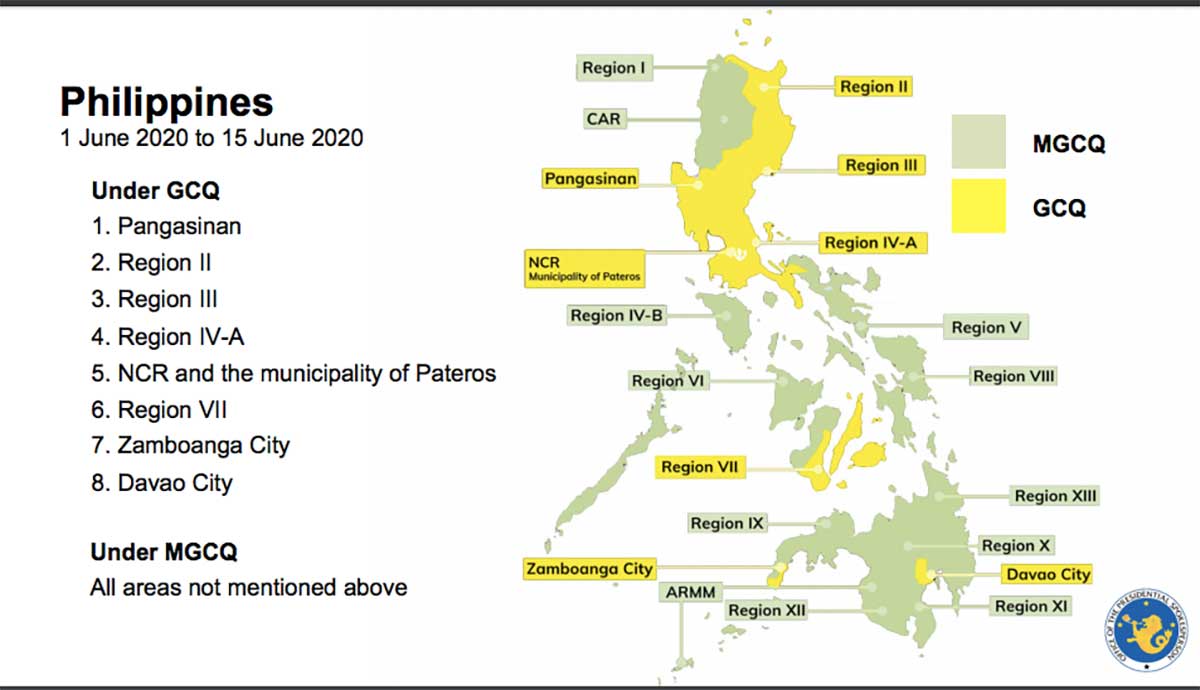
Malacañang announced on Saturday, May 30, that Zamboanga City and Central Visayas (Cebu, including the cities of Cebu and Mandaue, Bohol, Siquijor and the eastern part of Negros) will also be under general community quarantine from June 1 to June 15 as the country continues the fight against coronavirus disease 2019.
This is based on Resolution No. 41 of the Inter-Agency Task Force for the Management of Emerging Infectious Diseases released by presidential spokesman Harry Roque.
Read more: COVID-19 cases rising in Zamboanga City, Batangas and Davao City – UP report
On Thursday night, May 28, President Duterte placed the National Capital Region (NCR), Region 2 (Cagayan Valley), Region 3 (Central Luzon), Region 4-A (Calabarzon), Albay, Pangasinan and Davao City under GCQ beginning June 1 “until we have reviewed the general situation” amid the COVID-19 pandemic.
NCR or Metro Manila, Laguna (which is part of Region 4-A), Region 3 (Bataan, Bulacan, Nueva Ecija, Zambales, Pampanga, Angeles City except Aurora) have been under modified enhanced community quarantine or MECQ while Mandaue and Cebu cities remained under ECQ since May 15.
The rest of the country will shift to modified GCQ or MGCQ from June 1 to June 15.
Barbershops and salons
The government also released the guidelines for the reopening of barbershops and salons in the country.
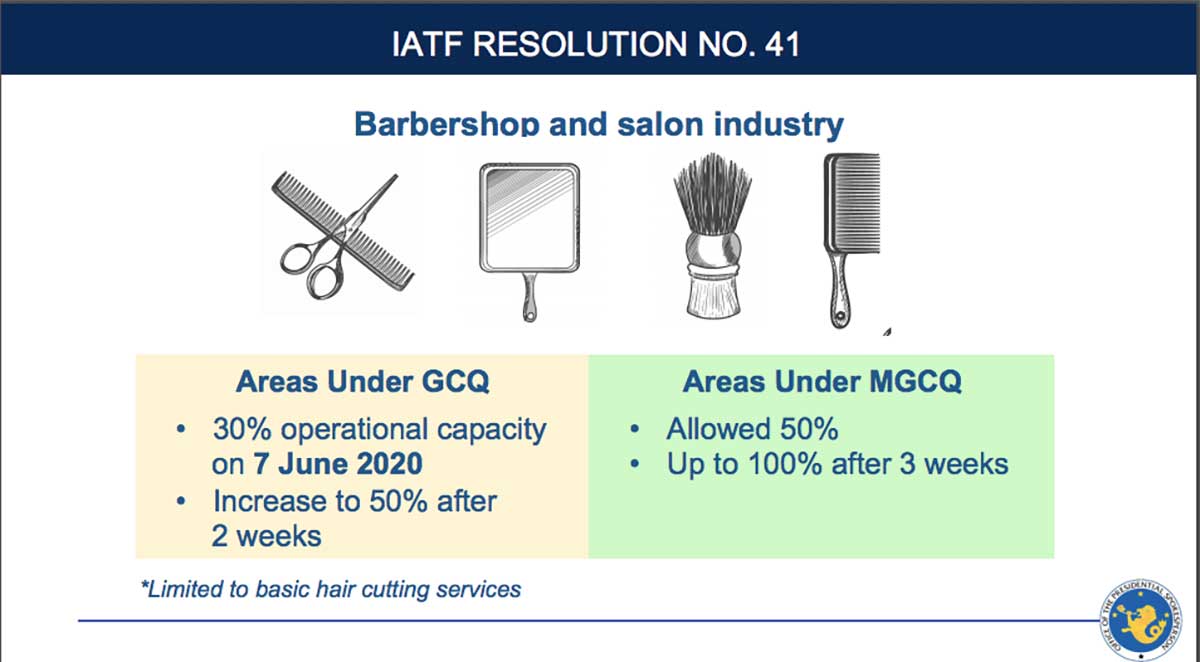
Under GCQ, barbershops and salons are allowed to operate at 30 percent capacity by June 7 and then increase to 50 percent after two weeks. Under MGCQ, they can open at 50 percent capacity and then 100 percent after three weeks.
However, Roque stressed that the services will be limited to simple haircutting. Pedicure and manicure as well as body massage, eyebrow waxing and other personal services are still not allowed under GCQ.
“The recommendations of the Department of Trade and Industry (DTI) to reclassify the barbershop and salon industry as Category (3) is hereby approved,” IATF Resolution No. 40 read. See the sectors under different categories here: LIST: Sectors allowed under ECQ, MECQ, GCQ
The DTI issued the guidelines to follow on minimum health protocols for barbershops and salons.
A. Posting of information at the entrance and other prominent or conspicuous areas about the following:
• Mandatory wearing of face masks at all times
• Social distancing protocols of the establishment
• Regular sanitation schedule and procedures (a 10-minute interval for sanitation in
between clients is required)
• Availability of alternative methods of payment, if applicable
• Availability of alternative methods of scheduling appointments (such as online, text messaging system)
• Client-personnel interaction protocols
• Policy against the bringing of companions, unless absolutely necessary
• Enforcement measures for clients who refuse to comply with the protocols in a
manner consistent with the law
B. Requiring the placing of the following at the entrance:
• Floor mat or foot bath with disinfectant
• Thermal scanner (for temperature reading)
• Alcohol that can be easily sprayed on the clients’ hands
• Health checklist to be distributed to all clients
• A system where the personal effects of clients, including bags, jackets, and gadgets, are disinfected and deposited in secured sanitary plastic bags
• Face shields to be distributed to clients if they availed shampoo services
C. Enforcement of the following protocols concerning equipment found in the workplace:
• Distancing of chairs to at least one meter apart on all sides
• Visible floor markings for guidance of clients
• Proper ventilation
• Personal effects of personnel should be placed in plastic bags stored in an area inaccessible to clients
• Face masks readily available for sale, or otherwise, to clients
• Sanitizing equipment and tools that are visible to clients
• Sterilization of workstation before and after each service
• Pieces of furniture that are made of porous materials must be covered in plastic for
ease of sanitation
• Strict use of disposable-only menus, reading materials and magazines.
D. Enforcement of the following protocols concerning employees in the workplace:
• No personnel with COVID-19 symptoms or with exposure to COVID-19 patients
shall be allowed to work
• No wearing of pieces of jewelry (such as rings, bracelets, watches, earrings, exposed body piercings)
• Observance of proper personal hygiene (such as clipped fingernails, observance of company-imposed personal sanitation)
• Mandatory wearing of personal protective equipment (PPE) including, but not limited to: face mask, face shield, eye glasses, gloves, hair caps
• Mandatory wearing of closed shoes
• Observance of the proper disposal of single-use supplies (such as cotton balls, popsicle sticks, tissue)
• Observance and enforcement of the client-personnel interaction protocols
• Mandatory declaration of health and whereabouts prior to every duty in case contact tracing becomes necessary.
• Frequent handwashing/sanitizing
E. Requiring the following procedures upon exit:
• No physical contact during payment
• Personnel are provided with small trays for accepting cash
• Ensure that clients who prefer to use an alternative mode of payment are able
to do so.
• Regular sanitation of high-contact areas and surfaces (such as pens used for filling out forms, door handles, common tables)
The DTI said barbershops and salons need to comply with the requirements before they will be allowed to operate again. This will be the new normal.
Religious gatherings
Justice Menardo Guevarra also announced on Saturday that religious gatherings will be allowed up to 50 percent of the capacity of the church or venue in MGCQ areas by June 1.
With regard to the areas under GCQ areas, Guevarra said the IATF will host a dialogue between the religious sector and representatives of the local government units on Monday, June 1. “The IATF will make a final resolution on the same day,” Guevarra said. – With Robertzon Ramirez


