


With Vaccine Pledges From China, Fears Of A Divided Asean Surface
Is Beijing’s charm offensive or vaccine diplomacy going to affect how the Association of Southeast Asian Nation deals with the dispute over the South China Sea?
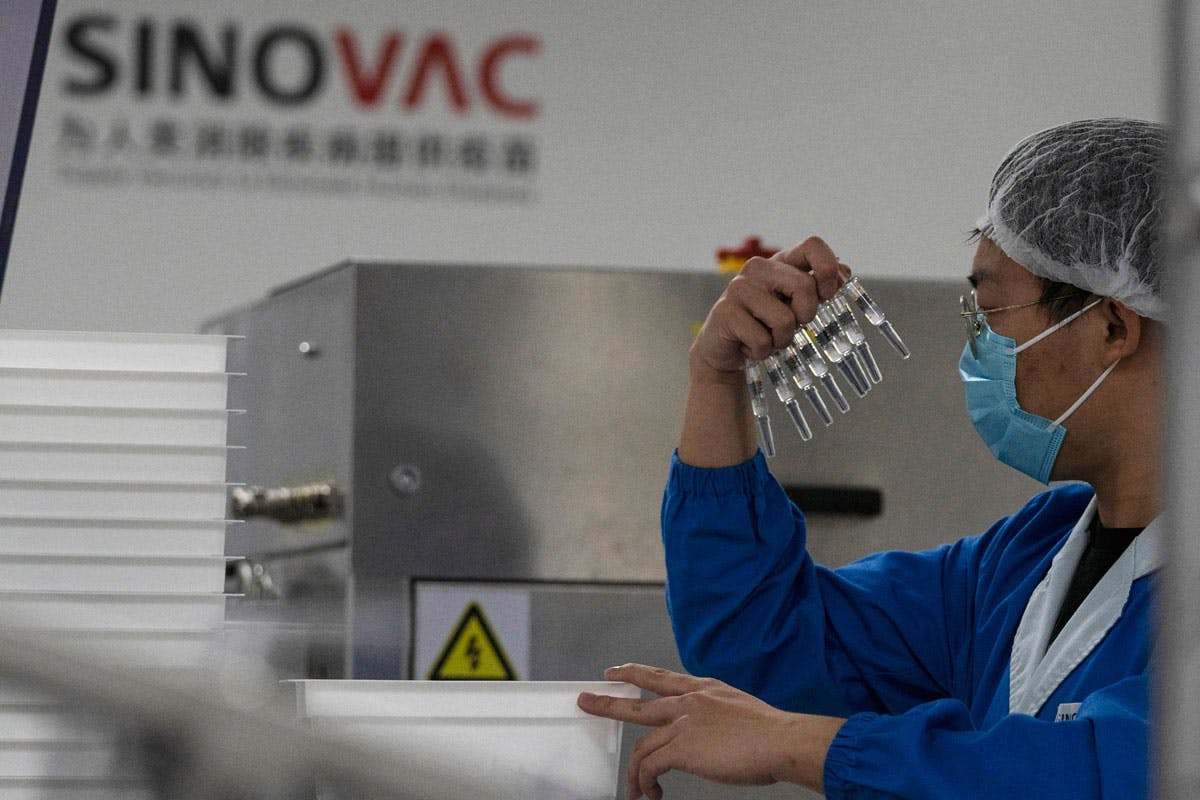
With the global race for a COVID-19 vaccine heating up, Beijing has assured Southeast Asian nations of a sure supply of Chinese-made shots.
However, regional security analysts warned that China could use “vaccine diplomacy” to secure concessions from members of the Association of Southeast Asian Nations or ASEAN on various issues, including the South China Sea dispute.
Brunei, Malaysia, the Philippines, Taiwan and Vietnam contest China's claim to almost all of the South China Sea.
In September, Philippine Ambassador to Beijing Jose Santiago Sta. Romana flew to Xiamen in southern China for a trade fair. This was his first flight since the Chinese authorities reported the coronavirus disease 2019 outbreak in Wuhan in December last year. But there are claims that the outbreak started as early as September.
The airport was swarming with people and Sta. Romana’s plane was packed. How the Chinese were able to hold a trade fair amid the COVID-19 pandemic can be half-owed to basic preventive practices, Sta. Romana said. The other half, the ambassador added, was the conduct of vaccinations on an “emergency basis.”
Since July, China has been using an experimental vaccine on medical port and airport workers as well as businessmen, students, migrant workers, government officials and diplomats who needed to head overseas. Chinese vaccine maker CanSino Biologics had also developed a special vaccine for the People’s Liberation Army, the armed forces of the Chinese Communist Party.
The 72-year-old ambassador refused to leave the embassy’s grounds up to around August.
Since then, he has gone to three trade fairs to represent the Philippine government.
“The Chinese have been able to control (the outbreak), partly with the use of basic best practices and partly with the use of their vaccine – you don’t hear anymore of COVID-related deaths here. Nobody is dying from COVID, not since March,” Sta. Romana claimed.
While this claim could be disputed – with Johns Hopkins University reporting that there were 32 new deaths in the past 30 days – the World Health Organization had earlier congratulated the Chinese and their health workers for bringing down the number to “a low level.”
China has reported 95,720 confirmed cases and 4,775 deaths as of Dec. 29, according to tracking by Johns Hopkins. On the same day, only 88 new cases were reported.
But international media reported earlier this month that China might have been underreporting its coronavirus tallies by more than half, noting that the Chinese Communist Party kept vital information under wraps while the rest of the world struggled to contain the pandemic.
China has fast-tracked its efforts and poured money and resources to develop vaccines and according to Beijing, this was because much was at stake. Experts said these moves could undercut the global backlash due to its supposed mishandling of the outbreak in Wuhan that led to the pandemic.
The emerging superpower’s vaccine diplomacy could also be a ticket to advance its political agenda, including “sensitive issues such as its claims in the South China Sea,” according to a study published this month by Singapore-based Yusof Ishak Institute.
Questions over the safety of Chinese-made vaccines have escalated, however, as several Asian news organizations, including Radio Free Asia’s Cantonese service, reported on Dec. 15 that “hundreds of Chinese workers” in Africa, including Uganda and Angola, who were “believed to have been vaccinated using Sinopharm Group’s vaccine” still tested positive for the virus.
Efficacy data that have been released could also erode the confidence in China-made vaccines as Sinovac’s trials in Brazil earlier yielded an efficacy rate of over 50 percent, as reported by Brazilian media.
Some Southeast Asian nations, however, are unfazed.
Indonesia, whose waters off the Natuna Islands have faced raids by Chinese fishing fleets backed by coast guard vessels, recently received 1.2 million doses of CoronaVac from Sinovac Biotech Ltd. and is expecting more from the Chinese pharmaceutical firm.
The Philippines was also in talks with officials of Sinovac for 25 million doses of its vaccine. Despite reporting on efficacy data, government officials still deemed the shots "acceptable."
In a recent vaccine logistics summit, COVID-19 policy chief implementer Carlito Galvez Jr. said the country’s Vaccine Experts Panel ranked Sinovac and Sinopharm as the top two candidates.
Largely all ASEAN members have been promised priority access to Chinese vaccines, especially Cambodia, whose prime minister – Hun Sen – is also a staunch supporter of China.
But are Chinese vaccines the best option for these countries with national and regional interests possibly at stake?
The Philippine embassy in Beijing, which has been kept in the loop of vaccine development and production of companies in China, believes the Chinese are in a position to provide enough vaccines to Asia sooner than most countries, owing to their massive manufacturing capabilities.
“When you have a situation where most of the vaccines developed in the United States have to focus in the US and then manufacturers in the United Kingdom and Europe have to focus on their continent, (you are invited to look for alternatives),” Sta. Romana said.
“In Asia, you have China who is willing to share it and that is why we consider it one of the options that is available to us if we want (the vaccine) soon,” he added.
‘No free lunch’
ASEAN, founded on principles of consensus and non-interference, has been criticized for its public discord on the Chinese expansionism in the South China Sea.
According to Gregory Poling, director of the Washington-based Asia Maritime Transparency Initiative, the body is composed of two camps – the claimant states (Brunei, Malaysia, the Philippines and Vietnam) and the landlocked states (Laos, Thailand, Myanmar and Cambodia).
“You have a second camp at the other end which is – Cambodia, Lao, Myanmar and, often, Thailand – that don’t share our anxieties, are much more willing to throw ASEAN overboard in the name of China… if that’s what it takes,” Poling said.
Indonesia doesn’t have claims over the South China Sea, but China’s nine-dash line overlaps with its exclusive economic zone near the Natuna Islands, which includes rich fishing grounds and natural gas fields.
The nine-dash line refers to the demarcation line used by the Chinese government to claim almost the entire South China Sea including the Spratly and Paracel islands. In 2016, the Permanent Court of Arbitration (PCA) in The Hague junked China’s claims based on a case filed by the Philippines.
The PCA’ s landmark award invalidated China’s “nine-dash-line” claim over the South China Sea and declared the Chinese-occupied Panganiban (Mischief) Reef, Ayusin (Second Thomas) Shoal and Recto (Reed) Bank to be “within the exclusive economic zone and continental shelf of the Philippines” based on the United Nations Convention on the Law of the Sea.
Singapore also has no claims but it has expressed its worries about maritime security, fishing and other security issues in the region.
Poling said that if the United States and other Western powers entered the fray and pledged enough doses to Southeast Asia, the region would be spared of Beijing’s political maneuvers.
But if they don’t, “not all, but a lot of Southeast Asian states are going to feel that they have no choice but to do whatever China says in exchange for the vaccine,” he added.
According to the Philippine embassy in China, these studies and expert opinions warning against a quid pro quo should certainly be looked at and kept in mind by Southeast Asian states.
But being vigilant should not mean Southeast Asian states should let go of opportunities to provide vaccines for their people, according to security analyst Chester Cabalza of the International Development and Security Cooperation.
“If the US offers, accept it. Same with Russia, China and other countries because you cannot choose. Our only choice is to save our people, which is our national interest, regardless of which country gives us the vaccine,” he said.
But the region should also be prepared for what comes after.
In the case of the Philippines, for example, Cabalza said Washington could seek the preservation of the Visiting Forces Agreement –a defense pact signed in 1998 that allows Philippine and US troops to hold joint exercises in Philippine soil.
Earlier this year, Duterte announced plans to terminate the VFA following the cancellation of the US visa of senator and former police chief Ronald dela Rosa, who strategized the controversial war on illegal drugs. The President suspended the termination of the VFA in June, citing "political and other developments in the region." He extended the suspension for another six months in November.
Harry Roque, a spokesman for President Duterte, earlier said the government’s suspension of the agreement’s termination did not equate to a “total lifting.”
The region should also be wary of Russia’s intent to join the exploration in the South China Sea, Cabalza noted.
“I think our only choice is to save our people which is our national interest, regardless of which country gives us the vaccine,” Cabalza said. “But in any giveaway – there’s no free lunch. There’s a reciprocal need for that and I’m sure these countries that will give us vaccines will ask for something.”
The South China Sea offers immense economic opportunities for nations like Brunei, Malaysia, the Philippines, and Vietnam due to major unexploited oil and gas deposits under its seabed. It is also home to some of the world’s important fishing grounds.
It also holds tremendous trade and military value as it serves as the main link between the Pacific and Indian oceans. The United Nations Conference on Trade and Development in 2016 estimated that about 80 percent of global trade by volume is transported by sea and about 60 percent of this number transits Asia.
The South China Sea, according to research by the Washington-based Center for Strategic and International Studies in 2016, carries about $3.37 trillion worth of trade yearly.
Code of conduct ‘won’t work’
ASEAN is currently working on a Code of Conduct (COC) on the South China Sea with China. While experts fear that Beijing will seek possible concessions from countries in the region in exchange for its homegrown vaccines, Sta. Romana said this would not happen as vaccine procurement and security concerns are dealt separately in diplomatic relations.
“If ever there’s an attempt to link (the two), we will of course push back,” he stressed.
The COC is a set of regional norms and rules in the disputed waters to prevent conflicts. In 2002, China agreed to sign with ASEAN an informal code of conduct, the Declaration of Conduct of Parties in the South China Sea (DOC), holding parties to a set of rules not to escalate tension and exercise self-restraint. It also prevents China and ASEAN claimant-states from further occupying features in the South China Sea.
The 1992 South China Sea Declaration and the 2002 DOC, however, failed to rein in China’s expansion in the South China Sea. Beijing began reclaiming land in seven features to build military bases on Fiery Cross, Subi and Panganiban Reefs in 2012, delaying discussions for a formal code of conduct until the man-made islands were completed.
In 2017, China finally agreed to a framework agreement to conclude a formal code with an impatient President Duterte, who urged Chinese President Xi Jinping during a bilateral meeting to conclude the code as soon as possible.
According to Sta. Romana, the pandemic has left parties stuck on the second reading of common points of agreement and the determination of areas where there was no agreement.
“The plan now, however, is to start meeting again and to meet every two months on the working group level. But I think the attitude is to see what we can accomplish as fast as possible but to be ready to continue discussing and use whatever time is necessary to be able to accomplish it,” he said.
The first reading was supposed to weed out duplicates of aggregated ideas and suggestions of each country. The third and final stage will be a process of dealing with all controversial items where no agreements were reached.
After this, a final version will be subjected to scrutiny and debates. With fissures within ASEAN and vaccine access that might derail regional interests, this undertaking might take longer than expected or, according to Poling, would result in a code that “won’t work.”
Sta. Romana said the goal of finishing the whole COC would not be possible next year, contrary to the claim of National Security Adviser Hermogenes Esperon Jr. in November.
But Poling said the COC “is not going to work and “if any regional effort is going to be effective in helping to manage the South China Sea, part of the formula has to be getting outside parties involved again… and (another) part is going to be having a diplomatic process outside of ASEAN.”
China is averse to the inclusion of other superpowers who are not part of the maritime and territorial disputes in the process, including the US, and prefers bilateral negotiations with claimant states.
The code won’t work this way, Poling said, as the camp of non-claimant nations, save for Indonesia, refuse to make choices that could irritate Beijing but could be beneficial to the region’s stake in the disputed waters.
The ASEAN, at this point, should endorse general principles that allow claimants to negotiate among themselves.
“So that the Philippines, and Vietnam, and maybe Malaysia and Indonesia can sit down and come up with their own regime to manage fisheries and to manage oil and gas without having to ask Cambodia for permission,” Poling explained.
For decades, the ASEAN has governed itself in the principle of consensus. The 10-nation bloc would only take positions when all members agree. Currently, one member can stop the rest from taking a stand if its opinion differs.
Cambodia is China’s closest ASEAN ally. It has been backing China over the dispute in meetings of the multilateral body, which has prevented consensus over unified regional action and has thrown the group into disarray.
Laos could be close second as it also relies heavily on Chinese investments and development assistance.
To a certain degree, Poling stated, Myanmar cares “a lot more about what China thinks than it does about its neighbors” in the region. In the middle are Singapore and Thailand, who are worried about issues but are not willing to threaten their economic relationship with China.
Brunei, dubbed in previous years as a “quiet” claimant, only broke its silence on the disputed waters this year when it released a statement urging parties to negotiate under the auspices of rules-based order.
“It’s really Vietnam and the Philippines that share the same anxieties about China. They’re willing to push back at times,” Poling said.
Malaysia, in a letter to the United Nations earlier this year, said China’s maritime claims in the busy waterway have no legal basis, a move seen as a signal of the country’s hardened stance on the matter. Indonesia has also pushed back against Chinese aggression in their waters in several instances.
Beijing has repeatedly assured nations, like the Philippines, that it would not exploit natural resources in exchange for loans, despite accusations that its financial hold on several countries in the region has kept the ASEAN disunited when it comes to the dispute.
The same could be said with vaccines, according to the Philippine embassy.
The 10-nation bloc said during its summit in 2017, when the body’s 50th anniversary was also commemorated, that it was planning to revise the ASEAN Charter that mandates all decisions to be made unanimously.
But the effort seemed to have taken a back seat as the region remains insistent on principles of non-interference and consensus-building.
The ASEAN is the world’s fifth largest economy in 2018 with a gross domestic product of around $3 trillion, based on its 2019 integration report. This makes it a very attractive trading partner to Beijing and – equally – a force to reckon with, Cabalza said.
But divided, it’s not important enough to the Chinese.
“No single member of ASEAN has the geopolitical weight to impose the kind of cost on China that’s necessary… So, the only way that the grouping has clout is all together or in collaboration with outside parties,” Poling pointed out. “(But) states in Southeast Asia tend to look to outside parties more than they look to their neighbors.”
About the author
Neil Jayson Servallos is a master’s in journalism student at the University of Santo Tomas.