



West Philippine Sea Fisherfolk Monument Unveiled In Quezon City
Akbayan said the monument symbolizes the “resilience, dignity, patriotism, and unwavering resolve of ordinary Filipinos who have become the country’s frontliners in protecting its sovereignty and territorial integrity.”

The Quezon City government and the Atin Ito coalition unveiled on Sunday, July 12, the country’s first public monument dedicated to Filipino fisherfolk who continue to defend the nation’s rights in the West Philippine Sea.
Called the West Philippine Sea Fisherfolk Monument, the sculpture by artist Gary Santiago Rojas depicts a Filipino fisher standing on a fishing boat while proudly raising a paddle.
Akbayan said the monument symbolizes the “resilience, dignity, patriotism, and unwavering resolve of ordinary Filipinos who have become the country’s frontliners in protecting its sovereignty and territorial integrity.”
Quezon City Mayor Joy Belmonte led Sunday’s unveiling ceremony, together with Akbayan party-list Reps. Chel Diokno and Dadah Kiram Ismula, former presidential adviser on political affairs Ronald Llamas, Atin Ito co-convenor Edicio dela Torre and fisherfolk leaders from Zambales and Bataan.
“Today, we join the entire nation in commemorating the 10th anniversary of our historic arbitral victory. We thank the Quezon City government, especially Mayor Joy Belmonte, for helping us make this meaningful initiative possible,” Dela Torre said.
Ismula, for her part, said: “This monument affirms what we already know in our struggle for sovereignty: remembering is our greatest weapon against deception and historical distortion. This is great because everyday, people who come here will be able to see the bravery and sacrifice of our fisherfolk in the WPS.”
Chief architect
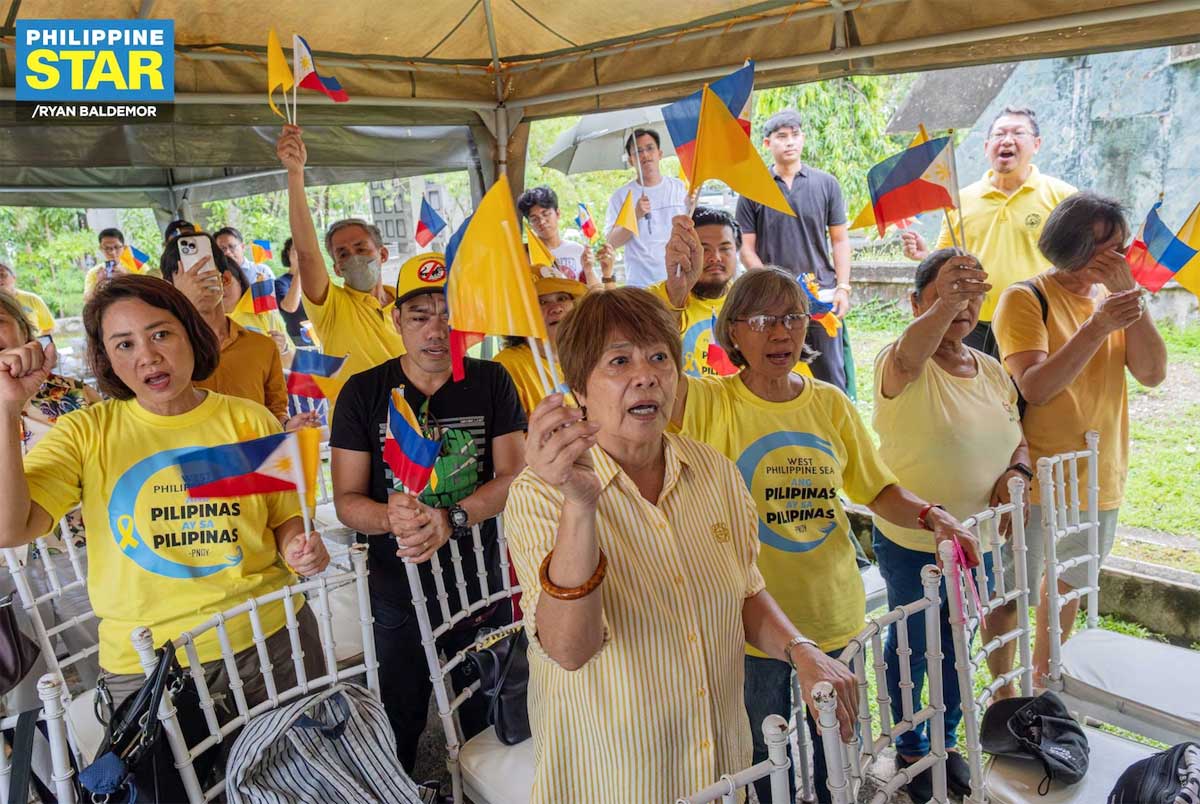
Supporters, allies, and representatives of fisherfolk communities gathered Sunday at the tomb of former president Benigno Aquino III to commemorate the 10th anniversary of the Philippines’ landmark arbitral victory in the West Philippine Sea.
Aquino was the chief architect of the arbitration case the Philippines filed against China in 2013, which led to the historic July 12, 2016 ruling by the Permanent Court of Arbitration invalidating China’s so-called nine-dash line claim and affirming the Philippines' sovereign rights within its 200-nautical-mile exclusive economic zone.
The commemoration began with a Mass officiated by Fr. Joseph Patrick Echiverria, who previously served in the Diocese of Palawan and lived among fishing communities that experienced firsthand the effects of China's encroachment into Philippine waters. A brief tribute program followed.
The tribute was organized by the Ninoy and Cory Aquino Foundation (NCAF) and the Liberal Party of the Philippines.
Liberal Party president and former Quezon 4 th district representative Lorenzo “Erin” Tañada III urged Congress to recognize July 12 as a national day of reflection to preserve the significance of the arbitral victory for future generations.
“Ang panawagan natin sa mga kongresista at senador, importante na pinag-iisipan natin na hindi tayo gumamit ng dahas. We asserted our rights and we won it, just like we did in 1986 when we won EDSA. We will continue to remember this and continue to tell our story to our children and the next generation," Tañada said.
Representing the fishing communities, Restituto “Ka Resty” del Rosario, chairman of the Bagong Pangarap Fishermen Association and the fisherfolk representative to the National Anti-Poverty Commission, thanked President Aquino for defending the country's maritime rights.
“Sayang hindi namin personal na nasabi nung buhay si Pangulong P-Noy – maraming, maraming salamat kay Pangulong P-Noy. Maraming salamat sa mga Pilipinong tumatayo na ang West Philippine Sea ay sa atin,” Del Rosario said.
Del Rosario recalled the 2019 Lakad Panawagan, when fishermen from Bataan and Zambales walked 135 kilometers over five days – from Olongapo City to the town of Santa Cruz, Zambales – to assert their right to fish freely in the West Philippine Sea.
He said he and his fellow fishermen are encouraged that more Filipinos are now standing up for the country's rights in the West Philippine Sea, including local governments that have begun officially observing July 12 each year as a Day of Victory.
NCAF executive director Francis “Kiko” Aquino Dee paid tribute to his “Tito Noy” by recalling how the late president dealt with the challenges in the West Philippine Sea and the country’s ultimate victory always with grace.
For one, following the arbitral ruling, the Aquino described the decision not merely as a victory for the Philippines but for the international community, Dee said.
“It showed that we lived under a rules-based order. It showed that we can settle our differences peacefully. It showed that we can talk to each other and in resolving disputes, we don't have to resort to violence,” Dee said.
Dee added that while the country's campaign to defend the West Philippine Sea has become “very aggressive and loud” over the past decade – “this might be what is necessary now” – the former president’s example remains relevant today.
“As we recommit ourselves to firmly standing up for our rights... we also ask ourselves how do we contribute to bringing back a world where reason, courtesy, and honor were strengths and the tools we used to assert our rights,” Dee said.
Dee and ATOM president Volt Bohol offered a yellow wreath at the former president’s tomb as participants sang Bayan Ko while waving Philippine and yellow flags.
Facing a military imbalance against a far more powerful China, Aquino chose a rules-based and peaceful approach grounded in international law rather than military confrontation. A decade after the landmark ruling, his leadership continues to remind Filipinos that even smaller nations can defend their rights through principle, diplomacy, and adherence to the rule of law.
An excerpt from the former president’s statement following the arbitral victory, released by his private office on July 13, 2016 read: “Let me emphasize: All countries that have made a comment on this issue, to our knowledge, have expressed adherence to international law. Indeed: International law has been made clearer with this monumental decision. This of course deals with the Philippines and China, clarifying each state’s rights and obligations; but as our lead counsel said, it also has very strong implications as far as other coastal states are concerned, with regard to UNCLOS” or the United Nations Convention on the Law of the Sea.
“At this point, may I suggest that instead of viewing this decision as a victory of one party over another, the best way to look at this judgment is that it is a victory for all. I say this because the clarity rendered now establishes better conditions that enable countries to engage each other, bearing in mind their duties and rights within a context that espouses equality and amity,” the former president added. “Might I say: The decision to pursue arbitration was not an easy one to make. Going into arbitration was called a game-changer. We foresaw and experienced the pressures in taking this route; yet until the end, we stood our ground.”
Aquino passed away on June 24, 2021.
Vigilance needed
For House senior deputy minority leader and ML party-list Rep. Leila de Lima, Filipinos should be vigilant in asserting and defending the country’s claims in the West Philippine Sea.
“We stood before the Arbitral Tribunal to assert the sovereign rights of the Philippines and protect what rightfully belongs to our people. But one thing is clear: that commitment should not end with the ruling,” she said.
Pinoy Workers party-list Rep. Karl Fernandez Legazpi said the ruling remains “as relevant as ever,” and must be upheld for the welfare of the fisherfolk who make a living in perilous waters. – With Delon Porcalla


