



UST Nursing Student Who Convinces Street Children To Go Back To School Is 2022 Kofi Annan Changemaker
From storytelling sessions to fundraising activities to create educational materials, Qjiel Giuliano Mikhl Mariano and “Streets to Schools” volunteers get to motivate street children to pursue their studies again.
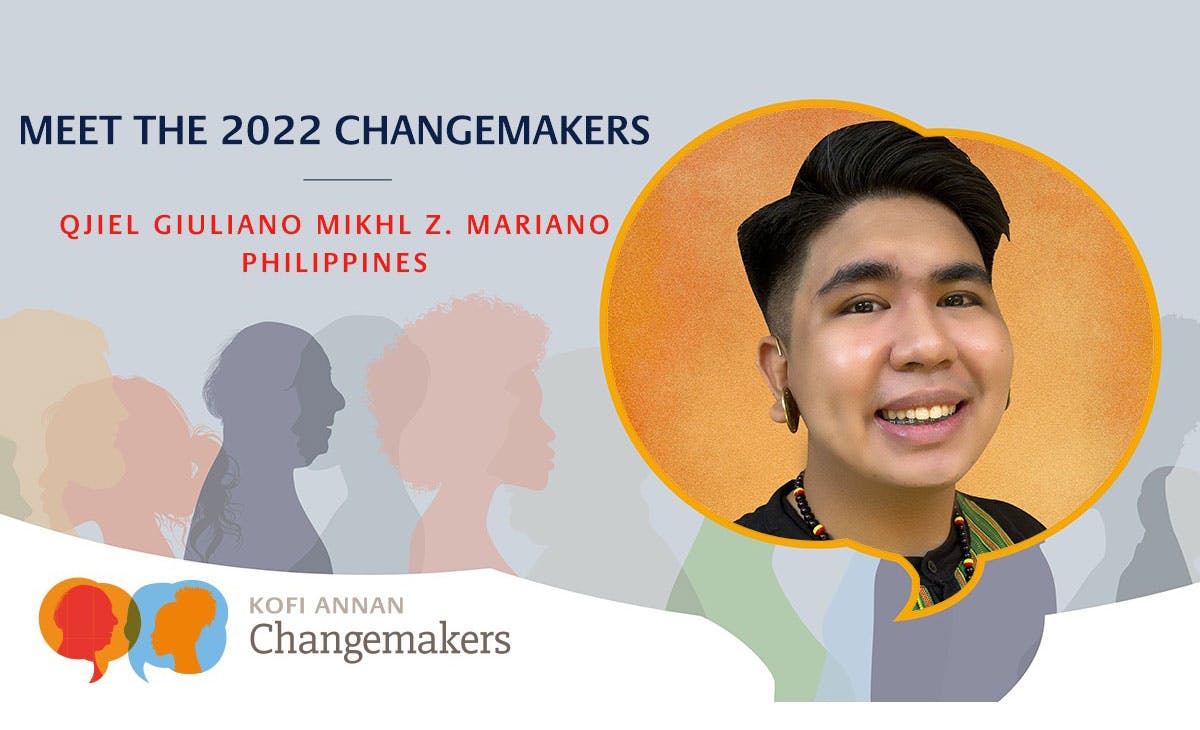
While his schoolmates got easily demotivated to help street children because of a negative anecdote, an aspiring nurse thought otherwise and tried to rebuild a culture of compassion through education.
This is the story of Qjiel Giuliano Mikhl Mariano, a 21-year-old incoming University of Santo Tomas senior nursing student, who was recently selected as one of the recipients of the 2022 Kofi Annan Changemaker grant for his "Streets to Schools" (STS) advocacy.
According to Mariano, their STS project was conceptualized in 2016 when he was 15 and still in junior high school. He heard the news about a fellow student who was threatened by a child beggar with a pair of scissors along Dapitan Street in Manila for food.
He said the story quickly spread around UST, sparking fear among many students, which later on stopped them from helping other children in need. This collective attitude did not sit well with Mariano and two of his friends, so they decided to shake things up.
“No one wanted to help street children, but what if we could?" Mariano told OneNews.PH in a recent interview, explaining the origin of his youth-led non-government organization (NGO) that caught the attention of an international foundation.
Turning a moment into a movement
For Mariano and his co-founders – Alianza Salvador and Anthea Terrenal – their mission then was only to help keep some misguided children “out of the streets” and “into the schools.” This is similar to what other NGOs have already been doing, so it’s just a matter of contributing to a worthy social cause.
Becoming part of the Young Bridging Leaders program, an initiative aimed at training and encouraging students aged 12 to 15 to be at the forefront of Sustainable Development Goal (SDG)-oriented projects in their own communities, enabled Mariano to set their idea into motion.
The SDGs are a set of 17 interlinked global goals designed and established by the United Nations (UN) seven years ago as “a blueprint to achieve a better and more sustainable future for all people and the world by 2030.”
Mariano and his fellow high school students aligned their group’s mission to SDG No. 4 that focuses on providing children access to quality education and other learning opportunities, especially among those in the underprivileged sector, as well as the UN Convention on the Rights of the Child.
“We turned it (our group) into an organization because of its potential [and] because we knew it could be more than just a project,” Mariano said in a mix of English and Filipino. He now sits as executive director of STS, which was officially launched in 2017.
The non-profit NGO began with a series of storytelling sessions and fundraising activities to create educational storybooks for the out-of-school children to read, hoping these could motivate them to learn more beyond the basics and seek formal education in the long run.
Volunteers would usually visit a barangay or community, like the inhabitants of the Manila North Cemetery, to teach and conduct reading sessions for the kids. Their goal was to prevent street children from going down the wrong path and resorting to violent means just to get what they need.
Soon their small organization expanded across 17 other regions in the country, which allowed Mariano and his colleagues to help more children in need. STS currently has around 200 volunteers nationwide composed of students and youth leaders between 13 and 19 years old.
When the COVID-19 pandemic hit and online classes became the new normal for schools, STS partnered with other private organizations and government institutions, like the Office of the Vice President, to open a donation drive and raise funds for electronic devices that poor children can use.
Some of their beneficiaries in Manila, Quezon City, Rizal, Zamboanga Sibugay, Iloilo, Camarines Norte and Baguio City received tablets, laptops and pocket WiFis. Mariano revealed that he plans to make more regular projects like this for STS through its regional chapters.
Based on their own estimates, he said their organization has been supporting more or less 10,000 out-of-school children directly and about 50,000 virtually. The young student leader added that at least 100 of the kids they helped got themselves reoriented to the formal education system.
Mariano is aware there is still a long way to go for the STS to even make a dent on the millions of children who were forced to drop out of schools, especially during the height of the pandemic.
When he pitched an idea to help some impoverished children living around Manila North Cemetery to one of his senior high school teachers previously, he said he was rejected. But he did not let his own frustrations get in the way.
“Your community is poor, but not poor enough. We will not help you,” Mariano recalled being told. He has since relied on other like-minded people and organizations for support, including fellow students, who helped him establish STS chapters even outside the country.
“No matter what community is out there, we could help them in our own way. Maybe not all at the same time, maybe little by little, but at least we would no longer hear that some people are not deserving of our help because that really broke me that day,” Mariano said.
Aside from its 17 regional chapters nationwide, STS managed to build its presence in the United States and Canada earlier this year through the efforts of young Filipino immigrants who moved into these countries.
By September this year, Mariano said they will be launching their Southeast Asian chapters, involving countries such as Singapore, Thailand, Malaysia and Indonesia. This wider collaboration was made possible through various student exchange programs they participated in.
“Since STS is very oriented towards the Sustainable Development Goals, we had so many international engagements with the youth (sectors) in those ASEAN (Association of Southeast Asian Nation) countries,” according to Mariano.
“They heard about our projects through the exchange programs that we do… The youth leaders there want to start their own versions of STS. It’s still in the process… We’re establishing it little by little, so we’re looking for volunteers... We’re identifying communities and assessing their needs,” he added.
Becoming a Kofi Annan Changemaker
Taking these developments into account, it almost came as no surprise that Mariano would soon find himself getting recognized by several organizations both here and abroad for making positive contributions to several local communities through his STS project.
He was recently named as one of the 12 Kofi Annan Changemakers for 2022 by the Kofi Annan Foundation, an independent not-for-profit organization that was established in 2007, which aims "to help build peaceful, democratic and resilient societies.”
The global NGO based in Geneva, Switzerland was named after the late former UN Secretary General and Nobel Peace Prize laureate Kofi Annan. It works “to promote better global governance and strengthen the capacities of people and countries to achieve a fairer, more peaceful world.”
Mariano is the lone participant from the Philippines in the Kofi Annan Changemakers journey this year. He is, however, the third Filipino to achieve such a feat after Lourence Balatbat and Junbert Pabon, who were both part of the inaugural youth leadership building program last year.
“Qjiel (he/him) is the founder of ‘Streets to School.’ The NGO has the goal of reducing poverty among children and young people on the streets, whilst coordinating efforts to bring them back to school. He hopes to continue to expand the impact of his initiative,” the foundation said of Mariano’s selection.
The Kofi Annan Changemakers is a monthslong youth leadership program conducted through online and face-to-face engagements with global leaders and experts. The 2022 virtual training will be held from June 27 to July 1 and the in-person meetings are scheduled from Nov.
21 to 25 in Geneva.
Each participant shall receive high-level training to develop their leadership, resilience, negotiation skills, forging consensus between organization stakeholders, as well as fine-tuning their community service projects, among other sets of competencies.
The Kofi Annan Foundation will also award a grant worth 3,000 Swiss Francs (approximately P168,840.41) to help fund the youth leaders’ advocacies. For Mariano, he plans to spend it on the “Ladders to Literacy” initiative of the STS.
In 2021, the same literacy program won the Education for Sustainable Development Okayama Award and earned Mariano the Youth Service America’s Everyday Young Heroes recognition for successfully leading it.
“Ladders to Literacy” teaches children to read, write and publish a book about the most pressing issues in their local communities, and how advocating for the fulfilment of the 17 SDGs could help solve these problems.
When asked why he continued pushing for the education of children despite dreaming to join the ranks of healthcare workers someday, Mariano said: “Even though we’re in the healthcare (industry) or other fields, all of [us] can contribute to the bigger picture and the (accomplishment of) SDGs.”
“Because unless we work together in our different fields, we don’t get to attack the problem in all aspects,” added the nursing student and STS founder, who has been a Youth Council Member of the Joint SDG Fund since May 2021.
Apart from having quality education, the UN-backed SDGs aim to create a world with no poverty and food insecurity: promote good health, well-being and gender equality among people; ensure clean water, energy and sanitation facilities for all; and reduce economic inequality, among other goals.
Mariano will join other youth leaders in the 2022 Kofi Annan Changemakers program namely Fahd Jamaleddine (27, Lebanon), Mahryan Sampaio (22, Brazil), Juwon Samuel Afolayan (27, Nigeria/United Kingdom), Luisa Fernanda Romero Munoz (28, Colombia), Manata Sadykova Aleksandrovna (25, Kyrgyzstan), Marius Affonfere (29, Benin), Shradha Pandey (22, India), Saif Ullah Khan (26, India), Samar Khalid Abushama (21, Sudan), Mohammad Shehadat (27, Syria/Jordan) and Stacy Owino (22, Kenya).


