



Unlimited Warrantless Arrests: Carpio, Morales, UP Law Ask SC To Nullify Anti-Terrorism Act
“In its fight against terrorism, the government must not be the source of terror and impunity itself,” former ombudsman Conchita Carpio-Morales says as legal luminaries assail the law for being vague, overbroad and unconstitutional.

Retired Supreme Court associate justices Antonio Carpio and Conchita Carpio-Morales led a powerhouse of legal luminaries from the University of the Philippines College of Law in asking the SC to declare the entire Anti-Terrorism Act (ATA) null and void for being “unconstitutional as written.”
The 86-page petition sought the issuance of an order to stop the implementation of the law, as well as the conduct of oral arguments.
The Carpio cousins submitted their petitions electronically on Wednesday, July 22 as the SC was closed for disinfection. The law took effect that day, after the end of the 15-day period counted from the law’s publication in the print version of the Official Gazette on July 6 – although the Department of Justice claimed that it was already effective on July 18, counting from the uploading of the law online.
Petitioners include UP Law associate dean and UP Institute for Maritime Affairs and Law of the Sea director Jay Batongbacal, UP Institute for the Administration of Justice director Dante Gatmaytan, former SC Public Information Office chief Theodore Te, and senior professorial lecturers Victoria Loanzon and Anthony Charlemagne Yu.
Joining them are former Magdalo party-list representative and current UP Law student Francisco Ashley Acedillo and incumbent UP Diliman University Student Council councilor Tierone James Santos.
The petitioners are represented by UP Law political law cluster chairman John Molo and fellow professors Luisito Liban and Gwen Grecia-de Vera (a former Philippine Competition Commission executive director and Manuel L. Quezon School of Law dean).
All the abovementioned lawyers teach constitutional law and have appeared before the SC in high-profile cases. They are joined by Darwin Angeles, who is listed as a Next Generation Lawyer for Dispute Resolution by the Legal 500 Asia-Pacific.
Named as respondents are the Anti-Terrorism Council, Executive Secretary Salvador Medialdea and the eight other administration officials who will sit as ATC members, the House of Representatives and the Senate.
Antonio Carpio had announced his plan to challenge the constitutionality of the ATA last June, before President Duterte signed it into law on July 3. Carpio argued that the law is a “very defective” measure with “many unconstitutional provisions” and will place the Philippines “permanently under a situation worse than martial law.”
Read more: Retired SC Justice Carpio Ready To Challenge New Anti-Terror Act, Calls It Worse Than Martial Law
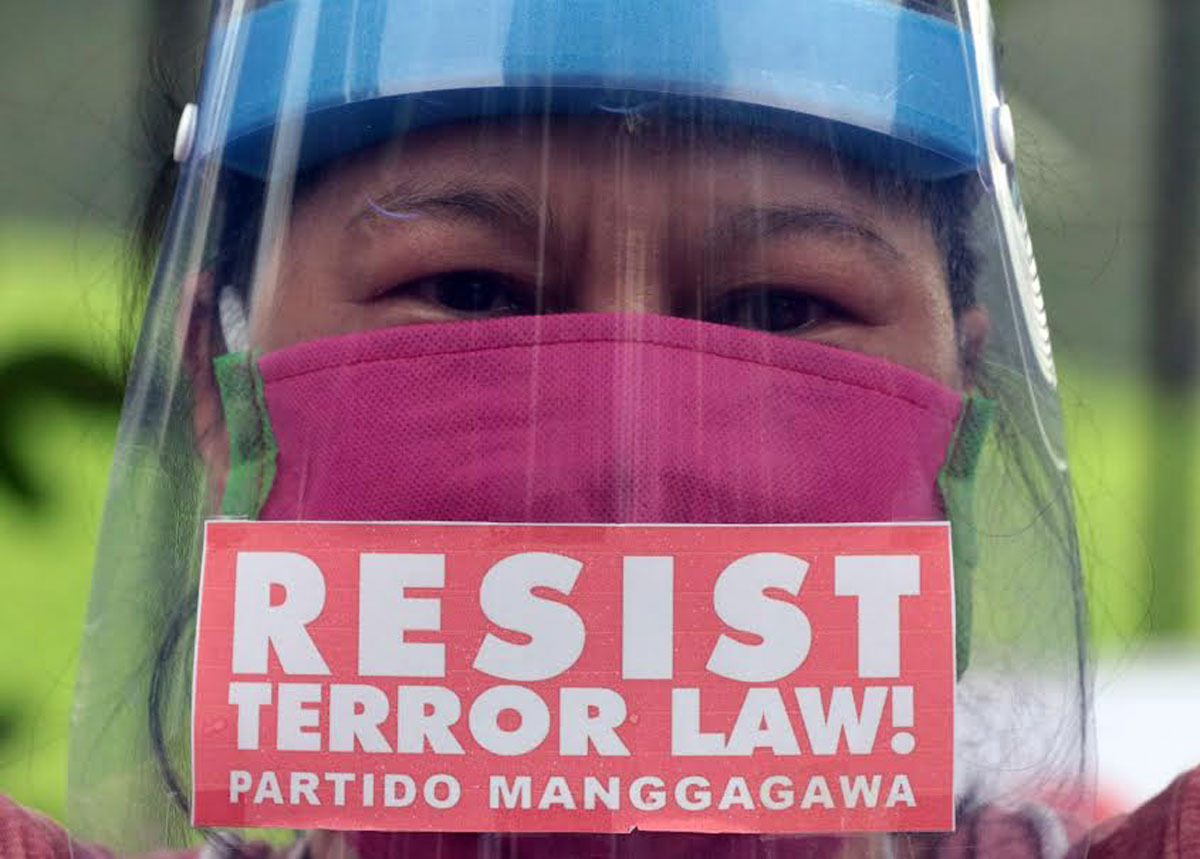
‘Certainty of misinterpretation and abuse’
Even if no one has been prosecuted yet under the newly enacted law, the petitioners argued that it is “mired by vagueness and overbreadth that repress protected speech, justifying its facial invalidation.”
The petition also questioned the creation of the ATC and the conferment of powers “greater than what the Constitution gives to the President” even in exceptional circumstances in times of invasion and rebellion.
These include the power to issue a written authorization for the arrest of persons merely “suspected” of committing terrorist acts – contrary to the Constitution’s requirement that a warrant be issued by a judge upon a finding of probable cause – and keep them detained for as long as 24 days without judicial charges.
By attacking the creation of the ATC, the petition seeks to invalidate the entire law. “Since its creation violates the Constitution in more ways than one, the Anti-Terror Council cannot be saved. With its demise goes the entire Anti-Terror Act itself, the Anti-Terror Council being its lynchpin,” it says.
The petition says that “most of the essential provisions animating the ATA are impaired by unconstitutionality.” If all of them were struck down as unconstitutional, the law itself would be left “without any reason to exist.”
In a statement, Carpio-Morales said: “In its fight against terrorism, the government must not be the source of terror and impunity itself. We must never let reason continue to escape us.”
Batongbacal pointed out the violent reaction of law enforcement agents to protests against various controversies faced by the Duterte administration, as well as the tagging of critics of the ATA as “terrorists” or supporters of terrorists.
He also took note of how a senator argued that the people should ignore what the law actually says and listen instead to how they interpret its provisions.
Related story: Do Not Read The Provisions Literally: How The Solicitor General Defends The Anti-Terrorism Act
The maritime law expert added that the government’s “attempts to suppress dissent and disapproval” have shown that “the certainty of misinterpretation and abuse of the ATA is thus proven even before the law has become effective.”
“The ATA itself represents a clear and present danger that the Supreme Court is duty bound to protect the public from,” he noted.
Molo, one of the petitioners’ lawyers, stressed that Congress virtually passed judicial powers onto the executive branch of government, which “affects judicial independence.”
“Is this acceptable? And can Congress keep taking powers away from the judiciary by passing other laws?” Molo asked.
“We believe the Supreme Court will protect the constitutional role of judges and justices and ensure they do not become rubberstamps in procedures designed to protect our freedoms,” he said.
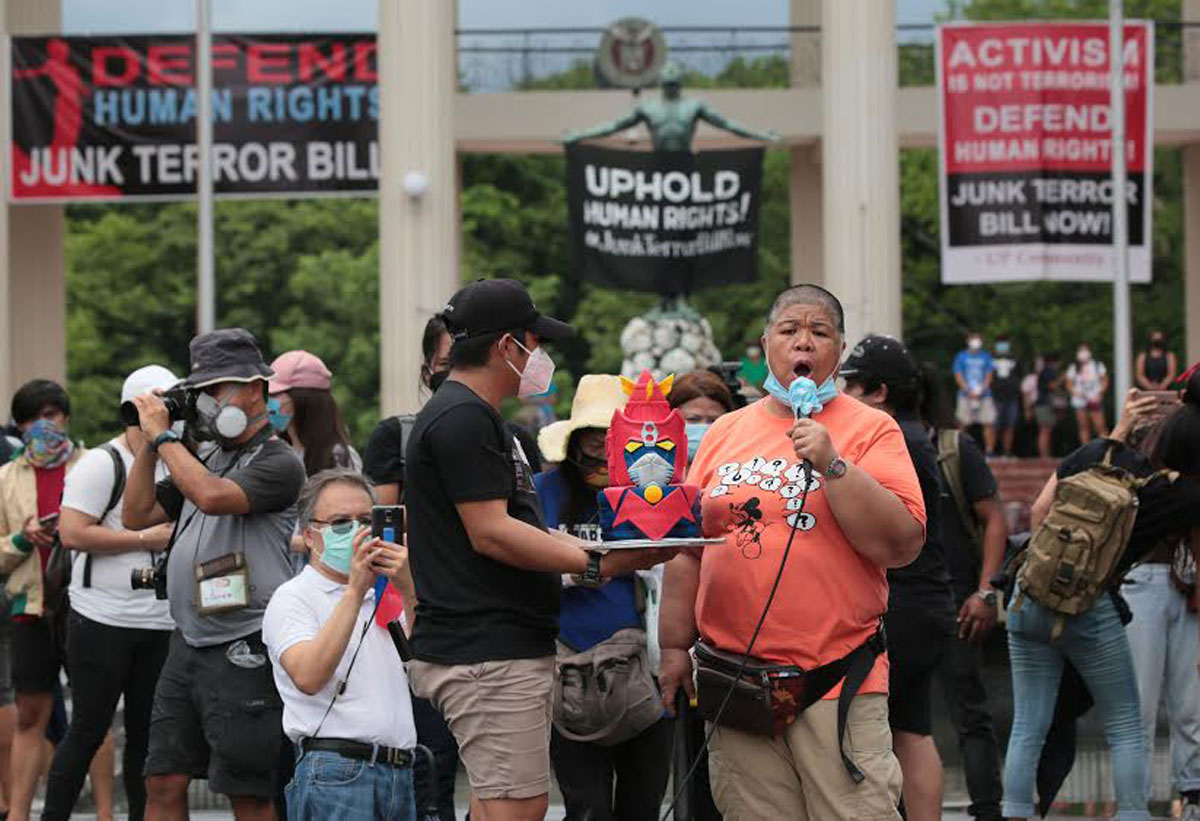
Imminent danger of prosecution
To get the SC to look into the merits of the case, the petitioners argued that they were in “imminent danger” of prosecution under the law.
The petition cited Carpio, Carpio-Morales and Batongbacal’s advocacy seeking to assert the Philippines’ sovereign rights over its exclusive economic zone in the West Philippine Sea, defying the pro-China policy of President Duterte.
It noted that Duterte’s eldest son, Davao City 1st District Rep. Paolo Duterte, in a now-deleted Facebook post accused Carpio of being part of an “Oust Duterte Movement.” Meanwhile, presidential spokesperson Harry Roque accused Carpio and Batongbacal of “warmongering.”
President Duterte himself, whose daughter Sara is married to Carpio-Morales’ nephew, called Morales a “spokesman of criminals” and accused her and Carpio of stoking tensions with China.
The UP Law professors cite the danger of the law to discussions of divisive issues and revolutionary societal movements as part of academic freedom. For one, the National Task Force to End Local Communist Armed Conflict and several police stations have made several social media posts that labeled legitimate activism and criticism as acts of terrorism.
Santos is known to be an activist and a member of Student Alliance for the Advancement of Democratic Rights in UP. As a student leader, he helped coordinate anti-ATA protest actions dubbed the “June 12 Grand Mañanita.”
The petition addresses the pronouncement in the SC’s Oct. "http://elibrary.judiciary.gov.ph/thebookshelf/showdocs/1/54474" 5, 2010 decision, which said that “a reasonable certainty of the occurrence of a perceived threat to any constitutional interest suffices to provide a basis for mounting a constitutional challenge.”
In the 2010 decision, Southern Hemisphere Engagement Network failed to hurdle the requirement and lost its challenge against the now-repealed Human Security Act of 2007. Hence, the Carpio petition extensively tried to show why the law has now put them in “imminent danger.”
The petition further argues that the mere enactment of the ATA poses an unconstitutional curtailment of civil liberties and an invalid intrusion into judicial prerogatives by the other branches of government. Thus, the issue is ripe for resolution by the SC without the need to wait for any person to suffer injury and abuse.
‘Vague and overbroad’
The petition also focuses on the “vague and overbroad” definition of “terrorism” under Section 4, which “may result in erratic and arbitrary application by law enforcers and may chill the people into silence.”
Section 4 provides that terrorism “shall not include advocacy, protest, dissent, stoppage of work, industrial or mass action and other similar exercises of civil and political rights.” The petition argues that this qualifier is rendered pointless by the caveat – “which are not intended to cause death or serious physical harm to a person, to endanger a person’s life or to create a serious risk to public safety.”
“Unsuspecting citizens would second-guess whether their actions would result in ‘extensive interference’ or ‘endanger’ the life of another in some shape or form. This produces a chilling effect on constitutional freedoms, especially free speech,” the petition states.
According to the petition, the vagueness of the provisions will give law enforcers “unbridled discretion” to interpret the law, resulting in “arbitrary and discriminatory enforcement” – likely targeting dissidents.
The law provides for the new crimes of “threat” to commit terrorism, “participation” in the planning of the commission of terrorism, “conspiracy” to commit terrorism, “proposal” to commit terrorism, “inciting” to commit terrorism, “recruitment to or membership in” a terrorist organization, and providing “material support” to terrorists. The petition argues that none of these crimes have been sufficiently defined.
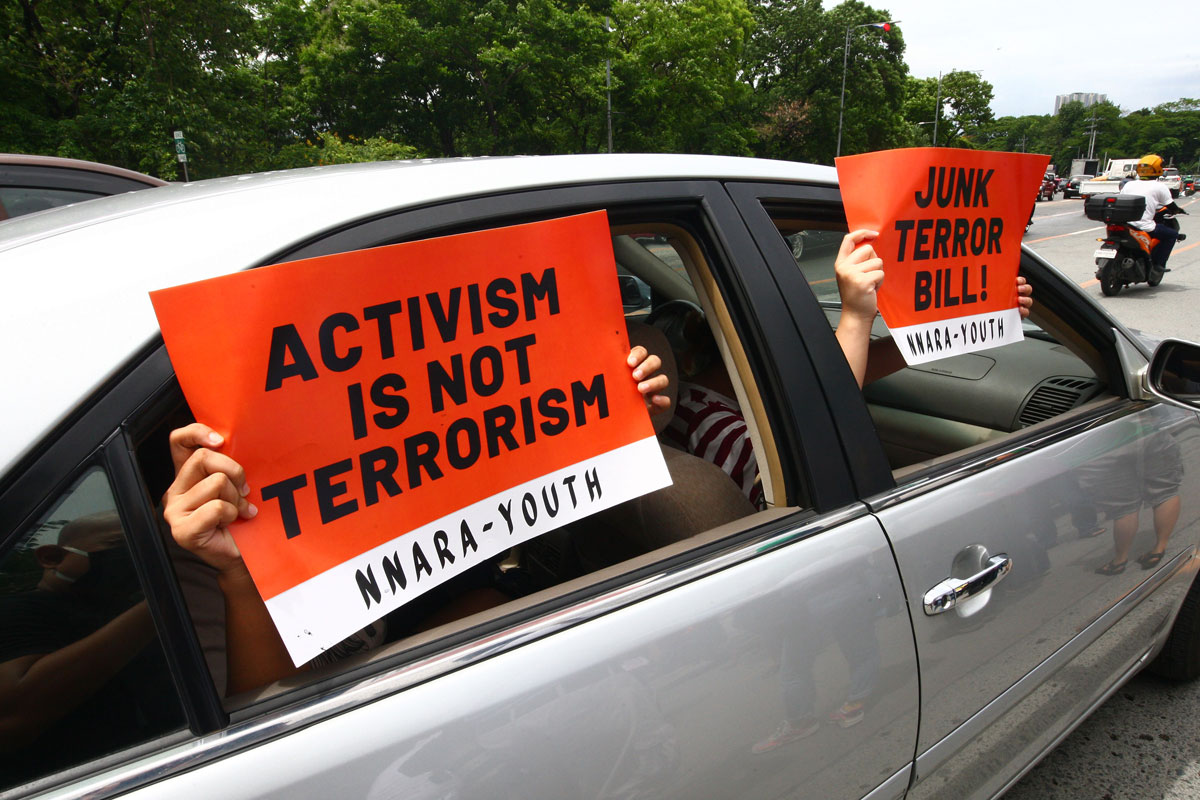
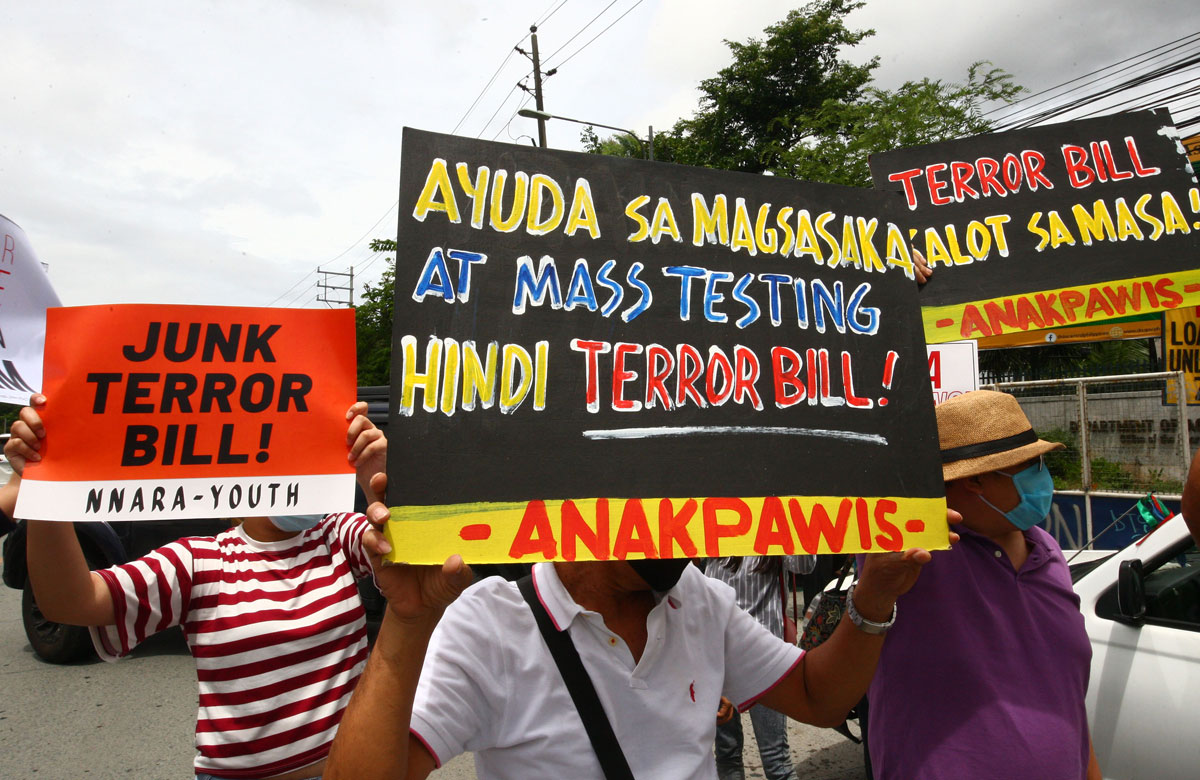
Detention without warrant upon suspicion
The petition also argues that the law allows the ATC, an executive body, to encroach on the judges’ exclusive power to issue arrest warrants, in violation of the Constitution.
During martial law, the 1973 Constitution allowed the designation of persons other than judges to issue warrants – giving rise to the notorious arrest, search and seizure orders that led to the indefinite incarceration of dissidents and opposition figures. The petition noted that this was the reason why the 1987 Constitution gave the power only to judges.
Faced with criticism, Sen. Panfilo Lacson explained that the power of the ATC to issue a written authorization to perform warrantless arrests should be interpreted as limited to the current rules under Rule 113, Section 5 of the Rules of Court.
Under Rule 113, Section 5, the only allowable instances are when the person is committing, has committed or is attempting to commit a crime in the presence of an officer, when the officer has personal knowledge that the person has just committed a crime, or when the person is an inmate who escaped from confinement.
Mere suspicion is not among the exceptions allowed by the Rules of Court for warrantless arrests. Yet the wording of Section 29 of the ATA provides for “any law enforcement agent or military personnel, who, having been duly authorized in writing by the ATC has taken custody of a person suspected of committing” terrorist acts.
Thus, the petition argues that the ATA substitutes the ATC’s determination of “suspicion” in place of the constitutional requirement of probable cause. It adds that the plain meaning of the word “suspicion” is where one is suspected of committing “something wrong without proof or on slight evidence.”
It insists that being “proactive,” as Lacson put it during the deliberations on the bill, cannot be a substitute for probable cause.
Endless cycle of warrantless arrest
Not only does the ATA allow warrantless arrest on mere suspicion, it extends to 24 days the period during which a person may be detained without judicial charges.
The petition argues that this is way longer than the three-day period allowed by the Constitution even in the exceptional circumstances of invasion and rebellion that justify the President’s suspension of the privilege of the writ of habeas corpus.
While the privilege of the writ may only be suspended for a maximum of 60 days under the Constitution, the petition says the ATA circumvents this by denying the remedy for as long as it remains a law.
The petition also warns that the law lacks limitations on warrantless arrests and would make it possible for suspects to be arrested and rearrested, effectively detaining them without charges indefinitely.
“On the 25th day, the ATC may order the re-arrest of the designated individual or member of an organization that remains designated/proscribed as a terrorist since the designation or proscription order is still valid,” read the petition.
The petition concludes that the operational provisions of the ATA cannot hurdle the strict scrutiny test, or the question of whether the law chose the least restrictive means or narrowly tailored the means to protect the compelling State interest. Thus, the ATA “cannot be implemented and must be voided in its entirety.”