Post-VFA Scenarios: Finding New Approaches To Maintain The Phl-US Security Alliance
A member of the Philippine Army says the military has started assessing the impact of the Visiting Forces Agreement’s termination on its operational readiness as the US military contributes a lot to the Philippines’ defense posture.
Filipino and American military planners are set to explore new approaches to operationalize the long-standing security alliance as both sides meet for the bilateral Mutual Defense Board-Security Engagement Board (MDB-SEB) next month.
This was after the Philippines served notice to terminate the Visiting Forces Agreement (VFA), a two-decade-old accord allowing US troop presence in the country, an Army colonel, who requested anonymity, said.
The March 11 conference was supposed to start the planning session for next year’s set of activities allowed under the MDB-SEB, a mechanism to implement the 1951 Mutual Defense Treaty (MDT), but the sudden termination of the VFA early this month will change the agenda of the meeting.
For this year, the two close allies had lined up a total of 319 large-scale joint and combined military exercises, cross-training activities, table-top simulations, subject matter experts exchanges and other non-traditional military cooperative arrangements like counterterrorism, humanitarian assistance and disaster response, medical and civic projects as well as fighting transnational crimes such as drug trafficking, human trafficking and piracy.
“Before the VFA was terminated, we were supposed to increase the number and frequency of engagements with our American counterparts, but that changed,” the source told The Philippine STAR.
“We will now wait for the Americans’ response, but both militaries are expected to look for new approaches on how we can continue to work together to perform our mandates and our missions. We would like to insulate the military-to-military relations from the political noise because these things are really very unpredictable. Our military-to-military relations with the US remain steady, constant and robust,” the Army colonel said.
Another military official, a flag officer of the Philippine Navy who also asked not to be named, said the navy-to-navy engagements would be seriously affected by the VFA termination even if ship-to-ship activities do not require boots on the ground, which is covered by the VFA.
“We still hope to send our vessels to join large-scale naval drills later this year in Hawaii during RIMPAC (Rim of the Pacific Exercise, the world’s largest maritime warfare) activities, but the annual Marines Corps-led ‘Kamandag’ exercises may no longer be held because the VFA ends on Aug. 11,” the flag officer disclosed.
“The VFA termination affects only activities done in our country’s soil, but outside the Philippines, we have more freedom to participate in exercises, training and other activities provided we are invited to join these events. If the US decides to invite us to take part in the RIMPAC exercises, then we will send our naval assets to join the multilateral drills,” he said.
Both officials said it is up to the Americans to decide what to do in the remaining 180 days.
“As far as we are concerned, all activities lined up within the 180-day period will continue. After Aug. 11, we have to stop whatever planned activities have been lined up until the end of the year,” the flag officer said. “The ball is in the Americans’ court, they can choose to continue or terminate all activities even before the 180-day period. But I am hoping they will sustain and continue until the termination date in the interest of both sides.”
The US plan to help develop a Marines Corps jungle base in the western Palawan area would no longer be pursued, including the possible rotation of a battalion of Marines in the Ulugan area.
“They should have no more presence after Aug. 11, we are on our own,” the flag officer pointed out. “The US lost a strategic location where it can project its power effectively and credibly in the region. We, too, lost the US forces as a deterrent factor. Both sides will lose something, but the impact will be greater for us, on our security interests.”
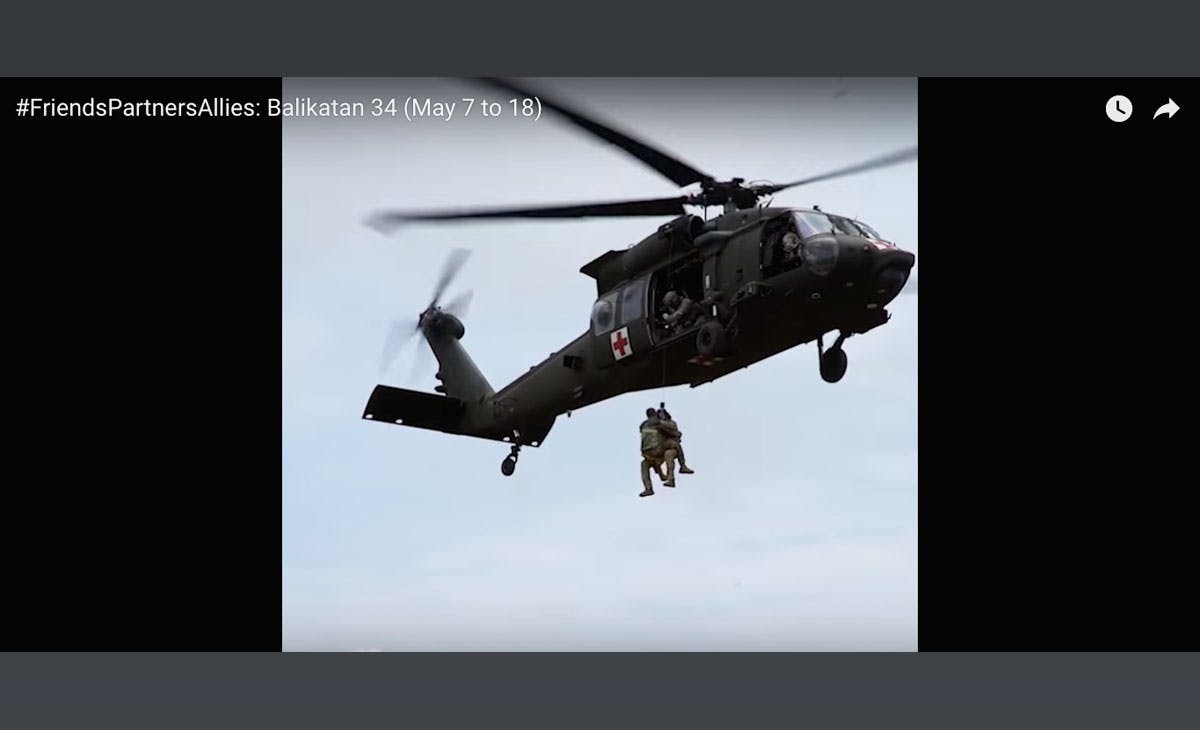
(The US embassy posted this video on its YouTube channel with the caption #FriendsPartnersAllies for the security of the Philippines and the Indo-Pacific as ‘Balikatan’ or the joint military exercises between the Philippines and the US came to a close in 2019. The embassy said ‘over 7,500 service members from the US, Philippines, Australia showed us what it means to work shoulder to shoulder.’)
Both military officials said the Philippines will continue to send soldiers for basic, advanced, and higher defense and military training and education to the US, as they expressed hope that there will be no deep cuts next year in the US State Department’s annual international military training and education program.
The Philippines gets an average of up to $3 million under this program, apart from about $50 million in foreign military financing and Excess Defense Articles from the US military.
Assessing threats
The Army colonel said the military has started assessing the impact of the VFA on its operational readiness as the US military presence contributes a lot to the Philippines’ defense posture in terms of equipment, training and funding.
“We were called to the defense department after the decision to terminate the VFA was announced to look into what we have to address regarding certain threats and to prepare for evolving and future threats to our security,” he said, adding they have some scenario-building based on threats assessments and challenges ahead.
“But we have been sidetracked by the global problem of coronavirus as we were asked to make scenarios and prepare for security measures if and when the virus spreads in the local population as seen in other countries,” he said, referring to the coronavirus disease 2019 or COVID-19.
The Army colonel said what they immediately saw was the military’s inadequate number of protective gear – mission-oriented protective posture suits – to deal with a disease outbreak. “We could not even find a reliable supplier who could deliver adequate supplies of face masks during the eruption of Taal Volcano last month,” he noted.
The military is ready to support the health department in its responses to COVID-19 even as the VFA termination will have more serious long-term security implications, the colonel stressed. “Public health, of course, is a national security concern and the military stands ready when called to action,” he said.
He said the military has been constantly planning responses to all scenarios and any contingency. “We continue to be aware of what’s happening in our environment all the time and to be able to plan ahead on how to gain access and control any situation – whether it is the coronavirus, our internal security problem and our own sovereignty and territorial integrity. We have to be always a step ahead, including in the sudden termination of the VFA,” he said.