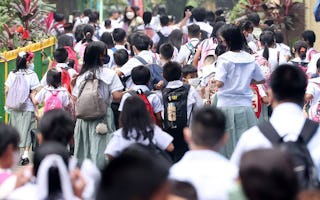



New EO Lets All Schools Suspend, Resume Classes
Under the order, automatic suspensions take effect when warnings, advisories, alert levels, forecasts or other official issuances from competent national government agencies so warrant.

President Marcos issued on Tuesday, Nov. 3, an executive order allowing schools to suspend or resume classes based on risk assessments in their areas, a policy that Malacañang said would ensure students’ safety while supporting learning continuity.
Under EO 130, three mechanisms govern the suspension and resumption of in-person classes, activities and onsite work: automatic suspension based on prescribed technical thresholds; localized suspension by local chief executives based on local risk assessments and prevailing conditions, and granular suspension by schools based on documented site-specific assessments.
Palace press officer Claire Castro said the order gives local governments additional leeway to decide which areas or schools would be covered by class suspension based on actual conditions.
“Each school day suspended is a huge loss. The goal of the new EO is to ensure the safety of students while continuing their learning,” Castro said.
Under the order, automatic suspensions take effect when warnings, advisories, alert levels, forecasts or other official issuances from the Philippine Atmospheric, Geophysical and Astronomical Services Administration (PAGASA), Philippine Institute of Volcanology and Seismology or other competent national government agencies so warrant.
In the absence of an applicable automatic suspension, local chief executives may declare localized suspensions based on documented local risk assessments and prevailing conditions.
Schools may declare granular suspensions only when no national or local suspension applies and documented site-specific assessments establish an actual or imminent threat to the safety, health or welfare of learners and personnel.
Classes and onsite work may resume once the suspension period expires or the applicable warning or declaration is lifted, downgraded or has ceased, provided required safety assessments and inspections have been completed.
Earlier resumption in areas covered by localized suspensions requires the concurrence of the concerned local chief executive.
The order stressed that the suspension of in-person classes “shall not automatically suspend learning,” directing educational institutions to implement appropriate alternative delivery modes and other learning continuity measures.
The Department of Education welcomed the measure, saying it provides more flexible, orderly and responsive guidelines for suspending and resuming classes and onsite work in schools and learning centers.
“We sincerely thank government agencies, school superintendents, school heads, teachers, local government units (LGUs) and other stakeholders who listened, collaborated and supported the advancement of this measure,” the DepEd said.
The department is expected to issue implementing guidelines within 30 days, including technical thresholds, grounds, criteria, documentary requirements, timelines and coordination procedures. – With Bella Cariaso