



Pinoys Craved For Chocolates, Sweets More Since The Pandemic Started
What’s your comfort food? "It seems that a little bit of sweetness” helped Filipinos “drown out the bitterness” in 2020, according to a study.

Elaine, 32, a sous chef (or second in command in a kitchen), was among the crew of a luxury cruise ship who were sent home when the coronavirus disease 2019 (COVID-19) pandemic happened in March last year.
While waiting for a call for her to go back to work and address dwindling finances, Elaine decided to cook various kinds of food and sell them online, mostly to neighbors.
While she offers mostly home-cooked meals, she noticed that "my sales would go up whenever I introduce food with dessert or merienda (snack) on the side."
She then found herself baking cakes because of this while also buying milk tea online.
"I couldn't resist the temptation. It's like I've lost my job, I don't have money and food makes me feel better," she said.
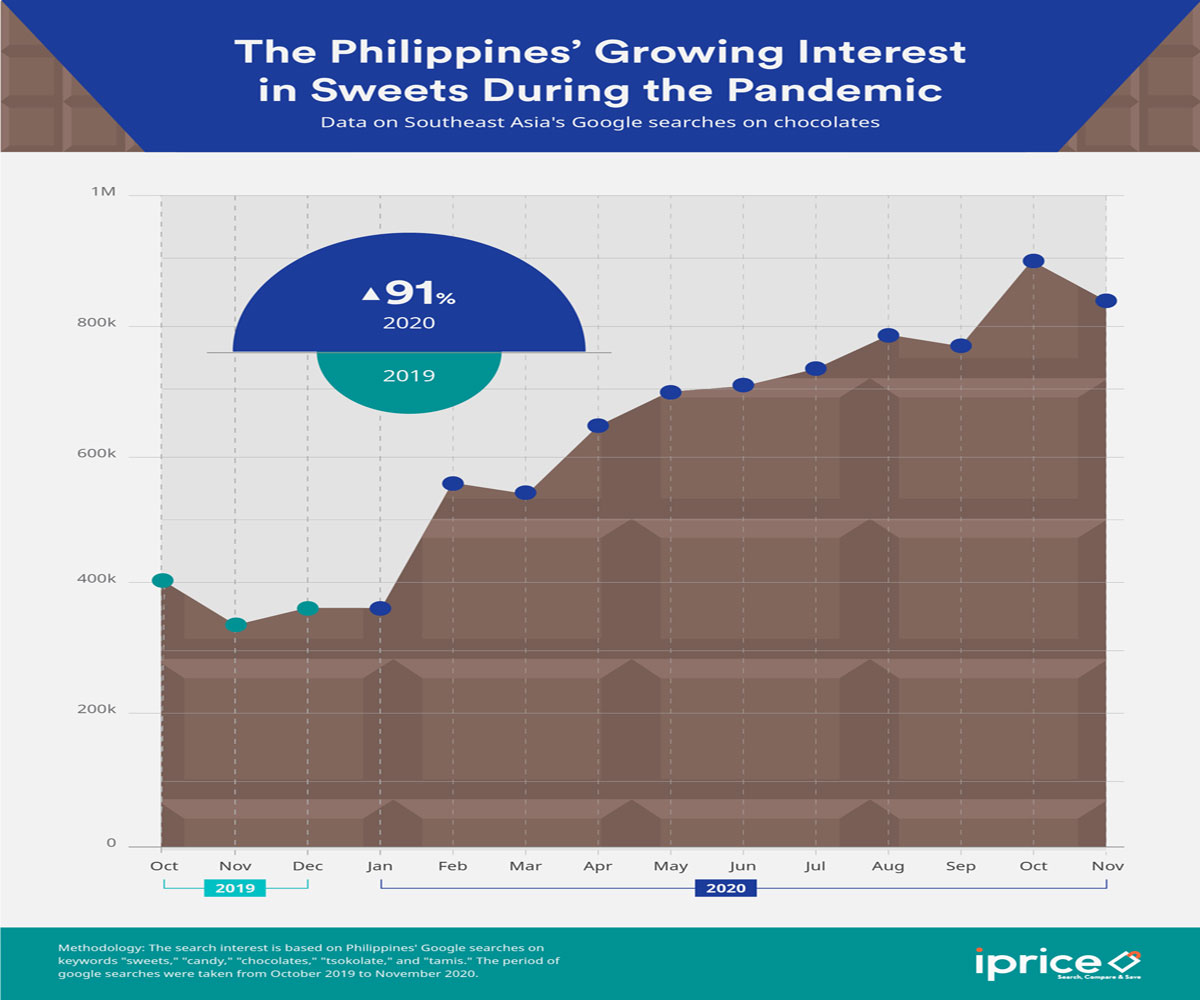
According to iPrice Group, a meta-search website, Filipinos searched for "sweets," "chocolates" and "candies" 91 percent more during the pandemic compared to 2019.
"Search interests (for sweets) in the Philippines continue to grow over the year… when the pandemic started," iPrice Group said in a press statement on Jan. 20. "It seems that a little bit of sweetness can help drown out the bitterness that is 2020."
In a normal year, February and October would garner the most Google searches on sweets and chocolates due to Valentine's Day and Halloween, iPrice noted.
However, in 2020, Filipinos have been searching more and more for sweets throughout the year. For instance, a random month like September 2020 has garnered 38 percent more interest in sweets than February 2020 at the time when there was still no lockdown in place in Metro Manila.
In April 2020, the second month of lockdown, search interest for chocolates and sweets started to increase by 20 percent.
“But is the data enough to blame the pandemic for this phenomenon? Well, the monthly average of Google searches in 2020 is 91 percent more than 2019’s. Furthermore, October 2020 (Halloween) has 122 percent more interest in chocolate than the year before (October 2019). This year-by-year comparison could certainly be a telltale sign,” Iprice stated based on its research.
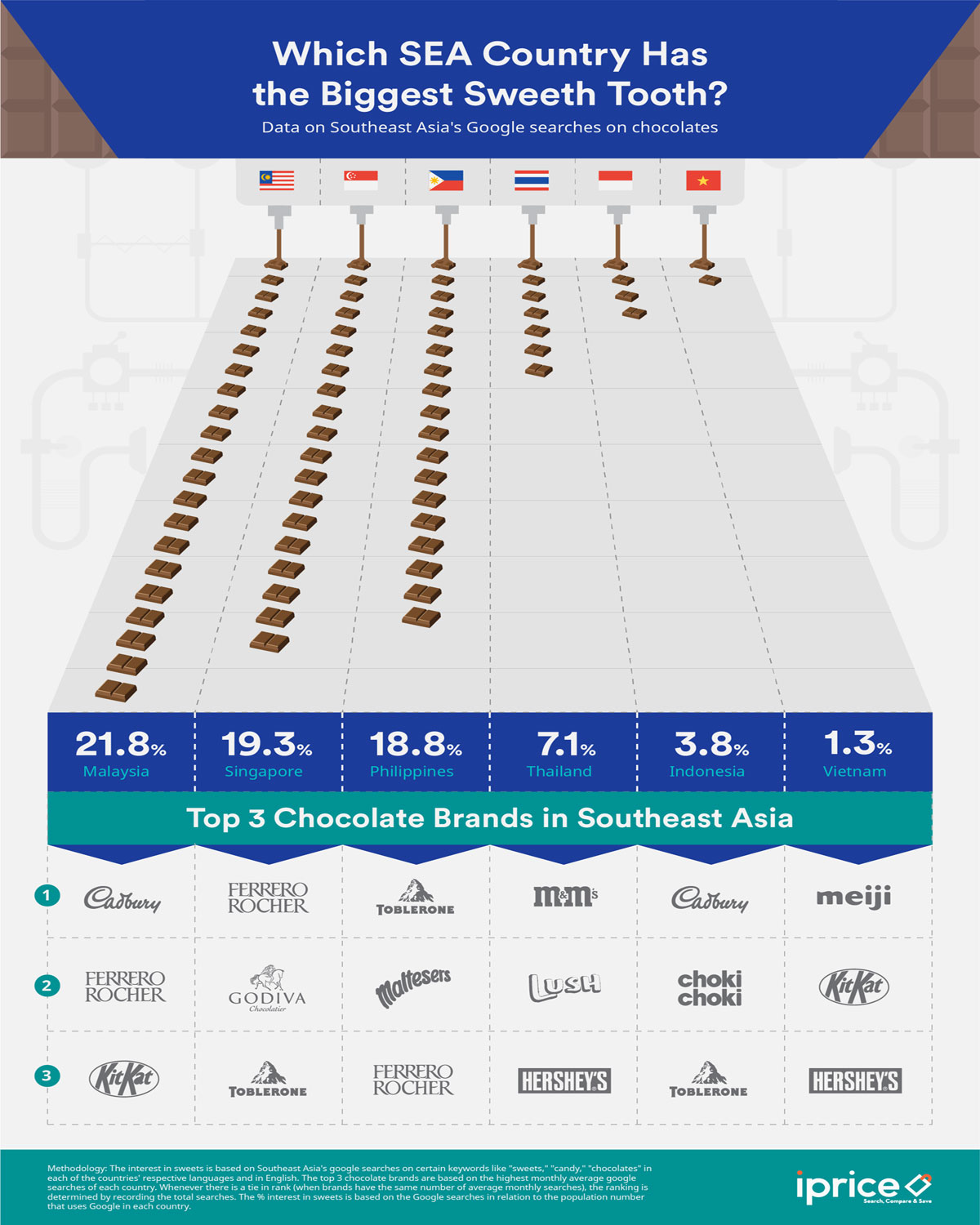
iPrice’s data also showed that the Philippines ranked third in Southeast Asia in terms of interest in chocolates and sweets.
Nearly 18.8 percent of the country’s Google population looked for sweets, the highest number after Malaysia (21.8 percent) and Singapore (19.3 percent).
These figures were validated by the International Diabetes Federation Diabetes Atlas data on diabetes prevalence in Asia. Malaysia ranked second while the Philippines was at 24th.
Out of all the chocolate brands the e-commerce aggregator recorded, it revealed that Western chocolate brands reigned in most of Southeast Asia. In the Philippines, people looked for Toblerone, Maltesers, and Ferrero Rocher the most. Its searches were way more than local brands like Chocnut, Flat Tops and Curly Tops.
The top three Western chocolates have 254 percent more searches than the top three local chocolates. In terms of local chocolates, Philfoods’ Flat Tops ranked number one, followed by Chocnut and Curly Tops.
It seems that only Indonesia is the most interested in Southeast Asian chocolates. It has the most search interest in brands from the region. Choki-Choki, a humble liquid chocolate snack in a narrow plastic package, ranked second in the country.
Beating the stress
Zenaida Velasco, a nutritionist-dietician who has a master’s degree in psychology, said stress could be one the reasons why Filipinos craved for sweets while under quarantine.
Velasco cited the pandemic as the common stressor last year due to unemployment, marital and family issues, as well as work or school problems.
She explained that stress could trigger the release of cortisol – a stress hormone. High cortisol levels can lead to weight gain as these increase appetite and signal the body to shift metabolism to store fat.
“‘Pag tayo na-stress, we see sweets as comfort food,” Velasco said told "Usapang Community Quarantine" during a Facebook Live interview on Saturday, Jan. 30.
Velasco pointed out the cortisol “creates that demand” for sweets, fatty and salty foods. “This is also attributed to the usual advice given to those who are depressed, ‘Ikain mo na lang ‘yan,’ or whenever a parent hits a child, and would later on appease the child with a question ‘Ano gusto mo ice cream? O ipagluluto kita ng masarap na pagkain.’”
The pandemic also deprived people of gimmicks and the opportunity to go out whenever they wanted to unwind.
"You are just at home. In a sense you felt a sense of safety (when) eating ice cream for example," she said.
Velasco, who is the president of the Nutritionist-Dieticians Association of the Philippines (NDAP), underscored that eating comfort food is "good" as long as you eat it in "moderation." "Kailangan ibalanse mo rin, siyempre ang kapalit nyan ay health mo."
Too much sugar consumption can lead to many chronic diseases including Type 2 diabetes, and is also a major cause of obesity.
Data from the International Diabetes Foundation showed the diabetes prevalence in the Philippines is almost four million, representing 6.3 percent of the 63.26 million adult population. It estimates that by 2045, the number of diabetic Filipinos will rise to 212 million.
Obesity rate in the Philippines, meanwhile, has jumped from 20.2 percent in 1998 to 37.2 percent in 2018, based on the National Nutrition Survey. That means three or four out of 10 Filipino adults are obese.
The World Health Organization has also declared obesity as the largest global health pandemic in adults, and poses more serious problems than nutrition.
And with the COVID-19 pandemic, those who are obese or have diabetes have higher risks of getting severe illnesses from the coronavirus infection. The United States Centers for Disease Control said obesity may triple the risk of hospitalization due to COVID-19. A study in England showed that one-third of the 20,000 people who died due COVID-19 were diabetics.
Velasco said while many Filipinos are aware that they need to control their sugar intake, many times they fail to do it.
"Often than not, Filipinos are not able to comply with their dietary restrictions because there's an emotion that's attached to the food," she emphasized.
How do you manage your stress in this time of the pandemic? Here are some tips from Velasco:
- Eighty percent of the stress is based on perception, 20 percent on things you cannot control. To beat stress, go to the 80 percent. Stress can be a spice of your life, or kiss of death. Rather than be frazzled with something, sit down and think about it.
- Connect with someone if you can't find a solution. A problem shared a problem halved.
- Always be in the spirit of gratitude. Always be thankful that you have life, that you are healthy despite this pandemic.


