



Philippines, China Trade Protests Over SCS Encounter; Australia, Canada Express Concern
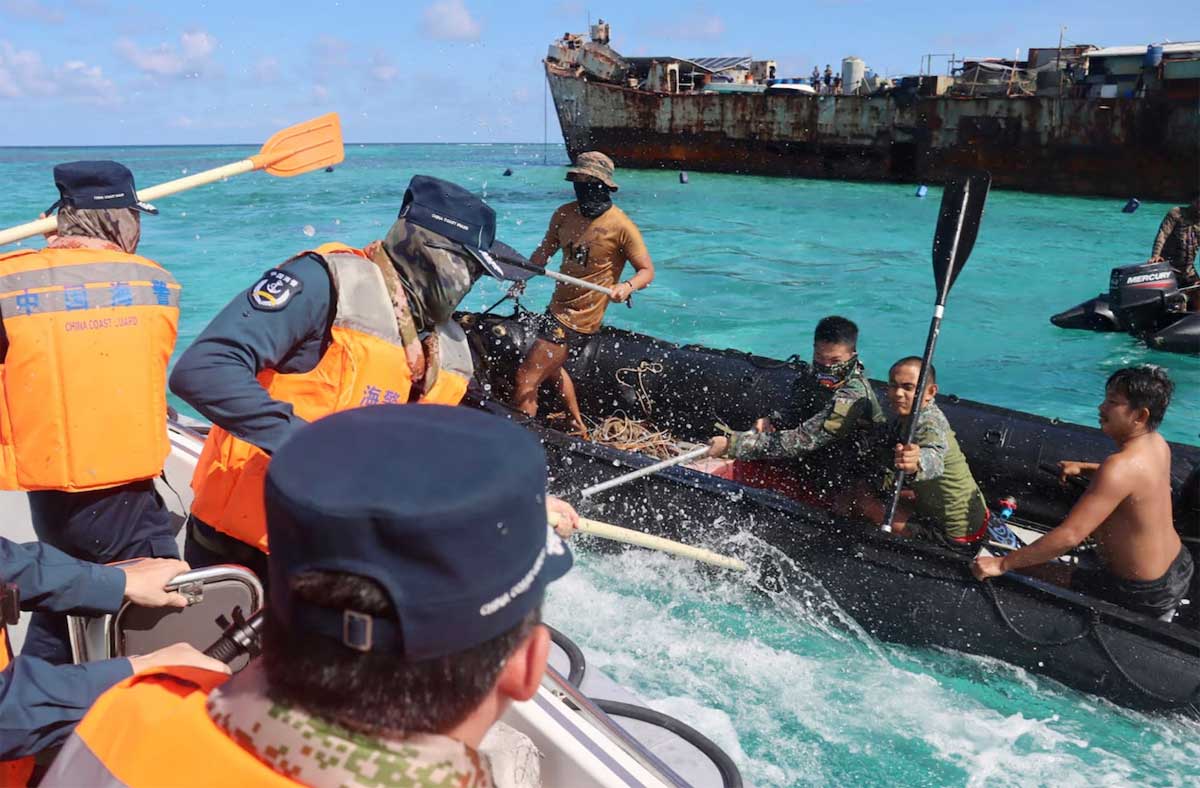
The Philippines said Chinese Coast Guard personnel struck one of the Philippine Navy staff on the head with a wooden baton, and China claimed the Philippine personnel were the first to attack.
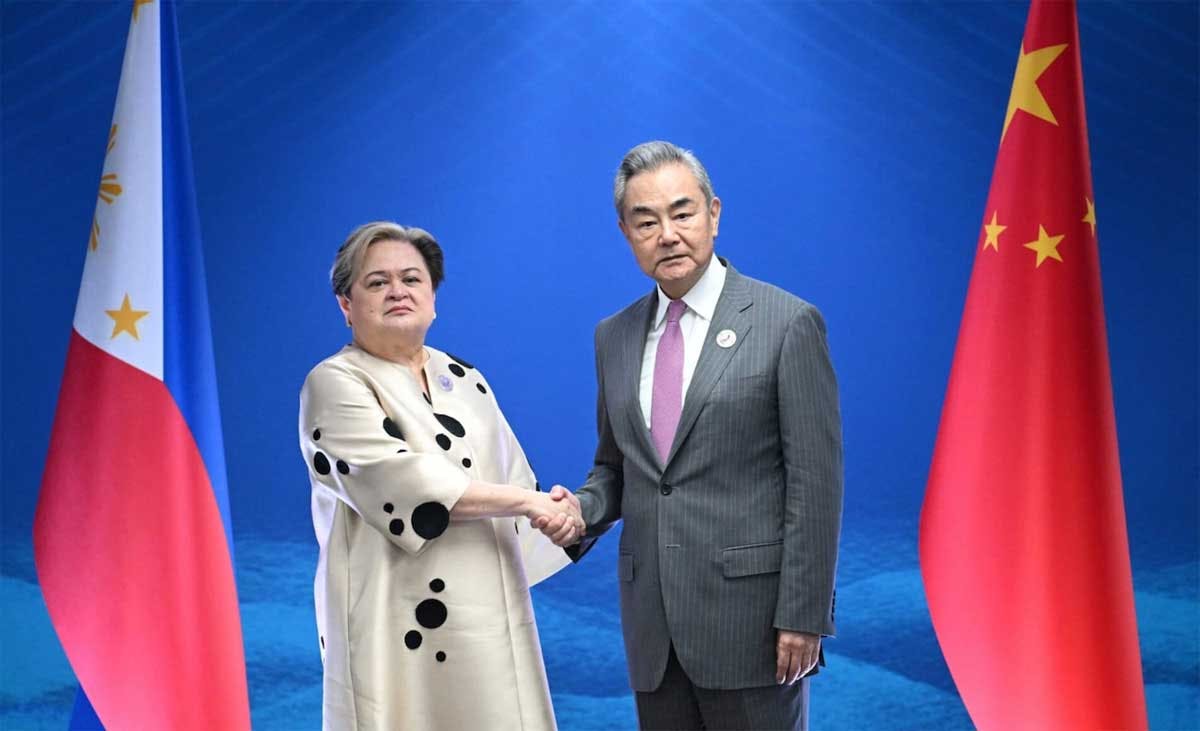
The foreign ministers of the Philippines and China met in Pasay City on Wednesday, July 22, and both made “strong” protests over an encounter between the two countries’ vessels this week in contested South China Sea waters.
The Philippine foreign affairs secretary, Ma. Theresa Lazaro, said in an X post that she reiterated the protest over what she called “unacceptable actions against Filipino personnel,” while Chinese Foreign Minister Wang Yi was quoted by an official readout as lodging a protest over “the Philippine personnel’s egregious act of ramming Chinese law enforcement vessels.”
Bilateral relations have been tense in recent years amid repeated maritime confrontations in the South China Sea, which China claims almost entirely as its own despite a 2016 arbitral ruling that invalidated those claims.
The incident this week took place on Monday, July 20, in Ayungin Shoal. The Philippines said Chinese Coast Guard personnel struck one of the Philippine Navy staff on the head with a wooden baton, and China claimed the Philippine personnel were the first to attack and accused Philippine vessels of ramming a Chinese patrol boat.
The Department of Foreign Affairs (DFA) said Lazaro also asked China anew to remove the remaining structures in Bajo de Masinloc or Panatag Shoal.
Defense Secretary Gilbert Teodoro Jr. accused Chinese Ambassador Jing Quan of downplaying President Marcos’ meeting with him following Monday’s confrontation in Ayungin.
Jing, in an interview with reporters Tuesday night, July 21, confirmed that he met with Marcos, but said that the meeting was “constructive” and covered a broad range of issues apart from the maritime dispute.
Teodoro said the President had summoned Jing to Malacañang to relay the Philippine government’s protest over the Ayungin incident.
Palace officials, however, said the meeting with Jing was scheduled before the Ayungin encounter.
In another development, retired Supreme Court senior associate justice Antonio Carpio said the DFA might be in a difficult situation after China disclosed a supposed agreement with the Philippines on handling issues in Ayungin.
Carpio hinted the DFA was “now in a bind (after) China has disclosed that the DFA had agreed not to resupply Sierra Madre without prior notice and prior consultation with China, and not to build at all on Ayungin Shoal.”
The DFA has yet to comment on the issue.
Teodoro said he had no knowledge of the agreement.
In the meeting between Wang and Lazaro, the Chinese foreign minister said China-Philippines relations stood at a crossroads, and that the Philippines needed to make a “correct and rational” choice regarding its future direction, according to a readout released by China’s foreign ministry.
Wang also accused “certain forces” within the Philippine military and police of deliberate provocations, undermining dialogue and “carrying out the orders of external forces.”
Lazaro said that the two also “discussed the importance of keeping communication lines open, managing tensions, and pursuing practical ways forward.”
Australia’s Wong says region faces choice about its response to SCS ‘aggression’
Australia’s foreign minister said on Wednesday that Asian countries face a choice in how they respond to instances of aggressive conduct in the South China Sea that were of concern to Canberra.
A recent encounter in the South China Sea between China and the Philippines was a real concern, in addition to being destabilizing and risky, Penny Wong said on the sidelines of a meeting led by the Southeast Asian bloc ASEAN.
“We are concerned about some of the aggression we are seeing,” Wong said. “We are concerned about some of the destabilizing conduct we are seeing.”
“The countries of the region have a choice to make about how we all respond to that.”
Wong was referring to an altercation on Monday in which Manila said one of its navy personnel was struck on the head. Beijing accused Manila of provoking the incident, resulting in both countries summoning each other's ambassadors.
China’s foreign ministry said Australia was not party to the South China Sea issue and had no right to intervene in related maritime matters.
“China urges relevant countries to stop stirring up tension and inciting confrontation,” ministry spokesperson Lin Jian said at a daily briefing, adding that Beijing would continue to properly handle maritime-related disputes through dialogue and consultation.
Canada FM urges Middle East de-escalation, calls SCS confrontation ‘troubling’
Canada is calling for a de-escalation and a permanent ceasefire in the Middle East, with the situation “quite grave,” its foreign minister Anita Anand said on Wednesday on the sidelines of an ASEAN meeting.
She also reaffirmed Canada’s support for international law in addressing tensions in the South China Sea during meetings with Southeast Asian counterparts in Manila.
Anand said Ottawa remained committed to protecting civilian lives and critical infrastructure in conflict zones, while also expressing concern over the latest confrontation between Philippine and Chinese vessels in the South China Sea.
Anand said Canada would “always call for de-escalation, a ceasefire, and respect for humanitarian considerations and human life” as fighting in the Middle East intensified.
“The situation is quite grave, and we very much hope that parties will come to the table and ensure that the permanent ceasefire is negotiated and held,” she said, adding that hospitals, schools and other civilian infrastructure must be protected.
She also said Canada remains concerned about the latest maritime incident involving the Philippines and China. “Without question, the incident is troubling, and we are concerned,” Anand said. “We do not agree with intimidation as a means of addressing disputes.”
She said Canada supports resolving maritime disputes under the United Nations Convention on the Law of the Sea (UNCLOS) and reiterated Ottawa’s longstanding support for a “free and open Indo-Pacific.”
“Whether we’re talking about the Indo-Pacific, the Strait of Hormuz, or waterways generally, there is a need to remember that the structure of freely navigable waters and international law is a guidepost that we can gravitate towards,” Anand said.
Asked about her meeting on Tuesday with Chinese Foreign Minister Wang Yi, Anand said they discussed bilateral ties and regional security. “In terms of the broader geopolitical situation, we did spend some time on the Indo-Pacific, and I raised my concerns,” she said, without elaborating.
Beyond security issues, Anand said Canada is pushing to diversify trade beyond the United States and is seeking to conclude a free trade agreement with ASEAN.
“Making sure that there’s unanimity towards concluding the FTA between ASEAN and Canada, that’s our top priority here at this summit,” Anand said. — With Pia Lee-Brago, Andrew Ronquillo, Michael Punongbayan, Ghio Ong