



OFWs In France Urged To Take Caution As Rioting, Looting Mar Nationwide Protests
French President Emmanuel Macron voiced the public’s “anger” and “shame” over rioting and looting during nationwide protests against rising living costs and poor conditions in schools.
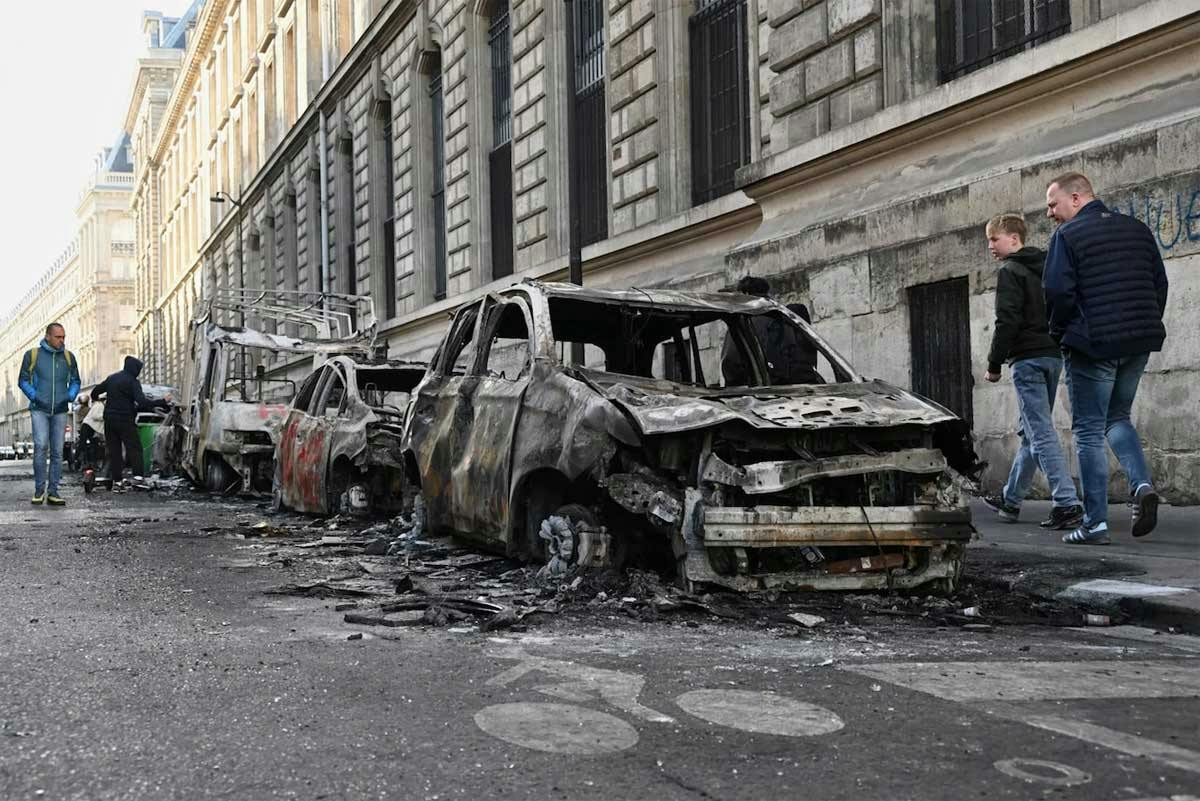
Sen. Erwin Tulfo advised overseas Filipino workers (OFWs) in France to take strict precautions when heading to work amid ongoing riots, looting and violent clashes between protesters and authorities in Paris.
The senator also urged the public on Sunday, Oct. 18, to pray for the safety of all deployed OFWs and their families back home.
French President Emmanuel Macron on Sunday voiced the public’s “anger” and “shame” over rioting and looting during nationwide protests against rising living costs and poor conditions in schools. At least 2,400 people were arrested.
Macron echoed other government officials in blaming much of the violence on far-left activists, accusing them of attacking police and public buildings to foment chaos.
“Those who looted will have to pay for the damage, and those who sought to bring down the Republic will be held accountable,” Macron said in a televised address to the nation.
He denounced “unrestrained violence” by “insurrectionist elements from radical far-left groups, joined by numerous criminals.”
Macron earlier held an emergency meeting with senior government officials, a day after masked groups set fires and attacked city halls in several cities. He said he had instructed prefects to work with mayors to protect public buildings and businesses in the coming weeks, including by banning protests when necessary.
Flames engulfed the 19th-century City Hall in the city of Limoges, in central France, causing its roof to collapse and nearly destroying the building.
New tensions erupted in Paris on Sunday
In Paris, hundreds of protesters gathered again on Sunday at the Place de la République amid a heavy police presence. Officers used tear gas as tensions flared sporadically in the neighborhood, with small groups of people trying to set bicycles and trash bins on fire.
“The right to protest is a fundamental right. Deliberately and collectively sowing disorder through violence is not,” Interior Minister Laurent Nuñez wrote on X, citing the looting of hundreds of businesses across the country.
Authorities estimated the marches on Saturday, Oct. 17, had a turnout of about 550,000, while organizers put it at 800,000. Demonstrators answered calls from a labor union, student organizations and activists hoping to revive the “yellow vest” movement, which emerged in 2018 to protest social injustice.
Mass protests in France are often marred by violence on the fringes of otherwise peaceful marches, leading to clashes with police. The arrest tally reported Sunday approached the nearly 2,000 recorded nationwide during a single day of yellow vest protests in December 2018.
Paris police said one person died of a heart attack, without providing details. The Paris prosecutor’s office said it was investigating.
Paris police said 855 people were arrested in the capital region. Prosecutors said 557 remained in police custody.
“I am actually stunned by the level of destruction and violence that was expressed,” said government employee Marie Peyreigne, 57, wondering what had led to the mayhem.
Parisians inspecting the damage photographed the partially dismantled base of the square’s central monument, a statue of Marianne, a symbol of France.
Jean Foissy, 74, said he had wanted to join the protest but encountered “a wall of riot police and fires everywhere” and returned home.
“I was very scared,” he said. “I’ve been a Parisian since I was born, so when I got here, it almost made me want to cry because I find it so bad, it hurts me.”
Margaux Eude, 26, said she supported the protest movement but “didn’t think it would escalate like this.”
“It’s the troublemakers who came, and it breaks my heart because it delegitimizes the movement,” she said.
Protests in Milan, Lisbon, Belgium, Albania
Rioters also clashed with police, looted stores and set property on fire in central Milan in Italy on Saturday, emptying Piazza del Duomo and a luxury shopping arcade when the area would usually be teeming with shoppers.
The march against wars and rising living costs began peacefully. But masked protesters threw stones, paving blocks and other objects at riot police and set fire to barricades made from bar tables. Images of the aftermath showed a severely damaged carabinieri car.
Police used water cannons and tear gas to disperse the crowds.
At least two police officers were injured and about 50 demonstrators, including many minors, were detained, the LaPresse news agency reported.
Italian Premier Giorgia Meloni condemned the violence in a social media post.
“Demonstrating is a right. Setting our cities ablaze is not,” she wrote, citing “hooligans who exploit demonstrations to sow chaos, attack those responsible for ensuring security and hold entire cities hostage.”
Milan’s center-left mayor, Giuseppe Sala, said “the reasons for the protests were understandable. The violence against law enforcement and serious damage to the city are not justifiable.”
The unrest coincided with nationwide demonstrations in neighboring France against rising living costs and in support of high school students’ grievances. French police used tear gas and water cannons to disperse violent protesters who joined the rallies.
In Lisbon, Portugal, tens of thousands of people marched through central Lisbon on Saturday to protest against soaring living costs and a deepening housing ?crisis in Portugal, increasing pressure on the center-right government.
Portugal's biggest union, CGTP, which called the rally, said “many tens of thousands” packed one of the capital's main avenues. Police gave no crowd estimate.
Protesters say low wages are failing to keep pace with housing costs and the rising cost of living, leaving many people struggling to make ends meet in the European Union and NATO member state.
The demonstration followed days of growing unrest, including a tent camp set up by housing activists in the northern city of Porto that police cleared in a pre-dawn operation on Monday, Oct. 12.
It coincides with protests in France against rising costs and declining public services, and smaller protests in Belgium. There are also mass protests in Albania, where protesters are demanding the prime minister’s resignation.
Portugal’s inflation hit 3.6 percent in September, driven by rising food and fuel prices, the latter up 15 percent year-on-year following an increase in tensions in the Middle East.
House prices have more than doubled since 2017, while rents for new leases have nearly doubled, fueling one of Europe's worst housing affordability crises.
Albanian Prime Minister Edi Rama on Sunday rejected calls to step down and said street protests, which continued for a sixth day, were a threat not to his government but to Albania's hopes of joining the European Union.
Student-led demonstrations, fueled by anger over perceived government corruption, a lack of jobs and poor education standards, have engulfed central Tirana and spread to other cities in the past week.
Demonstrators demanding Rama's resignation have set fire to government buildings as well as banks, smashed shop windows and pulled up paving stones to throw at police.
Violence erupted again on Sunday when thousands gathered outside the Education Ministry and hurled rocks at riot police who responded with tear gas, water cannon and rubber bullets.
The unrest, which followed months of largely peaceful protests over the summer against a luxury coastal development backed by US President Donald Trump's son-in-law Jared Kushner, poses the biggest challenge yet to Rama, who has governed since 2013 and last year won a fourth term in office.
“I am not being challenged, the government is not being challenged, a government majority or a winning party in the elections is not being challenged but a path is being challenged, a mission is being challenged,” Rama said in a live address on Facebook.
“Albanians need to think very clearly: Do they want this, do they want that, or do they want the EU?”
EU condemns use of violence in protests
Rama invited students to talks as excavators dug up and ?removed the paving outside his office in central Tirana before protests started on Sunday.
“This will not absolutely stop the protesters. This is just made to remove any way of protection of the protesters from the police. This is just that,” said Elton Prendi, 40, a Tirana resident.
The European Commission condemned the use of violence in Tirana and other cities and welcomed authorities' commitment to protect people's right to protest.
Police said 388 people had been charged with criminal offences during the demonstrations. Scores of police officers and protesters have been injured. – With Reuters


