



Marcos Urged To Take A Clear Stand On Sabah; Jacel Kiram Insists Malaysia Should Recognize Arbitral Ruling
International law expert Harry Roque said the Sulu Sultanate heirs’ recent legal victory bolsters the country’s claim over Sabah.
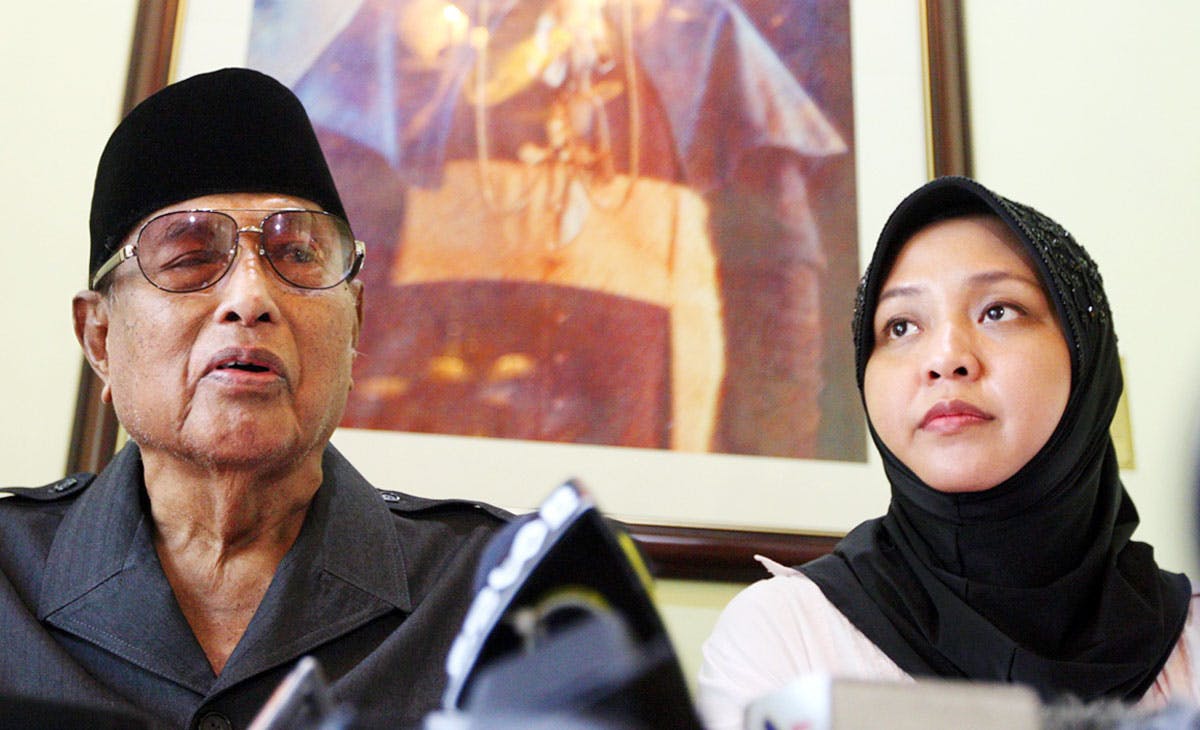
An international law expert urged President Marcos on Wednesday, July 20, to take a clear stand in asserting the country’s sovereignty over Sabah given a recent French arbitral ruling favoring the Sultanate of Sulu heirs.
Harry Roque, who also served as a spokesman for former president Rodrigo Duterte, said Marcos should “decide once and for all if the country’s position on Sabah remains a territorial claim of the Philippine republic or a proprietary claim of the Sultanate of Sulu descendants.”
Roque said the Sultanate heirs’ legal victory bolsters the country’s claim over Sabah.
“The Philippines has never given up its claim over the territory. I advise our President to clarify whether the country would actively pursue this claim or allow the Sultanate heirs to deal with the Malaysian government in private,” Roque said in a television interview.
He said the President should make a firm decision on this matter since the Sultanate of Sulu heirs ceded the sovereignty of Sabah, then known as North Borneo, to the Philippines in 1962.
This served as the basis for the Philippine claim to Sabah that was initiated by the government of then president Diosdado Macapagal in the 1960s, he said.
“We consider the victory of the Sultanate descendants as a victory for the nation. According to the arbitral court, the Sultanate of Sulu is the owner of Sabah. Thus, we can say that Sabah is part of Philippine territory,” he said.
Roque said the arbitral ruling is in consonance with the 1939 British High Court’s Macaskie decision, which recognized the Sultanate descendants as rightful owners of Sabah.
Roque told “The Big Story” on One News also on Wednesday that the heirs of the Sultanate of Sulu must be compensated despite the sovereignty issue.
Roque said the heirs must be paid their proprietary rights as they leased the land but the payments were withheld in 2013 even if the Malaysians benefitted from Sabah.
But at the same time, the government must not forget that “this is a sovereignty issue” because of the assignment made during the first Macapagal administration where the Sultanate in “very clear words” assigned all their rights to Sabah to the Philippines.
The heirs of the Sulu Sultanate are seeking to seize Malaysian government assets around the world in a bid to enforce a $14.9 billion arbitration award they won against the Southeast Asian nation, despite a stay on the case handed by a French court, their lawyers told Reuters.
A French arbitration court in February ordered Malaysia to pay the sum to the descendants of the last Sultan of Sulu to settle a dispute over a colonial-era land deal.
Malaysia said on Wednesday, July 13, the Paris Court of Appeal had stayed the ruling, after finding that enforcement of the award could infringe the country's sovereignty.
A Reuters report on July 16 quoted law minister Wan Junaidi Tuanku Jaafar as saying that the stay would prevent the award from being enforced as Malaysia works to set aside the ruling. Malaysia had not previously participated in the arbitration.
Lawyers for the claimants, however, say the February ruling remains legally enforceable outside France through the New York Convention, a United Nations treaty on international arbitration recognized in 170 countries.
“The ‘stay’ that seems to comfort the Malaysian government temporarily delays local enforcement in one country, France itself,” said Paul Cohen, the heirs' lead co-counsel, of London-based law firm 4-5 Gray's Inn Square.
"It does not apply to the other 169."
With some exceptions, such as diplomatic premises, any Malaysian government-owned asset within nations party to the UN convention is eligible for the purposes of enforcing the award, said Elisabeth Mason, another lawyer for the heirs.
Petronas assets held
The heirs claim to be successors-in-interest to the last Sultan of Sulu, who entered a deal in 1878 with a British trading company for the exploitation of resources in territory under his control – including what is now the oil-rich Malaysian state of Sabah – on the northern tip of Borneo.
Malaysia took over the arrangement after independence from Britain, annually paying a token sum to the heirs, who are Philippine nationals.
But the payments were stopped in 2013, with Malaysia arguing that no one else had a right over Sabah, which was part of its territory.
The claimants moved to seize two Luxembourg-based units of Malaysian state oil firm Petronas as part of efforts to enforce the award.
Petronas, which has described the seizure as “baseless,” has said it will defend its legal position, adding that the units have divested their assets.
Lawyers for the heirs said the units were now under the control of bailiffs in Luxembourg, pending any appeal by Petronas against the seizure.
“We note Petronas’ description of certain transactions, and we note their statement that those transactions are complete,” Mason said.
“We will discover the full picture of all assets in due course.”
Ruling must be recognized
In an interview with “The Big Story” on Monday, July 18, Princess Jacel Kiram, the daughter of the late Sultan of Sulu Jamalul Kiram III, said that the member states of the New York Convention have to abide by the arbitral ruling.
“So this is a ruling from an arbitration court, it has to be followed,” she stressed.
Kiram admitted that the Paris court ruling came as a surprise to them even if she knew about the case.
“Alam ko lang meron, they wrote a letter to the court, but I’m not privy to what our lawyers are doing, na-surprise na lang kami (we were surprised) when it came out in the news that there’s an arbitration ruling favoring the Sultanate of Sulu and its claim to Sabah, and asking Malaysia for $14.9 billion,” she explained.
She said should Malaysia still choose not to recognize the arbitration ruling, her family will seek to seize its assets worldwide to enforce it.
“We are just talking about proprietary… so we own a property, but Malaysia's claiming it's their property, so ito na (this is it), in-allow na ng court that it's here, and Malaysians need to pay P14.9 billion for a property we never benefited from instead they benefited from,” Kiram noted.
The territorial dispute of Malaysia and the Philippines over Sabah (formerly North Borneo) goes way back. Sabah, which used to be ruled by the sultanate of Brunei, was ceded to the sultan of Sulu, Jamalul Ahlam, in 1704 as means of gratitude after the latter helped suppress a revolt in the sultanate of Brunei.
In 1878, the Sultan of Sulu then leased Sabah to the British North Borneo Co., a chartered company tasked to administer and exploit the resources of Sabah, where part of the deal was that the company would pay 5,000 Mexican gold coins, which, Kiram said, later increased to 5,300.
When Sabah was annexed to the then-newly formed Federation of Malaysia following its independence from British rule in 1963, the British North Borneo Co. then transferred its payments to the new government, where it is now being paid in Malaysian ringgit.
Kiram argued that when the 2013 Sabah standoff happened – where 56 militants and 10 Malaysian security forces were killed –the cheques being paid to the Sultanate of Sulu for the rental payment of Sabah by Malaysia was stopped.
Kiram said that the territorial dispute is not only between the sultanate and Malaysia, but rather getting justice for Filipinos as well.
“Buti na lang ito may magagaling na abogado and may mga (It’s a good thing there are great lawyers and other) concerned groups who helped us, helped us get justice not just the sultanate but the Filipinos deserve,” she added. – With Reuters