



Marcos Sets ‘Discussion’ With Chinese Ambassador
“If we want to use force, we may easily win. But no, we will not choose force and we love peace,” the Chinese ambassador was quoted as saying.
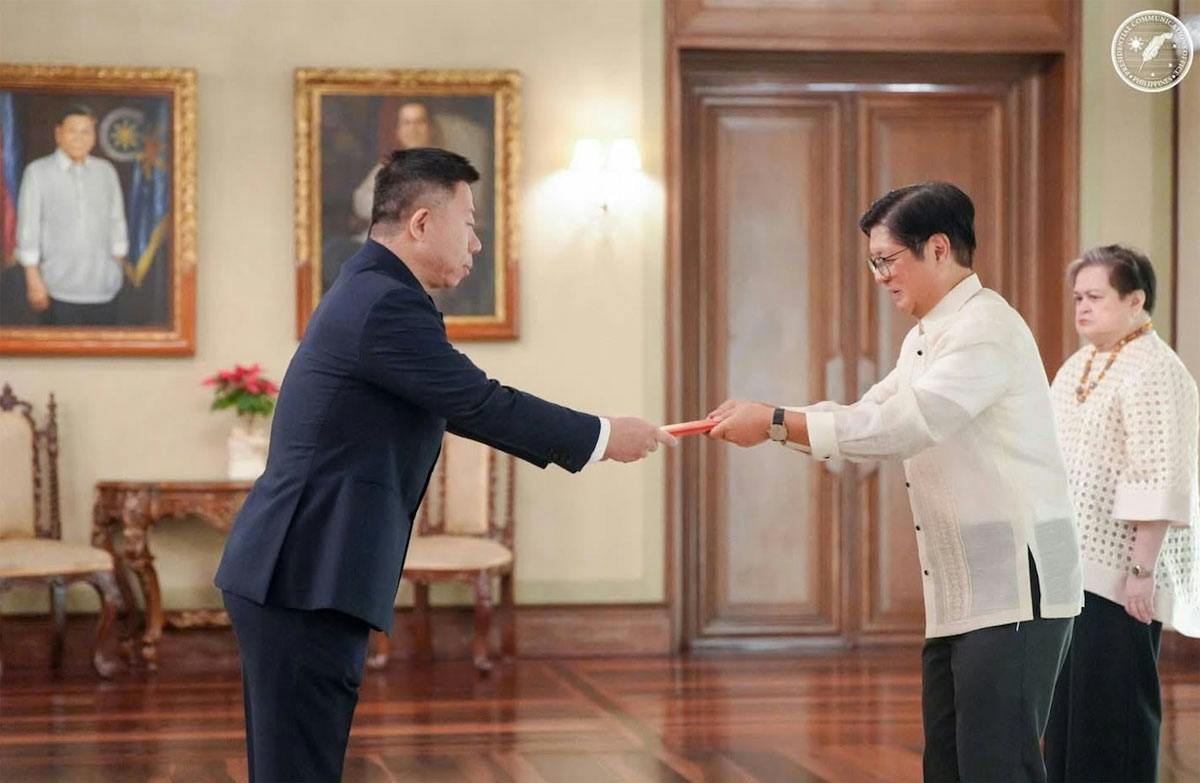
Chinese Ambassador Jing Quan’s remark that Beijing could “easily win” a conflict with the Philippines has drawn the attention of President Marcos, who would like to have a word with the envoy over what he really meant.
“It sounds very much to me like a threat, and it is not a very diplomatic statement to be made. So we perhaps would like to understand what exactly it is that he means,” the President told reporters on the sidelines of the 125th founding anniversary of the Philippine Coast Guard (PCG) on Friday, Oct. 16.
“I think that deserves a discussion between the ambassador and myself,” Marcos said, when pressed if he was going to summon Jing.
Jing on Thursday, Oct. 15, dismissed as “nonsense” Defense Secretary Gilberto Teodoro Jr.’s description of China as the region’s “troublemaker,” accusing the Philippines of fueling tensions while insisting that Beijing prefers peace despite its military strength.
In an interview on the sidelines of the second Diliman Dialogues in Quezon City, the Chinese ambassador said: “If we want to use force, we may easily win. But no, we will not choose force and we love peace.”
“We should feel fortunate enough that you have a neighbor like China in this region,” he said, citing conflicts in Ukraine, Gaza and Venezuela as reasons countries in East and Southeast Asia should cherish regional peace.
Jing’s remarks came a day after Teodoro said China, not the Philippines, was the source of regional tensions, pointing to Beijing’s actions in the West Philippine Sea and its disputes with other countries.
“Who’s the troublemaker?” Jing asked, challenging the characterization and accusing Philippine authorities of targeting Chinese teachers and arresting Chinese workers whom he described as innocent.
He also accused critics of spreading what he called groundless allegations against China and inciting hostility between the two countries.
The ambassador also defended continued diplomatic engagement despite disagreements over the West Philippine Sea, saying maritime disputes should not be used to restrict cooperation in trade, investment and people-to-people exchanges.
On military-to-military communications, Jing said keeping channels open was important to prevent misunderstandings and possible conflict. He argued that dialogue should not be treated as a concession by either side, but as a way to manage differences and reduce risks.
He urged Manila and Beijing to discuss maritime disputes directly, maintain a safe distance between their forces and seek ways to manage tensions.
Worrisome
Teodoro expressed belief that Jing’s statement may be part of a bigger plan.
“We are really examining this statement, because it wasn’t just a slip of the tongue. There is actual substance to those statements. At the very least, the true intent has been laid bare: in the same statement, he claims they want peace, yet immediately follows up by saying they can use force – and that we would lose. That is a threat. That is the true essence of that statement. We are being intimidated,” Teodoro said over radio dzMM.
“We aren’t looking for a war. We just want to be treated with respect. Imagine, they actually made a statement like that. At the same time, it’s as if they’re insisting, ‘You have to talk to us.’ Right? I suspect this is happening because inter-agency committees are uncovering their activities. Things like the continued operation of POGOs, the issue of fake steel, illegal mining, human trafficking and various other illicit acts. I believe this series of statements has emerged because they’ve hit a blank wall; the usual avenues they rely on are no longer open to them,” Teodoro added.
The Department of Foreign Affairs (DFA) had denounced Jing’s remarks.
“It is regrettable that Chinese Ambassador Jing Quan today had a poor choice of words that would seem to convey a thinly veiled threat of the use of force, which is hardly helpful in the context of the complicated bilateral ties between the Philippines and China,” the DFA said in a statement issued late Thursday.
“It is hoped that all diplomats accredited to the Philippines take greater care in the language used in public statements so as not to further erode mutual trust and confidence, nor derail the advancement of dialogue and constructive engagement,” the department added.
Apology sought
Senators rebuked Jing, with Sen. Risa Hontiveros demanding the diplomat be declared persona non grata if he fails to issue a formal apology.
“Very unambassador-like statements. You’re an ambassador, you’re a diplomat. Why are you talking about war? He should know diplomacy is the better alternative to war. They can beat us? So who’s the troublemaker now?” the senator told reporters, stressing that merely summoning the envoy is no longer enough.
“He must retract his statement and formally apologize to the Filipino people and our government for such remarks,” Hontiveros said.
“If he refuses to do that, he should be declared persona non grata,” she added.
Sen. Erwin Tulfo, vice chairman of the Senate committee on foreign relations, issued a separate statement asserting that the country will not back down from military intimidation.
“Our sovereignty is not negotiable, our dignity is not for sale and our resolve must never be mistaken for weakness,” Tulfo said.
Deputy Speaker Paolo Ortega V said in a statement such remarks from China does not offer security. “It is asserting dominance and expecting silence in return. That is the opposite of peace.”
Deputy Speaker Jefferson Khonghun meanwhile cited China’s continued water-cannoning, ramming and blocking of Philippine vessels, which only shows that its purported restraint is only “selective and conditional.”
Mamamayang Liberal Party-list Rep. and Senior Deputy Minority Leader Leila de Lima described the envoy’s statement as the “language of a liar and an invader who lacks sincerity in promoting peace.”
Akbayan wants Jing to be kicked out of the country over what the party described as a “brazen threat” against the Philippines.
“Ambassador Jing Quan should go home,” Akbayan president Rafaela David said. – With additional reports from Mark Ernest Villeza, Michael Punongbayan, Neil Jayson Servallos, Andrew Ronquillo and Daphne Galvez


