


Leading EDSA Revolution Was ‘Atonement’ For FVR — Biographer
According to his family biographer, the late former president Fidel V. Ramos always wanted to be on the right side of history.
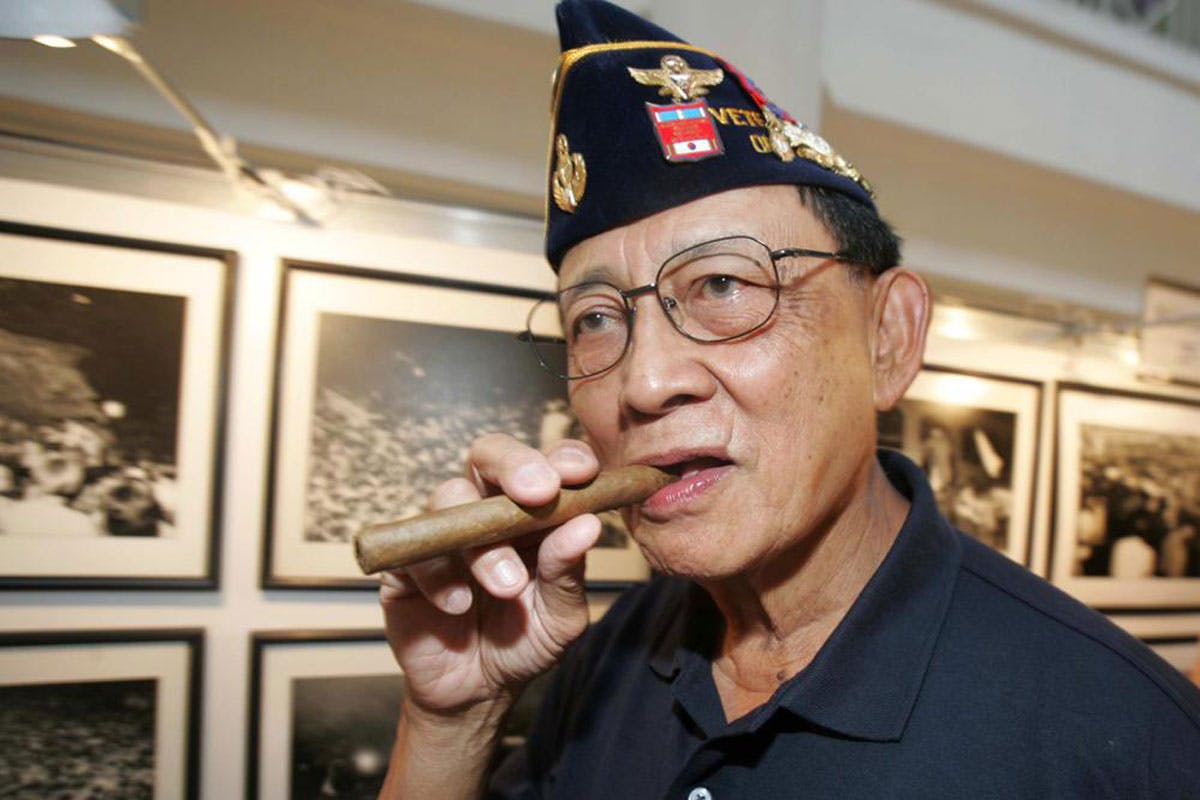
Being one of key personalities of the EDSA people power revolution that led to the ouster of then dictator Ferdinand Marcos Sr. served as an atonement for former President Fidel V. Ramos, according to his family biographer.
“Basically, sa kanya (for him), the atonement was leading the EDSA revolution, it was sort of being sorry for it (being part of the dictatorship). Ganun ‘yung gusto niyang [iparating] (That’s what he wanted to convey),” Melandrew Velasco, a newspaper columnist and author, said over “Wag Po!” on One PH on Monday, Aug. 1.
According to Velasco, even before the EDSA revolution happened in 1986, there was already a rift between the Ramoses and the Marcos family. Ramos and Marcos are second cousins.
“But the Ramoses, in fairness to their family, including their old man Narciso, there was really a division, a rift, it started in 1983, when (former senator Benigno) Ninoy Aquino (Jr.) was assassinated,” Velasco said, referring to the assassination of the opposition senator and known archenemy of Marcos.
Ramos served as the chief of the Philippine Constabulary for 14 years. He was appointed to the position in 1972 by Marcos Sr., his second cousin, shortly before martial law was declared. The arrests that immediately followed Proclamation No. 1081 that placed the country under martial law were carried out by the PC.
“If former defense secretary Juan Ponce Enrile was martial law’s chief architect, Ramos was its chief enforcer,” veteran broadcast journalist Patrick Paez wrote.
But “FVR has long redeemed himself of this past. A look back at his public career shows how the decisions he made at critical times may explain why history has been kind to him,” Paez said, noting that the public started disassociating Ramos from Marcos around 1981.
“The West Point graduate and Korean War veteran has been made deputy chief of staff. Yet he was passed up for promotion as AFP (Armed Forces of the Philippines) chief of staff in favor of (then general) Fabian Ver, also a cousin of the president (Marcos) and a long-time head of security,” Paez noted.
“Martial law may have seemed to (then) General Ramos a reasonable and constitutional response to the events prior to September 1972: student radicals stormed Malacañang; a young army Lt. Victor Corpuz defected and led a daring New People's Army raid on the armory of the Philippine Military Academy; the military intercepted a huge arms shipment from China by the NPA; and the bombing of the Liberal Party miting de avance in Plaza Miranda was being traced to the communist party,” Paez said.
“By 1981, however, the promise of a ‘new society’ was unraveling. The economy was in freefall. The communist insurgency was gaining strength. It was fortuitous that FVR was not on top of the AFP,” Paez added. “FVR saw another appointment with history coming and when the moment came in February 1986, he chose to be on the right side of it.”
Ramos also stood by the late former president Corazon Aquino, who was installed following the EDSA revolution, through seven coup attempts.
Aquino then anointed Ramos as her candidate in the 1992 presidential election.
“FVR failed to get the ruling LDP (Laban ng Demokratikong Pilipino) party to back him. But he would still emerge winner, with a new political party of his own, the Lakas-NUCD (National Union of Christian Democrats),” Paez said.
Ramos, more popularly known as “FVR” and who was president from 1992 to 1998, died on Sunday, July 31 from COVID-19 complications. He was 94.
FVR strengthened democracy
It was Aquino who restored democracy in 1986, but it was Ramos who strengthened it, former senator Franklin Drilon said.
Drilon, who served in various posts in the Cabinet of the two late leaders, said Ramos deserved the monikers “Steady Eddie” and “Stabilizer-in-Chief” given his ability to remain calm and not lose sight of the big picture in the face of daunting challenges and during tense situations.
“President Cory restored our democracy, but it was president Ramos who really strengthened the institutions of democracy. He maintained the principle that democracy is the best way of life for us,” Drilon told “The Chiefs” on One News on Monday night, Aug. 1.
“He defended these institutions of democracy when he was a member of the Cabinet. But when he became president, he strengthened them so that today there is no threat to our democratic system of government,” Drilon added, referring to the seven attempts to overthrow Aquino by forces loyal to the late strongman. At that time, Ramos was Armed Forces chief, and later appointed as defense secretary.
Drilon also recalled that Aquino made a very difficult decision of endorsing Ramos as her successor, against the recommendation of her allies, friends, and her brother, Jose “Peping” Cojuangco, who was her closest political adviser.
“President Cory made that decision alone. It was her judgment that president Ramos would be the best person to succeed her and she was correct,” Drilon said.
Regret
Meanwhile, Velasco also disclosed that Ramos somehow regretted endorsing former president Rodrigo Duterte in the 2016 elections.
Ramos had a short stint in the Duterte administration, serving as special envoy to China from July 2016 until his resignation in October that same year.
The Ramos biographer recalled the discussion that he had with the former president in the latter’s office sometime in February 2017.
“He told me, ‘Mel, I think you're right. I may have made a mistake in endorsing that guy,’” Velasco shared.
Velasco said Ramos disagreed with Duterte’s policies and style of running the country.
“There might be some disagreements, the way the country was being ran. Iba ‘yung kamada niya (His style was different) as far as governance is concerned. As we looked back there were instances that he was critical of the Duterte administration,” the biographer said.
But Ramos cared for another former president, Gloria Macapagal-Arroyo, treating her as his own daughter even after she faced controversies, such as the “Hello Garci” scandal.
The “Hello Garci '' scandal, which erupted in June 2005 after a telephone conversation of Arroyo supposedly ordering Commission on Elections official Virgilio Garciliano to rig the 2004 election results in her favor, led to mass protests and charges of electoral fraud against Arroyo.
“FVR treated GMA like [his] own daughter. So talagang inalagaan niya ‘yung political career ni President Arroyo (He really took care of President Arroyo’s political career). But somehow, somewhere along the way, hindi sila nagkaintindihan (there have been misunderstandings),” Velasco said.
“When she was offering to resign and saying sorry to the nation over the scandal, it was FVR who saved the day. He was the white knight,” he added.
Among those who asked for Arroyo to resign was the so-called “Hyatt 10” composed of seven Cabinet secretaries and three heads of government agencies who left their posts following election fraud charges against their former boss.
“Many blamed him for saving Gloria, but there was an underlying reason why he did that,” he lsaid. According to Velasco, Ramos thought that no one was ready to take over the presidency should Arroyo leave Malacañang. At the time, the vice president was Noli de Castro.
How should the people remember Ramos? Velasco described the former president as “a reformer, a peacemaker, a consensus builder and an inclusive president.”
“When I say inclusive president, lahat tayo (all of as) are riding on one ship: the Philippines,” he said.
Inurnment
The inurnment of the cremated remains of Ramos at the Libingan ng Mga Bayani is set on Aug. 9 at 10 a.m., his grandson said on Tuesday.
Sam Ramos-Jones said the family “is truly grateful for the overwhelming outpouring of support and well wishes.”
“As we grieve, let us also celebrate a rich life – dedicated in service to this nation and its people,” Ramos-Jones said in a statement, announcing that the late president’s wake will begin tomorrow at Heritage Park in Taguig City where all guests are encouraged to wear white.
The family also thanked the Office of the President, the Armed Forces, as well as friends and supporters for helping with the funeral arrangements.
To help manage the flow of guests and better adhere to COVID-19 precautions, the family has designated certain dates and times for groups and sectors wanting to visit the wake.
On Thursday, Aug. 4, from 7 a.m. to 2:30 p.m., the schedule will be for government officials, 3 p.m. onwards will be for members of the Ramos Cabinet while evenings are reserved for tributes.
The following day, Aug. 5, the same schedule will be followed, with the first batch allotted for government officials, followed by members of the diplomatic corps, the business community and civil society organizations.
It will be followed by former members of the Malacañang Press Corps, the Defense Press Corps, and the Foreign Correspondents Association of the Philippines.
On Saturday, Aug. 6, the first batch will be for veterans, members of the military and law enforcement, and the West Point Society, followed by members of the Rotary Club in the afternoon. Sunday would be the start of the public viewing that will last until Monday.
Instead of flowers, the Ramos family is requesting contributions be made to any of the following charitable institutions: Veterans Memorial Medical Center, Philippine Red Cross, Hero Foundation, Inc., ABS-CBN Lingkod Kapamilya Foundation, Inc., Center for Health Improvement and Life Development (CHILD) Haus, JG Patnubay Foundation, and the Ramos Peace and Development Foundation, Inc. (RPDEV).