



Former DA Official Sees Food Crisis By End Of 2022
Based on data, former Department of Agriculture undersecretary for policy, planning, and research Fermin Adriano said there will be insufficient supply of rice, sugar, pork, chicken and even onions that will lead to a food crisis.
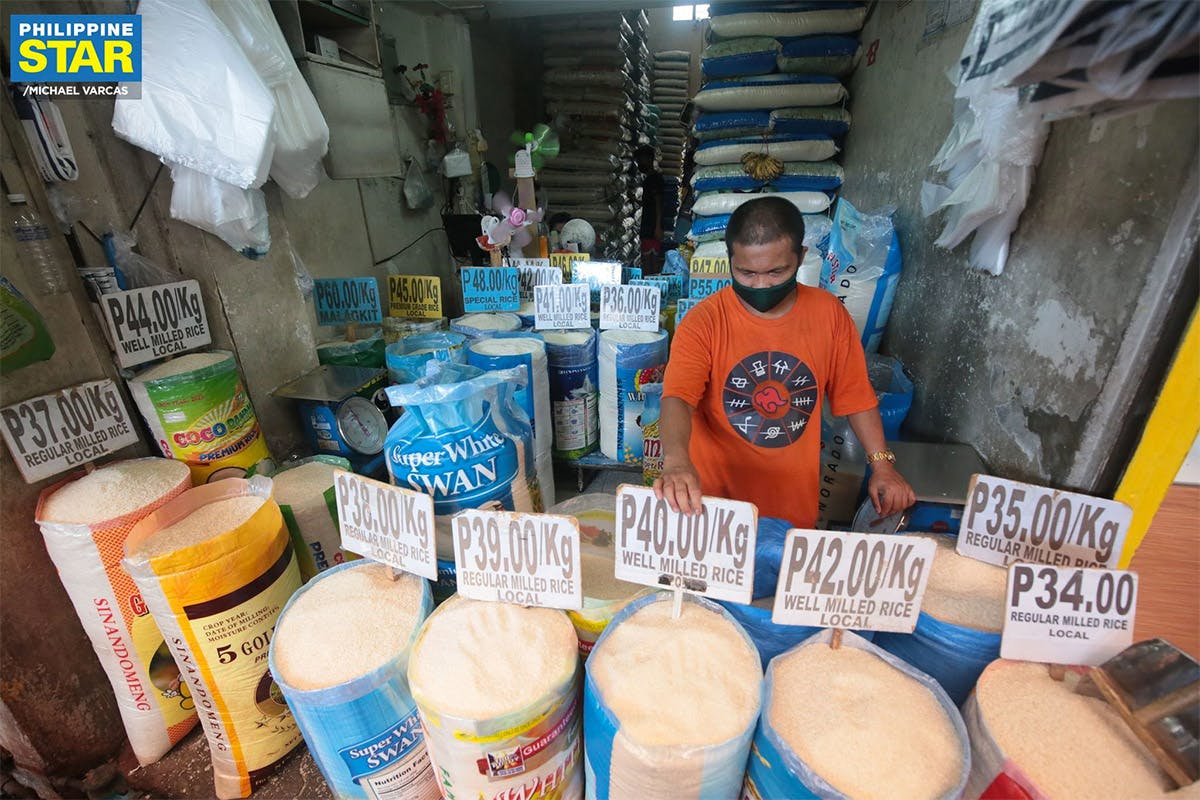
A former agriculture undersecretary has warned that the Philippines would experience a food crisis by the end of the year due to several factors.
Based on data, former Department of Agriculture (DA) undersecretary for policy, planning, and research Fermin Adriano told “Agenda” on One News on Thursday, Sept. 8, there will insufficient supply of rice, sugar, pork, chicken and even onions in the coming months.
“For example, rice, we did not apply the right fertilizer, so then it (production) will decline by about a million metric tons (MMT),” he said.
The government, Adriano added, also does not want to import rice amid soaring prices because it wants the country to produce its own supply and “be self-sufficient.”
By October, Adriano said the prices will increase by P2 to P4 per kilogram.
In July, President Marcos, who concurrently serves as agriculture secretary, said the government will increase the production of rice and corn to stabilize food prices instead of resorting to importation.
Adriano, who served as the information director of the University of the Philippines System and vice-chancellor of UP Los Baños, explained that his bold projection was also based on the possible effects of the reported collusion between Vietnam and Thailand to “become a cartel” and “dictate prices” in the international market.
The Philippines imports rice primarily from Vietnam, Burma, China, Thailand, and India.
Based on data from the Bureau of Plant Industry, the Philippines’ rice imports reached 1.9 MMT as of July this year. According to a report by the United State Department of Agriculture, the country is expected to continue importing rice by as much as 3.1 MMT for 2022 and 2023.
Rice is included in the basket of goods used in the computation of inflation.
The Bangko Sentral ng Pilipinas recently announced that the headline inflation eased to 6.3 percent year-on-year in August from 6.4 percent in the previous month, primarily due to slower increases in the prices of heavily-weighted food items, such as meat and fish.
Aside from insufficient rice supply, the former agriculture official also cited problems with pork, chicken, sugar, and onions in the country.
“We have a problem with pork because the ASF (African swine fever) is again a problem. We have a problem with avian flu, we culled about two million heads of layers already…in Minalin, Pampanga – and that avian flu is spreading fast,” he said.
Since the DA confirmed the first outbreak in July 2019, as of July 2022, 53 provinces, 704 cities/municipalities, and 3, 832 barangays have experienced ASF outbreaks.
In a memorandum dated Aug. 1, 2022, the DA-Bureau of Animal Industry also confirmed the presence of Asian avian influenza subtype H5N1 in 17 provinces throughout the country. The outbreak was confirmed to have entered the Philippines in January 2022.
Adriano likewise noted that “problem with sugar now, we all know that.”
“So all in fronts,” he said, adding that even the stock of white onions has been depleted as early as July.
Earlier, Marcos noted that the country would continue to import pork and chicken due to the ASF and the avian flu. He also previously said the Philippines may need to import 150,000 MT of sugar in October since the supply of the commodity would have dwindled by that time.
Now that there is an “uncertainty” on the government’s importation policy, Adriano pointed out that “it boils down again” to the issue of whether we can determine if there is a shortage or not.
Food security woes
Adriano also cited the protracted implementation of the Comprehensive Agrarian Reform Program (CARP) – otherwise known as the Comprehensive Agrarian Reform Law – for food security woes.
The CARP is the redistribution of private and public agricultural lands to help the beneficiaries survive as small independent farmers, regardless of the “tenurial” arrangement.
“Napakaliit na po ng lupa, less than a hectare, so no matter what subsidy the government gives, it cannot really provide a decent income to the farmers kung less than a hectare ‘yung sinasaka mo,” he said.
The solution, according to Adriano, is to encourage farmers to do farm consolidation where they “will have to convince that there should be a production schedule for their operations just like what happened in Vietnam, China, and Thailand.”
“It is not land property consolidation, but just production scheduling properly, so that we can put the necessary or provide the necessary irrigation, etc. It's much, much easier for [the] government to extend the services,” he said.
Adriano also highlighted the need to invest in technology as “studies have shown that the highest return” in agriculture is “investment in research and technology.”
“You need a lot of technology support, information dissemination, training for our farmers, because the battle now in agriculture is not about land, it's neither about machines or something like that, the battle now in agriculture is technology,” he said.


