


EDSA 1986 Memories: ‘Luhod Tayo, Luhod!’
There are moments in your life when you toss your cares into the wind and take a stand. And there are times when making that stand actually means taking a knee.
Much as I wanted to, I didn't get to cast a vote during the Feb. 7, 1986 snap elections.
I was a third year journalism student then. I reached voting age just three months earlier, but I wasn't a registered voter yet because elections weren't slated to take place until 1987.
But being the dictator he was, Ferdinand Marcos unilaterally decided to announce a snap election during his Nov. 4, 1985 interview with US talk newscaster David Brinkley on ABC News. The rubber stamp interim Batasang Pambansa had to play catch-up with Marcos' surprise decision and pass a law just to legitimize it.
It was just the way things were. Marcos dictated, and everyone else was supposed to follow.
But the times were changing.
When Marcos appeared on television on the evening of Feb. 22, 1986 to present two junior officers as part of an assassination plot by rebel soldiers against his family, I remember that many of us dismissed it as just another lie. that's the problem with lying – when you do it too often, no one believes you when you're finally telling the truth.
The memory of that broadcast is still vivid in my mind because I remember turning off the TV set in disgust and just calling it a night, unaware that in Camp Aguinaldo, rebel troops were already mobilizing. Over the radio, then Manila Archbishop Jaime Cardinal Sin was calling on the people to go out and protect the rebels.
The next day, Sunday, I woke up to the news of the rebellion over the radio. Enrile and Ramos had holed up in Camp Crame, and people were converging along EDSA.
After attending mass at the UP chapel, a schoolmate and I headed to EDSA to join the gathering crowds. But in Cubao, the bus had to let us off because the road was blocked. We got off and decided to walk the rest of the way to Camp Crame.
Topping the rise of P. Tuazon, it became clear why the road was blocked. From P. Tuazon, one could look southward at a sea of heads and shoulders bobbing up and down like coconuts along Metro Manila's biggest thoroughfare. It was surreal. Even after months of taking part in large rallies, one always tried to manage expectations. After all, people were still afraid, if not completely terrified, of what Marcos could do.
Those were days of uncertainty and disquiet, of rage and frustration that were building up to a crescendo. People had been gathering courage to go out into the streets to demand more freedoms and reforms, and underground newspapers provided a steady stream of information that government-controlled media kept out of the public eye. The Palace was crowded with plotters, the air was rife with conspiracies, and the economy ground to a halt, and then slid into the red.
But on that early Sunday afternoon, nothing could prepare us for the sight of all these people who suddenly occupied EDSA as if it was the most natural thing to do.
And so we waded into the crowd, smiling, chatting, talking to strangers, reveling in the newfound courage that we now shared with each other. the fear remained, certainly, because Marcos was still in power and he was clearly not going to take this lightly. But to see all these people taking a giant step, making that leap of faith, it suddenly made the gamble all worthwhile.
On the southbound lane, we spotted two trucks of heavily armed soldiers stranded in the sea of people. It wasn't clear if they were rebels on standby or government forces sent to attack. What was clear was that they were being wooed by people with bags of food, bread, and drinks.
At the gates of Camp Crame, people were climbing over, or handing bags of food through the steel bars of the fence. the gates were closed as a security measure, so the more athletic ones went up and over the metal fence to the relative unsafety of the police camp. I made a mental note to climb over the fence later. I did that the next day.
It was a long trek to Ortigas, where we heard government forces were gathering. But it certainly wasn't a lonely walk. Filipinos were out in force, many with entire families, laying claim to their own portion of EDSA for the day.
In Ortigas, fronting what is now Robinson’s Galleria, was an even bigger crowd. Several armored personnel carriers of the Philippine Marines, called LVT-5s, squatted on the westbound lane of Ortigas.
Civilians usually call them tanks because of their size and their tracks, although nothing bothers soldiers more than hearing their personnel carriers get called a tank. The LVT-5 is a 38-ton behemoth built by a company curiously called Food Machinery Corporation in 1954. It's an amphibious tracked vehicle that can carry 34 soldiers into battle inside its cavernous body. Some of them have a 105mm Howitzer on a turret on top.
That day, two LVT-5s were parked abreast along Ortigas, with several other Marine armored personnel carriers (APCs) and vehicles in a column formation. All around them were heavily armed Marines in their green leaf camouflage uniforms, nervously fidgeting with their firearms as the crowd pressed against them, chanting and wooing them at the same time to switch sides.
I spied a group of people in a heated argument and sidled up closer to listen. A marine officer in Marine camouflage but wearing a ballcap was arguing with Agapito “Butz” Aquino, brother of Benigno “Ninoy” Aquino Jr., who was assassinated in 1983. I remember reading the nametag of the marine officer: Tadiar. Later I would learn that he was general Artemio Tadiar, the commandant of the Philippine Marine Corps. and in the Marines, the commandant is next only to God almighty.
Ranged against him was Butz and several other opposition figures. Tadiar was telling Butz to clear out the people because he had orders to go to Camp Crame. Butz replied that he could not let the Marines do that because bloodshed would surely erupt. Tadiar tried to reason with Butz, saying they would just talk to the rebels. Butz was having none of it, saying that they were likely to start shooting at each other as soon as they see the armored column.
That argument went on for several minutes. At times, Butz would turn to the crowd and ask, “Padadaanin ba natin sila? (Are we going to let them pass through?)” and the crowd would roar, “Hindi! (No!)” At one point, Butz even managed to climb on top of one of the LVT-5s with a megaphone to rally the people to stay put and prevent the convoy from moving forward. the sight of Butz using LVT-5 as a platform must have upset Tadiar, because he ordered Butz to get off.
Tadiar tried to get Butz and the crowd to move away one last time, to no avail. To this, people started shouting, “Huwag padaanin, huwag padaanin!” People started squatting or kneeling before what they believed was the front of the massive steel beasts to prevent them from maneuvering towards EDSA.
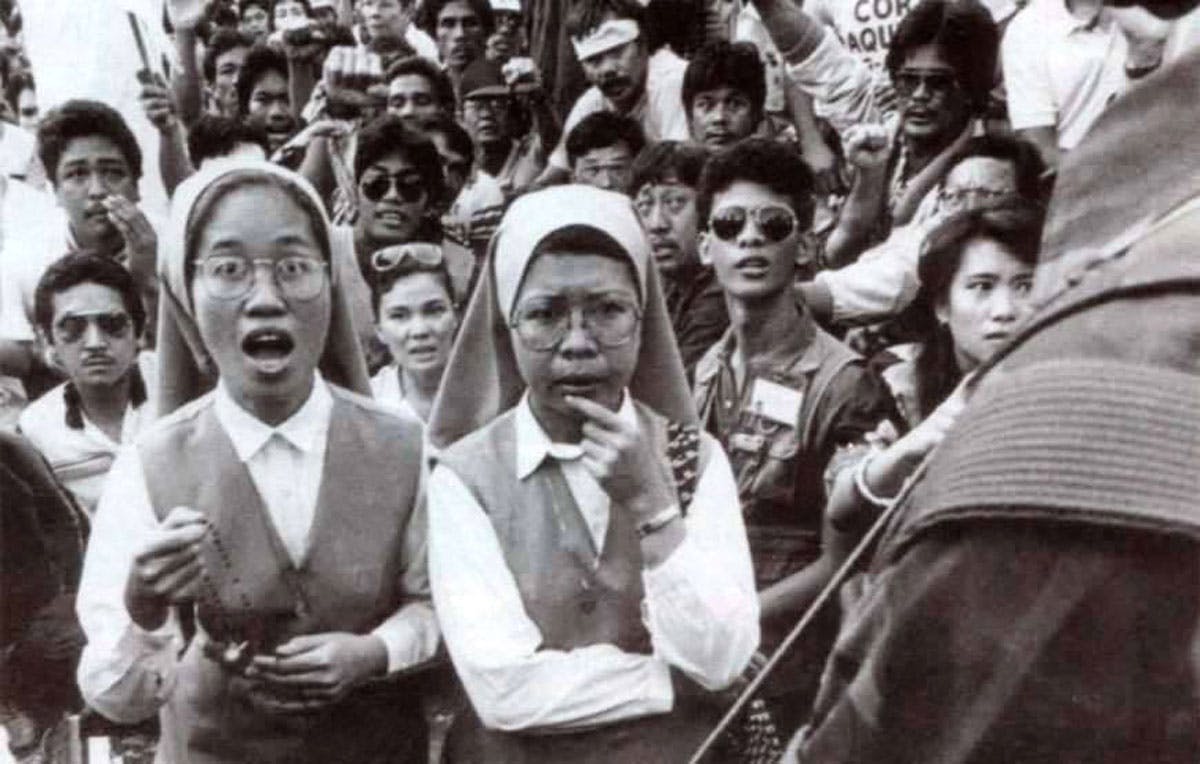
I really don't recall any conscious decision to plop myself between an APC and EDSA. At that point, at that moment, it just felt like the most natural and commonsensical thing to do. With the mid-afternoon sun bearing down on us, and while helicopters clattered overhead, we sat or knelt on the road to prevent the vehicles from moving. I remember two nuns in front of me, and Butz and several of his colleagues and supporters behind me. To my right, I think, squatted the activist Lorna Verano-yap. To my left, I would later learn, was the noted photographer Mandy Navasero.
The nuns started praying the rosary, although I doubt if anyone really counted the Hail Marys. Then we sang “Bayan Ko” and the “Lord’s Prayer.” Repeat the cycle.
In the meantime, the Marines who were earlier standing around the LVT-5s seemed to have disappeared. A heavily-bundled Marine who I earlier saw was hefting an M-16 with an M-203 grenade launcher and several belts of ammunition across his chest also disappeared.
Then the engine of the LVT-5 in front of us coughed to life.
It was a heavy rumbling that you could hear and feel as well on your chest. Clouds of black smoke puffed out of the exhaust pipe on top. The driver was revving the engine, and we thought, nah, he was just trying to frighten us to move away. Dasal pa, dasal pa.
And then the huge machine jerked forward suddenly by a few inches. That caused everyone to panic and fall down on their hands. “Walang aalis,” we called out to each other, “walang aalis! luhod, luhod!” There was fear and anguish on the faces around. But there was determination in their eyes. In those few seconds, I am almost certain a million thoughts and memories must have crossed everyone’s minds. It's just how we are wired. As for me, I just thought: I guess this is where you have to be.
And so we all stayed.
Then, a phalanx of news photographers and cameramen who were earlier busy taking photos and footage rushed up to the LTV-5 and pressed their hands to the hot metal as if to try to push them back. It was all symbolic of course. But the symbolism still rings with a message today: these people were there to do their jobs and cover an event; but at a crucial moment, they decided to take a side.
With that, people stood up and pressed against the LVT-5 to make sure that it wouldn't move anymore. I remember touching the metal with the palm of my hands. I wasn't bearing any of its weight, but it somehow felt unbelievably heavy. And it later struck me what a machine like that could do to a person who stood or knelt in its way.
With nowhere to go, the driver turned off his engine. When the machine fell silent, it was bedlam. People screamed and shouted for joy. Strangers were hugging, clapping and patting each other on the back. We had won.
Later in the day, the Marines negotiated to be allowed to park in the empty lot that is now Robinson’s Galleria, where people presented them flowers and gifts and notes of thanks for a day that could have been bloody but had turned out peaceful and victorious.
After that day, it felt like there was no way we could lose. No way.
I earlier said I failed to cast my vote in the Feb. 7, 1986 snap elections.
But it's OK. I cast my vote in EDSA instead.