


DepEd: Full In-Person Classes Start Nov. 2; Schools Open Aug. 22
The Department of Education has set the opening of classes in public schools for the next three years every August while full face-to-face classes must be implemented beginning Nov. 2.
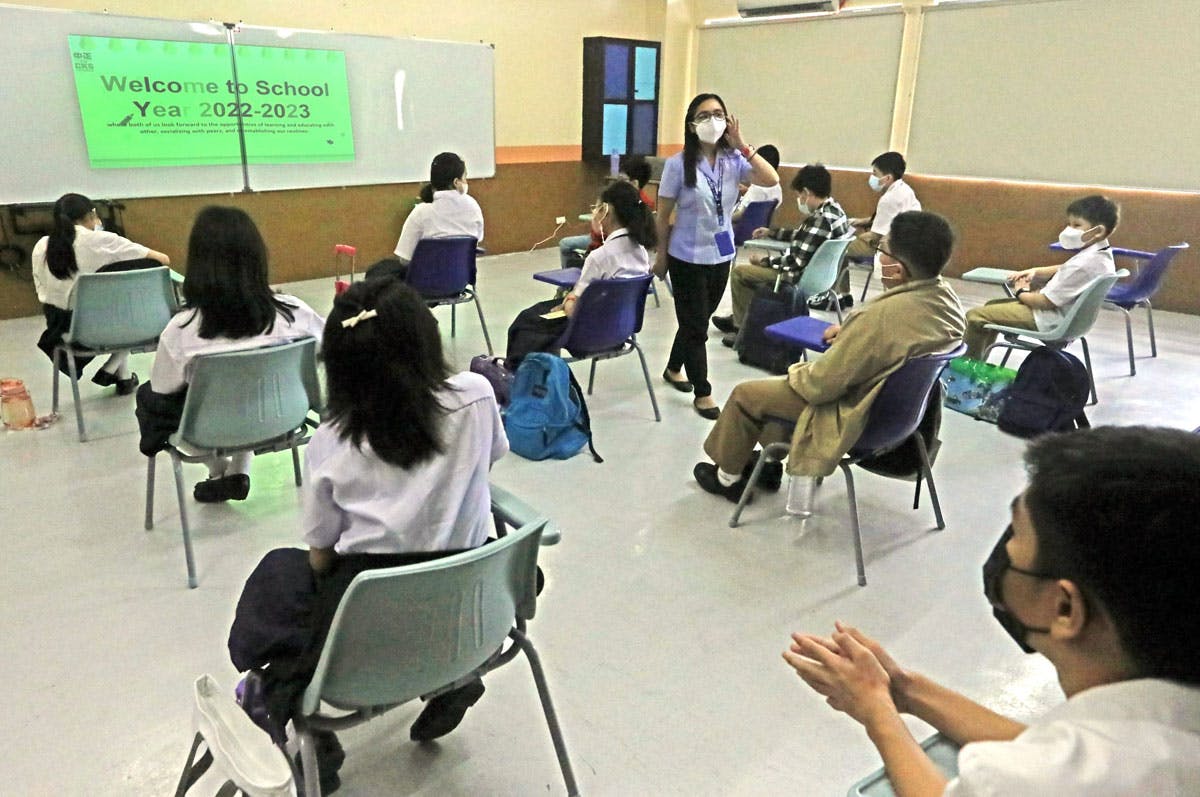
In her first order as secretary of the Department of Education (DepEd) and following an earlier pronouncement by President Marcos, Vice President Sara Duterte has mandated that all elementary and high schools all over the country, whether public or private, must implement full face-to-face classes starting Nov. 2.
“Starting Nov. 2, 2022, all public and private schools shall have transitioned to five days in-person classes. After the said date, no school shall be allowed to implement purely distance learning or blended learning except for those that are implementing alternative modes,” read the order, which is contained in DepEd Order 34, Series of 2022 publicized on Tuesday, July 12.
The order stated that school year (SY) 2022-2023 shall formally open in public schools on Aug. 22, 2022 and shall end on July 7, 2023.
Veering away from the pre-pandemic schedule of opening schools every June, the DepEd also set the start of classes in public schools for the next three years every August.
“Unless otherwise amended, the period of SY 2023-2024 will start from Aug. 28, 2023 to June 28, 2024 and SY 2024-2025 will be from Aug. 26, 2024 up to June 27, 2025. A separate DepEd order shall be issued for the school calendars of the respective school years above,” the order read.
Like in previous years, private schools were allowed to deviate from the DepEd’s school calendar, provided that they start classes not earlier than the first Monday of June and not later than the last day of August.
Under existing law, only the President – when the country is under a state of emergency or calamity – can set the school opening outside of the said period.
The coming SY shall consist of 203 schools days, which “shall solely be dedicated to academics and related co-curricular activities,” according to the DepEd.
Extracurricular activities are prohibited.
Based on the calendar, the Christmas break will be from Dec. 19, 2022 to Jan. 3, 2023.
A midyear break is also scheduled from Feb. 6 to 10, 2023, while remedial classes are set from July 17 to Aug. 26, 2023.
Options
To give schools ample time to adjust to the transition, the DepEd said those that have yet to implement five days of in-person classes are allowed to hold blended or full distance learning classes until Oct. 31.
The agency said no inspections, tools or any additional requirements to reopen schools and implement full in-person classes shall be required, except for compliance with the usual pre-pandemic regulatory permits and licenses.
It added that the guidelines shall apply regardless of the COVID-19 alert level imposed by the Inter-Agency Task Force (IATF) for the Management of Emerging Infectious Diseases or the Department of Health (DOH) in areas where the schools are located.
“The general policy of the DepEd on this (is that) regardless of the alert level, we will move to or go on face-to-face classes,” DepEd Undersecretary Epimaco Densing III said at a separate press briefing.
“However, we will now leave it to the IATF, that if there a surge and that the DOH would recommend eventually that we cease to do face-to-face classes … we will just follow the decision of the IATF,” Densing added.
Under the guidelines, schools are allowed to hold in-person, online or hybrid orientation for stakeholders at the start of the school year.
“The transition to five days of in-person classes presents learners with new stressors and challenges. This entails adjustment to the school environment, learning modality and additional safety protocols, as well as managing the mix of pleasant and difficult feelings,” the order read.
“Hence, providing psychosocial support during the first week of the school year is imperative in promoting, protecting and prioritizing the learners’ socio-emotional well-being, and developing their coping skills for this transition,” it added.
Ready, but…
The Teachers’ Dignity Coalition (TDC), which earlier requested that the opening of classes be moved to mid-September or early October, said it is ready to fulfill its responsibilities should the opening of classes push through on Aug. 22.
TDC chairman Benjo Basas, however, reiterated the need for teachers to have ample rest, especially if in-person classes will fully resume by November.
“We continue with our call to our secretary, VP Sara Duterte, for a dialogue,” Basas said in Filipino.
He earlier noted that teachers continue to render services even if classes have officially ended last month.
“There are still graduation and completion ceremonies; we have to do reading of forms and prepare documents for our performance rating… In the coming weeks until August, teachers will have to do other work such as in-service trainings, Brigada Eskwela and other back-to-school and enrolment activities,” Basas said.
For the Alliance of Concerned Teachers (ACT), the DepEd must meet certain requisites before full face-to-face classes are implemented next school year.
These include doubling the school maintenance and operating budget to ensure ample facilities and supply to implement health protocols, employing additional teachers to reduce class sizes, hiring more nurses and utility personnel, ensuring health protection of teachers and non-teaching staff, providing aid for families affected by the economic crisis and conducting a learning assessment of students to guide curriculum adjustments.
“These are some of the requisites for a safe back-to-school program this year because we need to address the ‘old normal’ problems to enable a safe 100 percent school reopening,” ACT president Vladimer Quetua said.
“It would be hard for students, teachers and parents to all go to school and encounter another surge of COVID-19, so we need to be careful and prepared,” Quetua added.
Private schools
Meanwhile, private school groups have asked Duterte to consider allowing them to implement blended learning beyond the Oct. 31 set by the DepEd.
“Respectfully, we will continue to appeal to our Education Secretary Sara Duterte to allow the hybrid and online options in private schools in addition to face-to-face classes,” Coordinating Council of Private Educational Associations of the Philippines managing director Joseph Noel Estrada said.
“(We) hope we can be heard on behalf of the schools, and especially the parents who still prefer their children to have an online component (hybrid) when they go back to face-to-face clas-ses. Some still have hesitations due to the rising number of cases recently, vaccination of young children and issues on public transport, among others,” Estrada added.
Federation of Associations of Private Schools and Administrators president Eleazardo Kasilag said FAPSA members are “unanimous” in opposing the full resumption of face-to-face classes by November.
“FAPSA’s rallying point is to appeal to the DepEd secretary to allow us to continue our classes the way we had announced them earlier. Others have had consultation already with parents and it is hard to flip flop on the opening and the modality that was agreed on,” Kasilag said.
“FAPSA believes the new secretary shall understand the plight of the suffering private schools,” he added.
Monitoring
Amid these developments, the Commission on Higher Education (CHED)-Central Luzon has started doing on-site monitoring of higher education institutions (HEIs) in the region to de-termine their readiness for limited face-to-face classes this school year.
CHED regional director Leonida Sigua-Calagui said that while HEIs have been allowed to reopen their campuses for limited face-to-face classes, this would still depend on their readiness amid the threat of the COVID-19 pandemic.
Calagui added that HEIs must comply with the requirements, which include a permit from the IATF, before they are allowed to start face-to-face classes.
Part of CHED’s on-site monitoring is the evaluation of the HEI’s learning continuity plans and student affairs services delivery programs, according to the official.
She said CHED will provide technical assistance to colleges and universities in the implementation of limited face-to-face classes.
“CHED-Central Luzon remains its partner in delivering quality higher education in the region,” she said in a social media post.
Learning spaces
The United States government, through the US Agency for International Development (USAID), has partnered with the DepEd to launch a training program on co-creating learning spaces for the future.
The Leaders in Futures of Education (LIFE) course will teach teachers and administrators how to collaboratively design and plan for innovative future learning spaces that will maximize children’s language and literacy.
After the course, participants will develop local prototypes of future learning spaces.
“We are taking this challenge even beyond this administration,” former Education undersecretary Nepomuceno Malaluan said.
Within the overall framework of the DepEd’s long-term goal for the Basic Education Development Plan 2030, Malaluan underscored that the goal of enhancing the capabilities of the coun-try’s education leaders and movers remains relevant, especially within and beyond crises and uncertain futures.
Fifty school leaders and teachers from the National Capital Region, Calabarzon (Cavite, Laguna, Batangas, Rizal, Quezon) and Tuguegarao enrolled in the LIFE course.
Through its All Children Reading Philippines project, the USAID aims to improve early grade reading skills for 100 million children by supporting the DepEd.
“I hope that this course will help our education partners gain the necessary tools and insights that will help you come up with innovative ways to design and create a better education for the future,” USAID Philippines acting education director Yvette Malcioln said.
The US government has been a key development champion in the Philippines for over 60 years, working with individuals, communities and the government to improve everyday lives.
Free college
In other developments, an expanded free tertiary or college education is being sought by Sen. Ramon Revilla Jr., who wants to include government subsidies for private higher education institutions.
Revilla has filed Senate Bill 29, which seeks to amend Republic Act 10931, or the Universal Access to Quality Tertiary Education Act, that would provide greater coverage of the government’s tertiary education subsidy.
He said the bill aims to expand the coverage of the tertiary education subsidy as provided for in the original law by introducing a voucher system that will allow indigent and academically competent students to enroll and study in private HEIs and technical-vocational institutions (TEIs).
“Similar to the voucher system that the Department of Education is already implementing, financial assistance in the form of vouchers will be provided to qualified tertiary students. The subsidy will not be given to the learner in cash and instead, will be paid directly to private HEIs,” he added.
The senator noted that the bill aims to have a “proportional budgetary allocation” to increase the access of Filipino students to tertiary education and promote the complementarity be-tween public and private HEIs and TEIs.
He pointed out that when enacted, the measure will help achieve and operationalize a provision in the updated Philippine Development Plan 2017-2022, which encourages the United Financial Assistance System for Tertiary Education or UniFAST Board to “implement a voucher system and improve the loan system to give students a choice in school, whether public or private, and educational tracks, whether technical-vocational education track or higher education, before the enrollment period.”
He said the bill likewise provides that all beneficiaries of the Tertiary Education Subsidy shall continue to receive such benefits until they complete their higher education degree program or post-secondary technical-vocation course as long as they do not fail in any subject enrolled in and comply with the residency requirements.
Revilla vowed to push for the passage of the measure to help more families send their children to college or in technical-vocational training courses.
“We should fast-track the passage of this bill with the noble intention of ensuring that the youth, especially those belonging to the poor, will have more doors of opportunities opening for them through quality education,” he said.
6% of GDP
Makabayan party-list groups have filed a joint resolution seeking to allocate six percent of the country’s gross domestic product (GDP) to education.
Representatives France Castro of ACT Teachers, Arlene Brosas of Gabriela and Raoul Danniel Manuel of Kabataan have co-sponsored House Bill 1783 that proposes “highest budgetary priority to education.”
The bill proposes that six percent of the GDP be allocated to the DepEd, state universities and colleges, Technical Education and Skills Development Authority and other “agencies and instrumentalities with mandates directly related to education.”
The measure noted that the public expenditure on education as percentage of the GDP “remains below the higher limits of the United Nations Educational, Scientific and Cultural Organization standard of six percent of the GDP.”
Citing World Bank statistics, the bill indicated that the Philippines’ public expenditure for education “never breached 4.4 percent from 1980 to 2020.”
“Hence, it is also among the worst countries in the Asia-Pacific region in terms of public expenditure for education,” the measure read.
It underscored that instead of looking at the allocation as spending, it must be viewed “as high-yield investments for the country’s future – our people’s children, the next generation of Filipinos.” – With Ric Sapnu, Pia Lee-Brago, Cecille Suerte Felipe, Sheila Crisostomo