Anti-China Caskets Dumped Around NCR
Edited pictures of Chinese President Xi Jinping, Foreign Minister Wang Yi and Chinese Ambassador Jing Quan, appearing dead and eaten by worms, were seen inside the caskets.
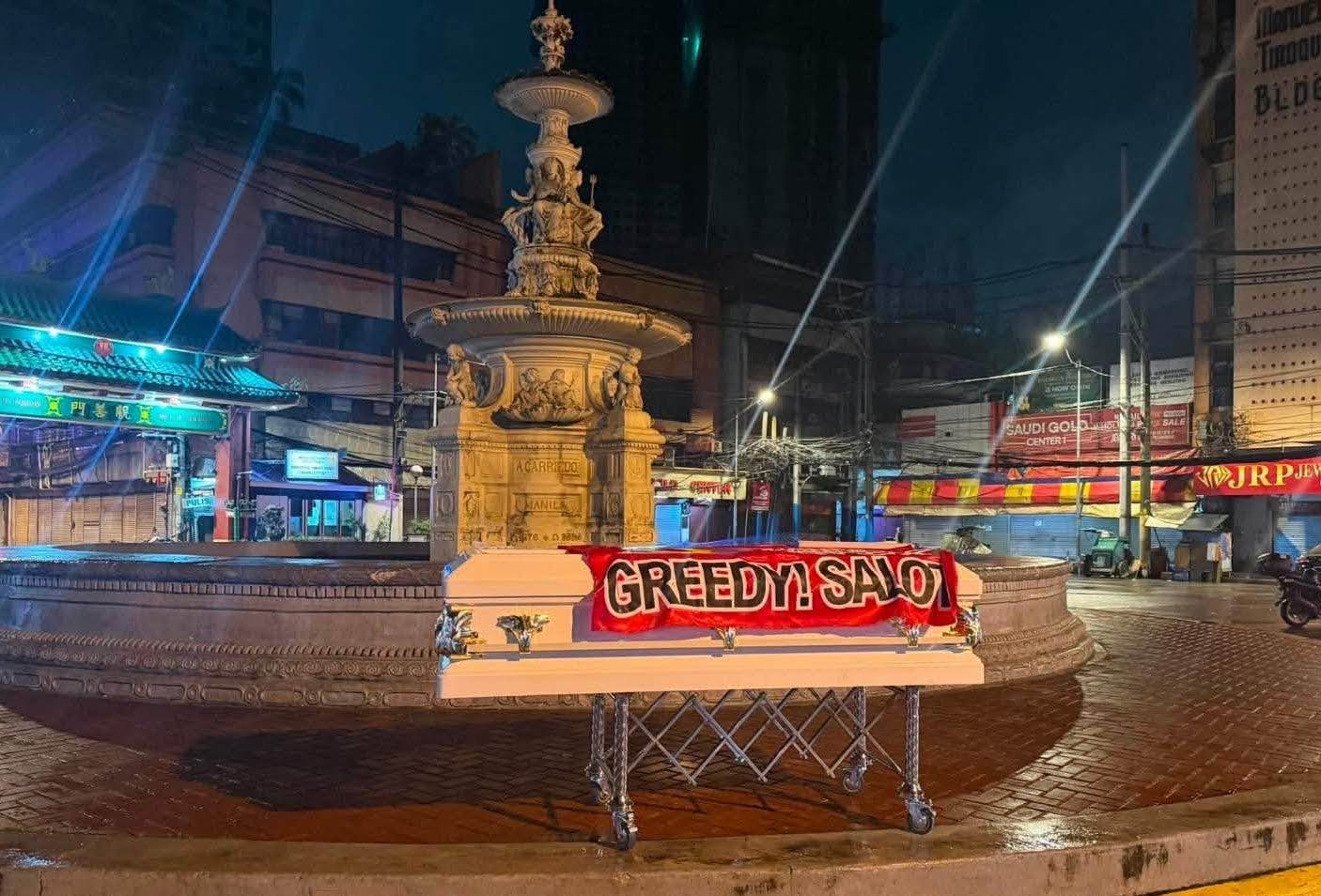
Police are investigating the appearance of five empty caskets with anti-communist and anti-China slogans across Metro Manila on Friday, Aug. 7, as no group has claimed responsibility for the stunt.
The caskets were discovered in Sta. Cruz, Manila; Barangay 54 in Caloocan; Barangays South Triangle and Teresita in Quezon City and along Gil Puyat Avenue in Makati.
The caskets were draped with red flags bearing the name of the Communist Party of China, with the words “Greedy!” and “Salot! (plague)”
Edited pictures of Chinese President Xi Jinping, Foreign Minister Wang Yi and Chinese Ambassador Jing Quan, appearing dead and eaten by worms, were seen inside the caskets.
Philippine National Police chief Gen. Jose Melencio Nartatez Jr. said the caskets and other materials found have been secured as part of the investigation to track down the responsible people and if laws or local ordinances were violated.
The coffins were left around 2 a.m. to 4 a.m. by masked individuals in gray and white vans, National Capital Region Police Office (NCRPO) director Maj. Gen. Anthony Aberin said, citing witness accounts and closed-circuit television footage.
He urged people with knowledge on the matter to coordinate with local police stations.
“This cowardly act will not be left unpunished. The NCRPO will ensure that the identity of those who are behind these acts will be uncovered and criminal cases will be filed upon completion of the investigation,” he said.
Palace slams stunt
While Malacañang respects every Filipino’s right to freedom of expression, placing caskets around to hit China does not help in advancing the country’s interests, Palace press officer Claire Castro said.
“If you are patriotic, please cooperate with our government to address your issues. Do not be a source of fear, intimidation or unrest,” she noted.
Reacting to the incidents, the Department of Foreign Affairs (DFA) said it “does not condone acts or threats of violence against any individual, including foreign nationals or officials. Such irresponsible and disrespectful acts cannot be tolerated.”
“While the Philippines upholds the right to freedom of expression, the DFA emphasizes that this right does not extend to threats of violence or acts that endanger the safety and security of others,” the agency added.
The DFA said such display does not represent how the country conducts foreign relations, nor does it embody how Filipinos express criticism or dissatisfaction.
“The Philippine government reaffirms that it takes seriously its duties and obligations concerning the safety and security of foreign nationals and officials in the country,” it added.
China outraged
The Chinese embassy in Manila dubbed the incident as “a blatant act of political provocation, personal attack and intimidation and threat, of a most egregious nature.”
“The Chinese embassy strongly condemns this despicable and shameless act and has made solemn representations to the Philippine side, urging it to immediately conduct a thorough investigation, bring the perpetrators to justice in accordance with the law and take all necessary measures to effectively safeguard the security and legitimate rights and interests of Chinese diplomatic and consular missions, institutions and personnel in the Philippines,” embassy spokesman Ji Lingpeng said.
“This incident once again shows that there are always people who, out of ulterior motives, spare no effort to stoke hatred and incite confrontation between the Chinese and Philippine peoples,” he added.
Ji noted that the Chinese embassy “is committed to ensuring that China-Philippines relations remain stable rather than strained, and that the peoples of our two countries grow closer rather than further apart.” – With additional reports from Michael Punongbayan and Helen Flores