



AFP Apologizes For Falsely Branding UP Alumni as NPA Rebels; IBP Says Red-Tagging ‘Illegal’
The office of Deputy Chief of Staff for Civil-Military Operations Maj. Gen. Benedict Arevalo, which administers the Facebook page, is conducting an internal investigation “as to how the list got published” on Thursday, Jan. 21.
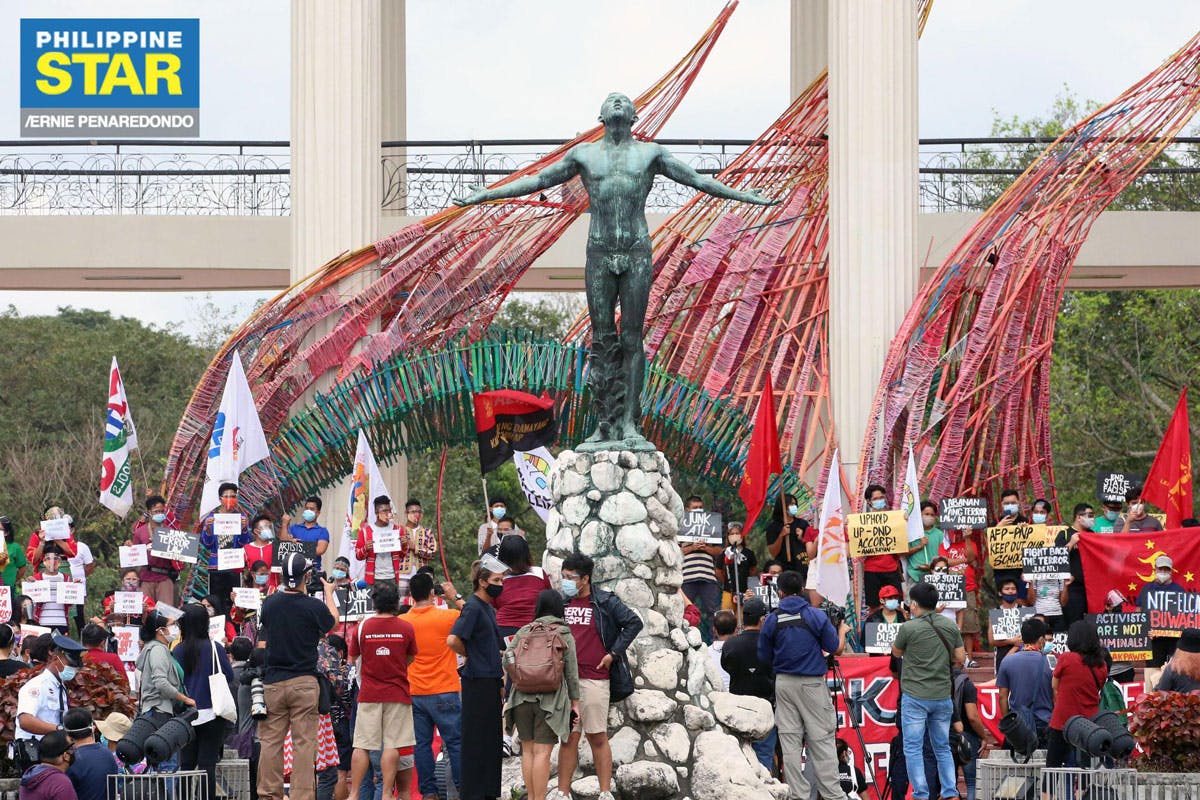
An office of the Armed Forces of the Philippines (AFP) has apologized for “inadvertently” accusing several prominent alumni of the University of the Philippines of being killed or captured members of the New People’s Army or NPA as the Integrated Bar of the Philippines (IBP) said “red-tagging is unfair, illegal, and disregards due process and the rule of law.”
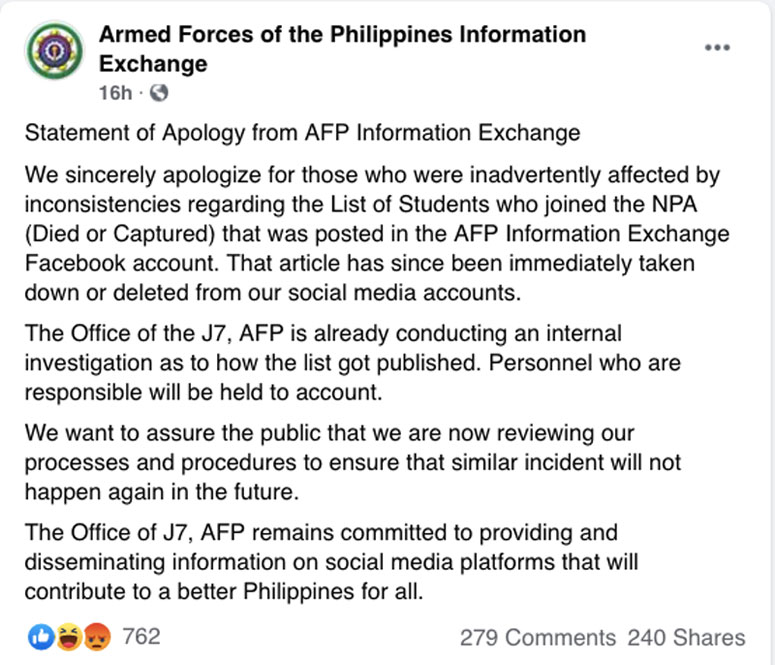
In a statement late Sunday night, Jan. 24, the AFP Information Exchange posted a statement on its Facebook page, saying: “We sincerely apologize for those who were inadvertently affected by inconsistencies regarding the List of Students who joined the NPA (Died or Captured) that was posted in the AFP Information Exchange Facebook account.”
It said the office of Deputy Chief of Staff for Civil-Military Operations Maj. Gen. Benedict Arevalo, which administers the Facebook page, is conducting an internal investigation “as to how the list got published” on Thursday, Jan. 21.
The office is “now reviewing our processes and procedures to ensure that similar incident will not happen again in the future,” according to the statement.
“The Office of J7, AFP remains committed to providing and disseminating information on social media platforms that will contribute to a better Philippines for all,” it said.
An earlier statement by the AFP Information Exchange, posted on Sunday 5:07 p.m., did not include any apology despite demands by the affected alumni – who threatened to take legal action, including cyberlibel complaints and asking the Supreme Court to cite the military officials in contempt in connection with the ongoing petitions questioning the constitutionality of the Anti-Terrorism Act.
Among the alumni tagged by the AFP Information Exchange included Alexander Padilla, the government’s former chief negotiator in the now-scuttled peace talks with the NPA, and Roan Libarios, a member of President Duterte’s very own Consultative Committee that was tasked to review the 1987 Constitution.
Defense Secretary Delfin Lorenzana had said the AFP would apologize as early as Sunday afternoon, but the AFP Information Exchange initially limited itself to saying that “inconsistencies regarding the list of some of UP students who became NPA was brought to our attention” and that “clarifications and appropriate actions will be promptly done.”
These developments came after Lorenzana on Jan. 15 unilaterally terminated the 1989 agreement requiring law enforcers to notify UP officials before entering its campuses, even if critics pointed out that there was no exit clause allowing him to do so.
UP Diliman chancellor Fidel Nemenzo on Sunday evening expressed “grave concern” about the possibility that the AFP may be implicating many more alumni and students in the 50-year-old insurgency on the basis of “a military database that is riddled with factual errors,” notwithstanding the billions of pesos of confidential and hard-to-audit intelligence funds at the government’s disposal.
In a statement on Monday, Jan. 25, the IBP vouched for its former national president Libarios, as well as fellow lawyers Padilla and Rafael Angelo Aquino.
Aquino is a Free Legal Assistance Group member representing Senators Francis Pangilinan and Leila de Lima, Quezon City 6th District Rep. Jose Christopher Belmonte, Rappler chief executive officer Maria Ressa and many others in one of the 37 petitions against the Anti-Terrorism Act.
“The named lawyers are not members of the New People’s Army (NPA). They were never captured. They are very much alive, not dead. They are responsible and respected Filipino lawyers who serve well our country in various capacities and meaningfully contribute to nation-building,” the IBP, which filed its separate petition against the ATA, said.
The mandatory organization of lawyers, through its national president Domingo Egon Cayosa, urged authorities to “right the wrong and set firm policies against red-tagging.”
It said it supports peace and order campaigns “carried out in accordance with law and established legal processes, with due regard for the fundamental rights of citizens,” but not “false and reckless publications, shortcuts and questionable means” that destroy the “very rights, public interests or principles that we all seek to protect.”
The IBP said red-tagging “compromises the security and safety of the subjects, besmirches their reputation, causes unwarranted risks, tension and distress to their families, friends and loved ones.”
It called out “misleading claims not only for the sake of its members but for all victims of similar red-tagging.”
If lawyers and “people of stature” were not being spared by reckless and false accusations of membership in the NPA, the IBP said it will also cause “terror and prejudice… to ordinary citizens who have no means or opportunity to clear themselves as they are unduly threatened, attacked, or even killed by the misguided and the unscrupulous.”
Otherwise, they “weaken the state that we claim to defend,” the IBP stressed.
Prior to the AFP Information Exchange post that attacked UP alumni, Lorenzana himself was criticized for showing a list of UP students who were allegedly killed in military encounters with the NPA during a Jan. 20 briefing.
The list included UP Cebu student Myles Albasin – who was captured alive in Mabinay, Negros Oriental, on March 3, 2018 and is currently detained in the Dumaguete City District Jail pending trial for charges of illegal possession of firearms and explosives.
In an open letter shared through the Facebook page of Kapatid – Families and Friends of Political Prisoners, Albasin’s mother Grace said she “feared for my detained daughter's as well as our family's safety, given how, under this government, such lists have become a tool of terror, a mark of death.”
“My daughter has been incessantly vilified through videos and memes on social media, and through tarps and posters in public places. Have you now marked her, and we, her family, for death?” asked the elder Albasin, a former editor-in-chief of SunStar Cagayan de Oro City.
“But there's the rub. With their vaunted billions in intelligence funds, it is hard to believe this was a mere error. I believe it was deliberate, intended to send a message,” she wrote.


