



A Matter Of Jurisdiction: Who Should Resolve ABS-CBN’s Issues?
The network wants the Supreme Court to throw out the quo warranto case. The solicitor general does not attend the Senate’s inquiry. The House Speaker is bickering with his former Senate colleagues.

Are they legal or political? ABS-CBN Corp.’s franchise issues are messy enough, but the question of jurisdiction is further complicating the public discussion.
The network wants the Supreme Court to throw out the quo warranto case filed by the Office of the Solicitor General and leave it up to Congress to decide whether to renew its franchise in light of alleged abusive practices raised by the OSG.
Meanwhile, Solicitor General Jose Calida declined the Senate public services committee’s invitation to a hearing on ABS-CBN’s compliance with the terms and conditions of its franchise.
He said it would be “sub judice” for him to answer questions regarding the issues he had raised before the SC. The sub judice rule directs parties to refrain from publicly discussing “matters under or before a judge or court, or matters under judicial consideration.”
Another match took place as House Speaker Alan Peter Cayetano called his former Senate colleagues “sipsip” or suck-ups for holding a hearing on the network’s issues on Feb. 24 even before his chamber, which has the authority to issue, renew or revoke broadcast franchises, has decided on the issue.
Case meant for Congress, not SC?
As one of the arguments in its 58-page answer to the OSG’s quo warranto case, ABS-CBN said the SC has no jurisdiction over the case because only Congress can revoke a legislative franchise.
The network cited Section 11, Article 12 of the 1987 Constitution, which states that a franchise cannot be “granted except under the condition that it shall be subject to amendment, alteration, or repeal by the Congress when the common good so requires.”
One of the conditions set under Section 14 of Republic Act (RA) No. 7966, which granted ABS-CBN its franchise, states that legislators reserve the power of “amendment, alteration or repeal by the Congress of the Philippines when the public interest so requires.”
There is a similar provision in Section 18 of RA 8332, the franchise charter of Multi-Media Telephony, Inc., which is used by subsidiary ABS-CBN Convergence, Inc.
ABS-CBN said Section 1, Article 8 of the Constitution defined “judicial power” as the duty of courts to “settle actual controversies involving rights which are legally demandable and enforceable.” On the other hand, it pointed out that the OSG conceded that a franchise is “not a right... rather, it is a privilege subject to regulation.”
Since a franchise is a privilege granted by Congress and not a right, ABS-CBN said “these decisions involve policy determination – or political questions.” Thus, the network asked the SC “not to preempt Congress’s exercise of its power” to tackle the pending bills for the renewal of its franchise.
In the House website, the committee on legislative franchises was described as having jurisdiction over “all matters directly and principally relating to the grant, amendment, extension or revocation of franchises.”

2009 Divinagracia case not a precedent?
The OSG, in resorting to a quo warranto case, invoked the SC’s pronouncement in its April 7, 2009 decision in the case of Divinagracia versus Consolidated Broadcasting System Inc. The decision described quo warranto as a “more appropriate, more narrowly tailored and least restrictive remedy that is afforded by the law.”
But ABS-CBN argued that this was a mere “obiter dictum,” or “an opinion expressed by a court upon some question of law that is not necessary in the determination of the case before the court.”
In the Divinagracia case, the company was accused of violating an explicit provision in its franchise to offer at least 30 percent of stocks to the public. The SC said the petitioner should have opted for quo warranto instead of asking the National Telecommunications Commission (NTC) to cancel its certificate of public convenience.
ABS-CBN argued that the case did not actually concern the franchise granted by Congress. Instead, it revolved around the NTC’s powers. Hence, it said the SC’s comment on the nature of a quo warranto case should not be taken as a binding precedent.
The network also argued that the OSG did not dispute the grant of the franchises or their validity. Hence, they cannot be deemed to have committed any usurpation in the subject of a quo warranto case.
Hierarchy of courts
ABS-CBN pointed out that the OSG violated the hierarchy of courts, which mandates that cases be taken first to the lower courts instead of going directly to the highest tribunal in the land.
The OSG cited the Oct. 8, 2019 decision on Ang Nars Party-list versus the Executive Secretary, in which the SC relaxed the rules “in the best interest of all concerned” since labor rights were at stake. This case revolved around the order of then president Gloria Macapagal-Arroyo to downgrade the pay of government-employed nurses to Salary Grade 11, despite the Philippine Nursing Act providing for a minimum base pay of Salary Grade 15.
Calida wanted the same exception on the ground that ABS-CBN is the “largest media conglomerate in the country,” and therefore its ability to shape public opinion and its perceived abuse of its franchise are “a matter of public concern that calls for an action by the State that granted the franchise.”
ABS-CBN argued that the quo warranto case was not comparable to Ang Nars, and said the issues – not the identity of the parties – should determine the “transcendental importance” of a case. It pointed out that the OSG did not even explain “how it found the issues raised in its petition so compelling as to justify invoking this Honorable Court’s jurisdiction in the first instance.”
This view was shared by two University of the Philippines College of Law professors, Theodore Te and Antonio La Viña.
Te said the quo warranto case “falls squarely” under the rule set by the SC in its March 12, 2019 decision on Gios-Samar Inc. versus Department of Transportation and Communications. In this decision, the SC stated it would no longer entertain petitions that raise factual issues directly before it, without first presenting evidence in a trial before the proper trial courts or the Court of Appeals. La Viña said the solicitor general should have first raised the issues before the NTC or the Securities and Exchange Commission.
Congress’ battles
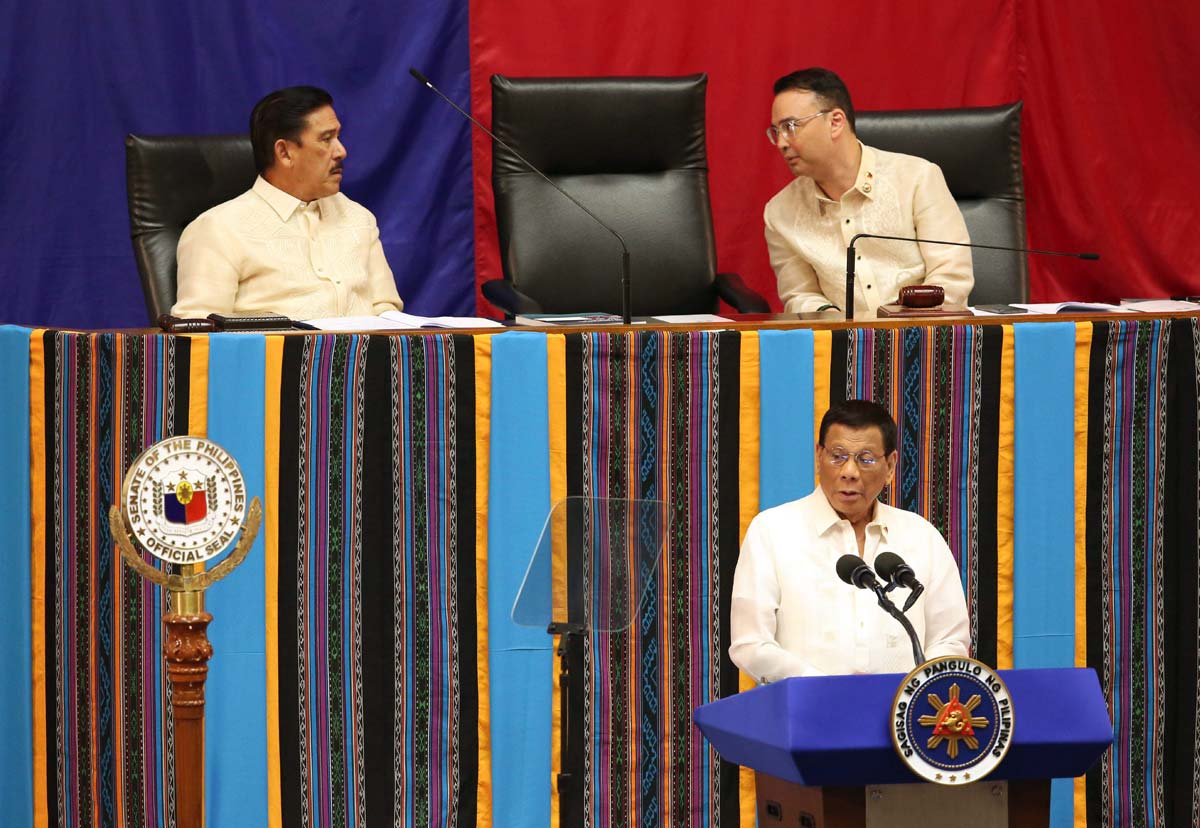
Although ABS-CBN would rather have Congress resolve its issues, its two houses have fought over whether the Senate public services committee could inquire into the issues that were raised by the OSG in its quo warranto case.
Cayetano on Feb. 20 expressed annoyance at Senate public services committee chairperson Sen. Grace Poe and other senators for not acting immediately on the moves to amend the Constitution, while forging ahead with a hearing on ABS-CBN’s issues. He argued that Section 24, Article 6 of the Constitution provided for franchise bills, as well as appropriation and taxation bills, to originate from the House.
The subtext of Cayetano’s statement was that the Senate should discuss ABS-CBN issues only after the franchise expires either on March 30 (the 25th anniversary of the law) or May 4 (the 15th day counted from the publication of the law). He told reporters that the House would only tackle the pending franchise bills in May or August.
Cagayan de Oro 2nd District Rep. Rufus Rodriguez on Feb. 12 quoted Palawan 1st District Rep. Franz Alvarez, chair of the legislative franchise committee, as saying that the reason its proceedings on the ABS-CBN franchise bills were delayed was because “wala pang clearance sa itaas (there is no clearance yet from the higher-ups).”
Cayetano had expressed disdain for ABS-CBN in the past; during the 2016 elections, he accused the network of failing to air his television advertisement in support of his running mate, now President Duterte.
However, Poe stressed that the Senate was a “co-equal” branch of government. Majority Leader Juan Miguel Zubiri pointed out that it was common practice for the Senate to hold committee hearings on the budget even before the House, from which the General Appropriations Act must originate under the Constitution, approves it on third and final reading. This was to save time and ensure the passage of the budget before the fiscal year began.
“By practice, by tradition and by precedence, we have discussed and debated on committee level issues on the budget, which should emanate from the House, as well as tax measures that can be discussed on committee level simultaneously with the House, provided that we do not approve the committee report ahead of the House,” Zubiri said.
Poe also pointed out that the same practice was followed for other priority measures of Duterte, such as the Tax Reform for Acceleration and Inclusion law. “Kailangan nating panatilihin ang balance at separation of powers (We need to maintain the balance and the separation of powers). We need to know the truth and we need the public to hear it,” she said.
Minority Leader Franklin Drilon, meanwhile, viewed the issue “both from the legal and practical standpoint” by emphasizing that there were only a few session days left before the expiration of the franchise.
Duterte’s steadfast allies in the Senate gave more consideration to the other branches of government. This time, Sen. Francis Tolentino asked: “Out of respect to a co-equal branch of government, the Supreme Court for that matter, isn’t it correct and judicious to defer to the highest tribunal in so far as the ABS-CBN issue is concerned?”
Drilon on Feb. 20 said holding the hearing would “assert that we have jurisdiction” over the matter, and insisted that the sub judice rule should not apply to the Senate because of its legislative work.
“We are a co-equal branch, and we are not subordinate to the Supreme Court. So we can conduct our own hearings. As long as there's no constitutional issue, we can continue,” he said.