



TRABAHO Bill: Not So Fast
The government is being urged to conduct more dialogues on the proposed measure so that the TRABAHO Bill will live up to its name – create more jobs and not the other way around.

Fireworks lit up the night sky over Araneta Center on Wednesday night, July 24. It looks as if it’s Christmas in July, but it’s actually just Araneta Center holding a Partners’ Night for the different locators and companies that have helped in the successful growth of Cyberpark, the business process outsourcing (BPO) development inside Araneta Center.
It was a star-studded night as the six Binibining Pilipinas beauty queens, led by 2019 Miss Universe Philippines Gazini Ganados, graced the party along with executives from BPO locators, development partners and Araneta Center officials.
The company plans to build five state-of-the-art towers within the eight-hectare development in the next five years. Two of the five, Cyberpark 1 and Cyberpark 2, have already been built and occupied by several locators including Alorica, Sterling, Stellar, Genesys and 24/7 In Touch. A third tower is currently under construction as well, slated for completion by next year.
What makes Cyberpark an attractive location for BPO locators apart from its accessibility and connectivity to transportation hubs is its certification as an economic zone or ecozone under the Philippine Enterprise Zone Authority (PEZA).
Cyberpark is intended to boost growth for Araneta Center and Quezon City in general. Compared to Makati, Taguig, Pasay and Muntinlupa, the city has constantly lagged in terms of development of office spaces for BPOs and other related industries, according to the 2019 Market Outlook of real estate services firm KMC Savills.

Araneta Center Inc. property manager Morriel Abogado, ACI executive director for office leasing Lorna Fabian, ASYA Design principal architect Albert Yu together with the Binibining Pilipinas 2019 queens during the Araneta Center Cyberpark Partner’s Night held at Spark Place, Araneta Center on July 24. Araneta Center’s Cyberpark 1 tower looms in the background. Photo by Ernie Peñaredondo, The Philippine STAR
That growth, however, could be dampened by President Duterte’s recent call for Congress to pass the Tax Reform for Attracting Better and High-quality Opportunities (TRABAHO Bill) as what critics of the law say.
“We have pursued tax reforms to fund our poverty-reduction programs. I therefore implore Congress to immediately pass Package 2 of the Comprehensive Tax Reform Program, or the TRABAHO Bill, which shall gradually lower the corporate income tax
and rationalize and improve fiscal incentives. It will energize our MSMEs (micro, small and medium enterprises) and encourage them to expand their business and hopefully generate 1.4 million jobs in the coming years,” the President said in his fourth State of the Nation Address on July 22.
Rationalizing incentives
TRABAHO Bill, which has been recently re-filed in Congress and renamed the Corporate Income Tax Reform Act (CITRA), aims to slash the current 30 percent corporate income tax rate — the highest in Asia — by two percentage points every two years starting 2021 until it becomes 20 percent by 2029.
In exchange for the tax cuts, the government, through the bill, wants to put a cap on the fiscal incentives that locators in various economic zones currently enjoy, making these time-bound and performance-based. (See The ‘Trabaho’ tax bill, explained)
However, the bill failed to hurdle the 17th Congress after Package 1, the Tax Reform for Acceleration and Inclusion (TRAIN) Law, brought unexpected adverse impacts on the economy.
The President isn’t ready to give up on the bill. Aside from calling Congress to re-file and pass the bill, he recently signed Administrative Order No. 18, which orders PEZA to “no longer accept, process or evaluate applications for the establishment of ecozones in Metro Manila.” The order seeks to promote the development of ecozones in the countryside and does not prevent locator companies from commencing operations in existing ecozones in the region.
The PEZA blamed the TRABAHO Bill for the 41-percent decline in the number of ecozone investments last year. With the President’s signing of Administrative Order No. 18, the PEZA sees fewer than half of the 130 pending ecozone applications pushing through.
When asked if the President’s call to pass the TRABAHO Bill will dampen Cyberpark’s growth, Araneta Center executive director for office leasing Ma. Lorna Datiles-Fabian told The Philippine STAR, “We see it as a good opportunity for us because this bill and everything they plan to do, it’s all going to help our employees. These locators are looking for the best offers for their employees and this is one of them.”
She added that Araneta Center has already talked with BPO firms and PEZA regarding plans to counter the potential impact of the bill.

An artist’s perspective of the Araneta Center Cyberpark complex, which will be composed of five BPO towers built around a central park over an eight-hectare property inside Araneta Center. Photo from Araneta Center Inc.
More dialogues needed
More than the developers, locators such as BPO companies are also welcoming the TRABAHO Bill, albeit with certain caveats.
In a statement sent to The STAR, the Contact Center Association of the Philippines (CCAP) said it is supportive of moves to rationalize the incentive regime and make provincial locations attractive to investors. CCAP currently has over 100 member companies that employ over 850,000 workers nationwide.
“CCAP has always been supportive of countryside development and we have seen success stories of CCAP member companies locating in the provinces, ” CCAP president Jojo Uligan said in the statement.
But the statement also said that CCAP wants more dialogues between the industry and government to alleviate concerns. It also continues to advocate for a “hub and spoke” model for investors, wherein locators will use Metro Manila as their landing destination in the country before expanding to rural areas.
“As CCAP promotes expansion in the provinces, it also acknowledges that there are a number of challenges to overcome in expanding to the provinces, including having the right infrastructure and the available talent pool,” CCAP said in the statement.
CCAP added that to demonstrate their commitment to rural development, they launched a partnership with the National ICT Confederation of the Philippines (NICP), which will mobilize its network of local councils nationwide in assisting provincial locations in promoting their localities to IT-BPM investors and locators.
The partnership was launched during CCAP’s annual conference, Contact Islands 2019, held on July 24 to 25 in Mactan, Cebu.
Despite concerns about the potential impact of the TRABAHO Bill and the moratorium on ecozones, the Philippines remains the leading destination of companies that are into customer experience delivery, and continues to grow faster than the global market growth rate of three to four percent despite posting a slower 5.1 percent growth last year, according to a report by Texas-based consulting firm Everest Group.
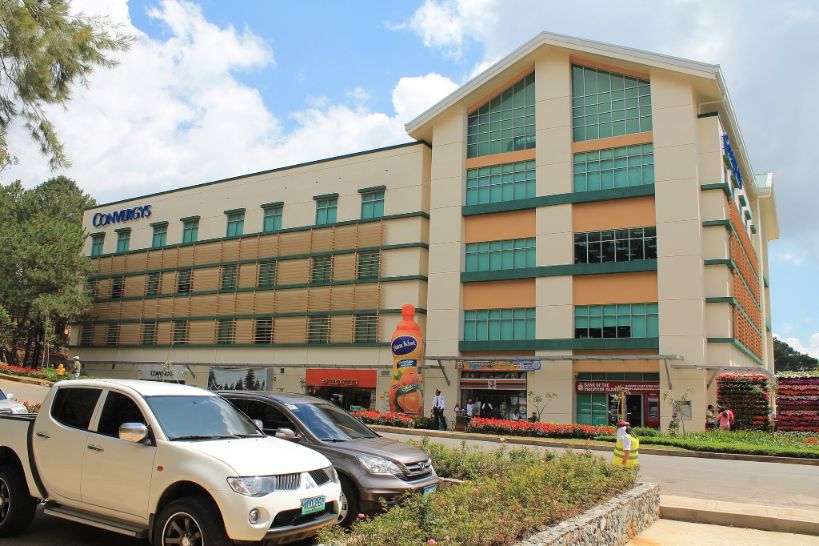
A Convergys contact center at an ecozone building in Baguio City. Under President Duterte’s Administrative Order No. 18, more ecozones in the countryside would see growth as the order puts a moratorium on the establishment of new ecozones in Metro Manila. Photo by Elmer B. Domingo from Wikimedia Commons (CC BY-SA 3.0)


