



This Earthquake-Resilient Table For Kindergaten Is Filipino-Made
The researchers want the little ones protected because they may be too young to know what to do in case of an earthquake.

To many people in Luzon, the memories of the July 16, 1990 Luzon earthquake are still fresh in their minds. The magnitude 7.8 temblor rocked northern and central Luzon, toppling weak buildings and homes and trapping people inside them. Cities like Baguio, Dagupan and Cabanatuan were among the most devastated by the quake that claimed over 1,600 lives.
One of the most memorable scenes from the quake was the collapse of the Liwag Building of the Christian College of the Philippines (CCP) and the heroism of 20-year-old student Robin Garcia. After the earthquake struck, Garcia was able to safely evacuate from the building but boldly returned to the collapsed structure to rescue trapped classmates. On his fourth try, an aftershock rocked the site, killing him.
The CCP was just one of several schools affected by the temblor. It illustrates how vulnerable schools and people in them are in such types of calamities.
In Metro Manila, where the Philippine Institute of Volcanology and Seismology (Phivolcs) predicts that an 8.5-magnitude earthquake could occur along the West Valley Fault, several public and private schools, colleges and universities are vulnerable. It creates the need for designing and building stronger, disaster-resilient school buildings.
But even in a disaster-resilient school building, there is still a risk of injury or death to students, teachers and school staff brought about by falling debris. In such cases, people could follow the usual “duck, cover and hold” method to protect themselves, which involves seeking cover under a sturdy object like a table or bed. In most public and private schools where tables are made of wood, this provides the least protection.
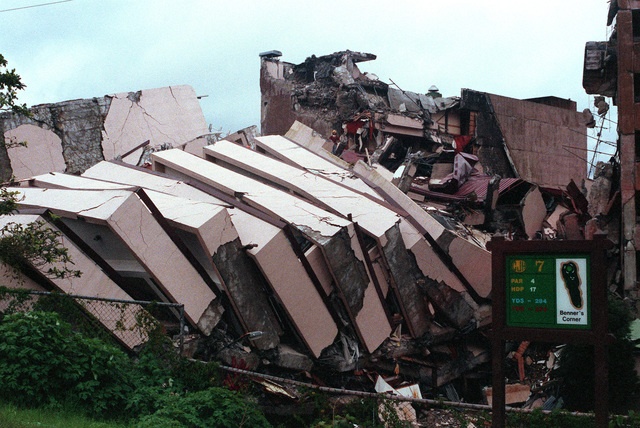
A view of a collapsed section of the Hyatt Hotel at Camp John Hay in Baguio City. The hotel was destroyed by the magnitude 7.8 earthquake that occurred on July 16, 1990. Photo from the US National Archives.
A life-saving ‘lamesa’
Luckily, a group of Filipino researchers from the Philippine Normal University, De La Salle University Manila and the Technological University of the Philippines invented a high-tech, earthquake-resilient classroom table that could save lives during a temblor.
In their research paper “Coupling School Risk-reduction Strategies with LAMESA (Life-saving Automated “Mesa” to Endure Seismic Activity),” which was published in the March 2019 issue of the Philippine Journal of
Science, the researchers explained the purpose for their invention and how it works.
The LAMESA — aptly named after the Tagalog word for table — is a prototype for a fixed study desk designed for use by kindergarten students in classrooms, which may be used as a sturdy surface to hide under during an earthquake. It has a length of 1.22 meters, a width of 0.69 meters and a height of 0.57 meters, which allows it to accommodate four kindergarten pupils underneath.
According to Marie Paz Morales, one of the researchers, news on the “Big One” earthquake that could possibly hit Metro Manila prompted them to conduct research and create the LAMESA.
“We thought of the most vulnerable group — the kids or kindergartens in schools — to be our main concern in building any infrastructure that will aid people when the ‘big one’ hits the ground. Though we instill earthquake preparation in the curriculum, this ‘passive’ preparedness may not holistically develop survival skills of the young, thus, prompting us to develop LAMESA as a survival tool and a teaching aid to initiate ‘active’ disaster preparation,” Morales said in a Facebook message to The Philippine STAR.
Equipped with Wi-Fi enabled sensors and an alarm system, it could detect the slightest seismic activity and trigger an alarm that would prompt students and teachers to duck and seek cover underneath the table. The prototype has a fixed response time of four seconds, which is quick considering that an earthquake, on average, lasts 30 to 40 seconds.
Upon activation of the alarm, the tabletop automatically rises into an inclined position to allow debris to slide down to the floor. As it is made of steel bars and has a thickness of 3.327 centimeters, it can endure the weight of falling debris such as wood, steel or concrete for up to 200 kilograms and ensure the safety of students hiding underneath it.
Another feature of the LAMESA is a compartment for storing “Go Bags,” which contain food, water, a first-aid kit and a flashlight in case the need for a prolonged stay underneath the table arises.
According to Morales, they plan to introduce lesson exemplars that teach disaster risk reduction and active disaster preparedness to kindergarten students, which will focus on self-care and readiness during calamities using LAMESA.
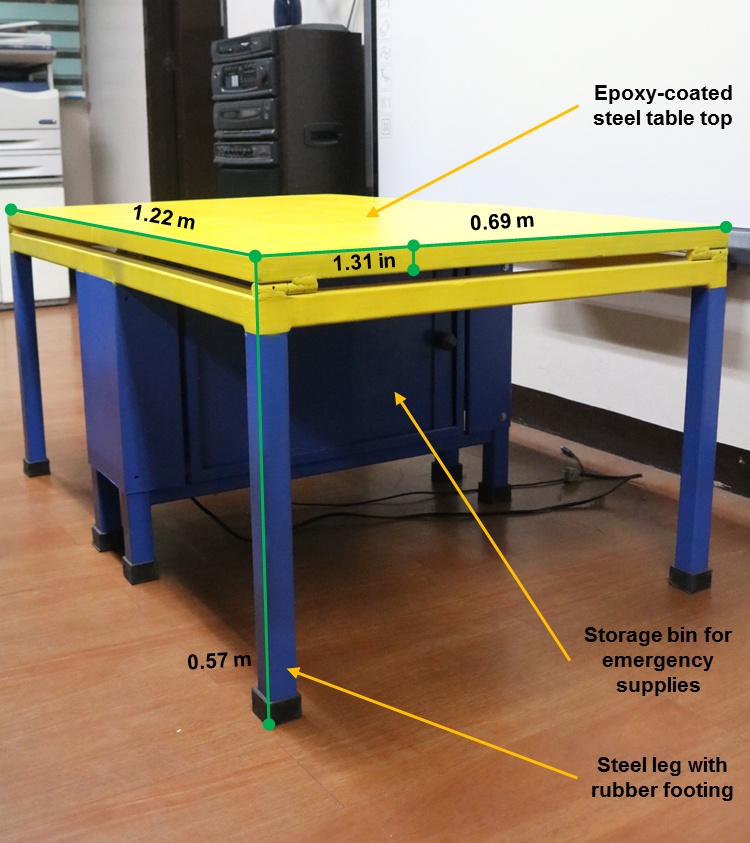
The features of the prototype LAMESA (Life-saving Automated ‘Mesa’ to Endure Seismic Activity) invented by a group of Filipino researchers. Photo from dost.gov.ph.
A work in progress
The LAMESA prototype is the result of collaboration among teachers, engineers, seismologists, machinists, technicians, metalworkers, and government agencies such as the Department of Education, Metropolitan Manila Development Authority and the Philippine Institute of Volcanology and Seismology. MMDA’s Mobile Earthquake Simulator served as a tool in testing the reliability of the prototype.
A group of parents, teachers, school administrators, and a district supervisor evaluated the LAMESA and underscored its durability, features, design and mechanism. The prototype is currently undergoing improvements to make the surface harder and the design more appealing and safer for students.
“Currently, we have applied for a patent for the design of LAMESA. With available fund we may be able to do some design modifications, which may focus on the kinds of materials used on the tabletop. We are contemplating on using fiberglass instead. We also wanted to establish the design stability so, given the available funds, we may be able to conduct load tests. We also thought of using a wall sensor to manage a set of desks or tables (LAMESA),” Morales explained.
The LAMESA prototype cost the researchers P100,000 to make, but according to Morales, they are hoping that the cost would drastically fall once it enters mass production.
“We have visited the agency in June to present our newly crafted design for a room system for kindergarten (a system of LAMESA within a room) for a possible grant from the Department of Science and Technology. Kindergarten officials from the DepEd also confirmed the benefits the innovation may bring to the kindergarten. They mentioned that, with good fund sourcing, they might be able to procure the device or the room system in the future, as per our proposal,” Morales said.


