


Targeted, Not Unlimited ‘Mass Testing’ Begins; Experts Hope COVID-19 Magnitude Will Be Ascertained
Netizens call for #MassTestingNowPH, but the Department of Health maintains the country must contend with limited resources and capacity.

The government’s much-touted “mass testing” that will begin Tuesday, April 14 will still focus on people with severe illness, vulnerable individuals like senior citizens, persons with existing medical conditions and pregnant women, and health workers who show signs of the coronavirus disease 2019 (COVID-19) – meaning the country continues to find itself unable to detect carriers of the virus who do not experience symptoms.
This was despite studies showing that a significant portion of COVID-19 carriers may be asymptomatic. Iceland, which tested 10 percent of its total population of over 340,000, found that as many as half of COVID-19 carriers may not even know it. The Centers for Disease Control and Prevention assumed a more conservative estimate of 25 percent.
In the Philippines, where netizens call for #MassTestingNowPH, Department of Health (DOH) spokesperson Undersecretary Maria Rosario Vergeire said the country must contend with limited resources and capacity.
“Gusto kong klaruhin na ito ay hindi po lahat ng tao ay ite-test. Hindi rin po ito indiscriminate testing (I want to clarify that not all people will be tested. This is not indiscriminate testing either),” she said during the government’s “Laging Handa” virtual press briefing on Monday, April 13.
The country’s single-day testing capacity on Saturday, April 11 was 1,208 specimens, 98 of which tested positive for the virus. The DOH projected that when the “mass testing” or “expanded testing” begins today, 3,000 tests could be conducted daily.
Vergeire said with current resources available, testing would continue to be “risk-based.”
There may be more tests to be conducted, but this is not much different from the current guidelines stating there would be “no need to test” persons with mild symptoms who are not elderly or have existing medical conditions.
“Ang ating tine-test pa po ay ang mga severely ill, ang mga vulnerable, at saka ’yung mga health workers na may sintomas (The ones we are testing are the severely ill, the vulnerable, and the health workers with symptoms),” she said.
But Vergeire explained that once the country could conduct 8,000 tests a day, testing could be expanded to cover frontliners, people exposed to COVID-19 cases, and those with recent travel history and are experiencing symptoms.
“Kapag capacitated na ’yung (laboratories) and we will be reaching 8,000 tests per day, i-e-expand na po natin yung populasyon para makasama kahit ’yung walang sintomas pero frontliners naman natin (If our laboratories are capacitated and we will be reaching 8,000 tests per day, we will expand the population so those who have no symptoms but are our frontliners can be included),” Vergeire said.
“Isasama na ho natin lahat ng may exposure, lahat ng mga history of travel na may sintomas. So it’s going to be evolving, it’s going to be progressive, tataas nang tataas ’yung coverage as our laboratory capacity increases,” she added.
Reasonable
Sought for comment, Dr. Anthony Leachon, special adviser to the Inter-Agency Task Force (IATF) on COVID-19, noted: “In an ideal scenario with unlimited tests, we should test as many as possible, including those who are mild/ asymptomatic.”
“They are likely the drivers of community transmission, because they are still interacting, and those positive should be separated from others (as soon as possible),” Leachon told The Philippine STAR.
He stressed the importance of expanding testing capacity to finally get an accurate picture of the spread of the disease before the enhanced community quarantine is lifted, tentatively scheduled on April 30.
“We will pursue these mild or asymptomatic cases as testing capacity is increasing so we will know the magnitude of the epidemic. But it will start with data gathering and data analytics. This is the one that would matter on or before April 30,” Leachon said.
For now, Leachon believes these measures by the government are “a good move” in accordance with the task force’s five-step blueprint: intervene fast; test early, often and safely; conduct contact tracing, isolation and surveillance; enlist the public’s help; and draw up an exit plan and prepare for economic rehabilitation.
For his part, Private Hospitals Association of the Philippines Inc. president Rustico Jimenez considers the government’s target “reasonable.” He says: “Please do not think about it on the negative side.”
“In medicine, there is no 100 percent,” Jimenez told The STAR. “We should support the program of the government for more testings now that kits are available. We should protect the frontliners at all times.”
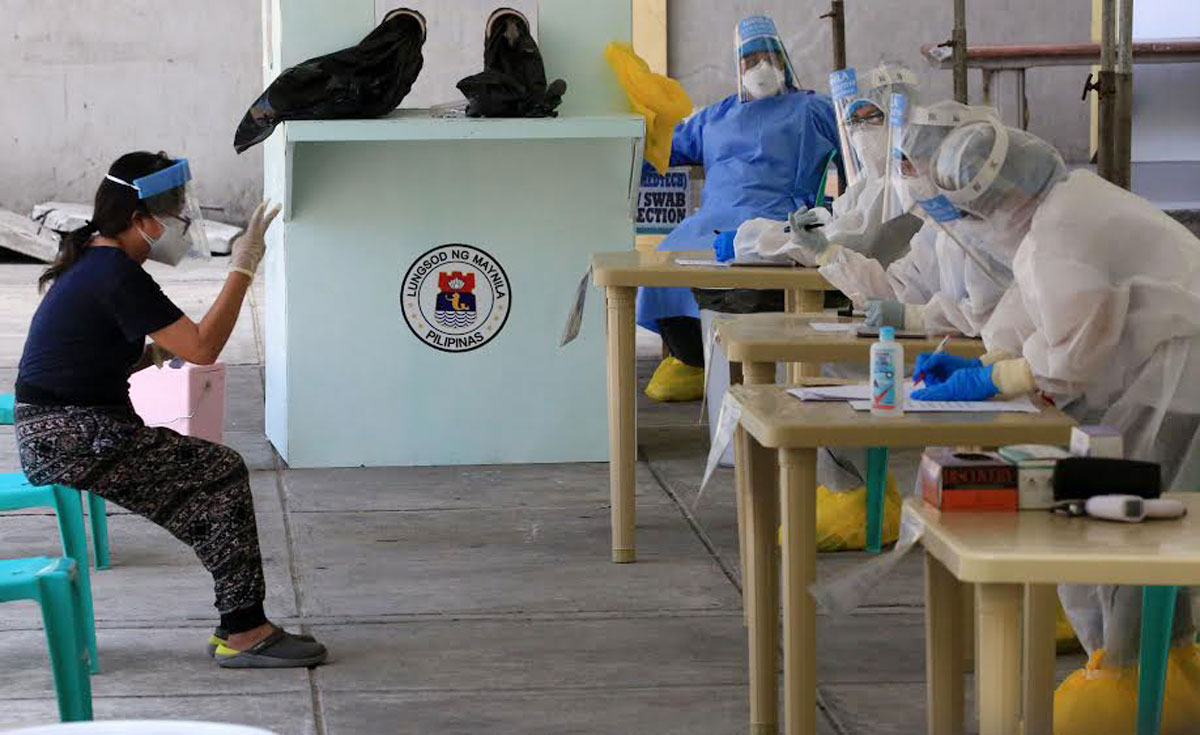
Some local government units have tried to step up their own COVID-19 testing efforts. On Monday, the Manila Public Information Office announced that seven city-run health facilities could conduct 232 swab tests a day, although these would have to be processed by the laboratories of the Research Institute for Tropical Medicine (RITM) in Muntinlupa or the University of the Philippines-Philippine General Hospital in Manila.
The Marikina City government tried to set up its own testing laboratory, but the DOH halted its opening as it disapproved of the location.
In Cavite, Gov. Jonvic Remulla said that to restart the economy, almost two million of the province’s population of 3.68 million should be tested. He noted that most of the confirmed cases in his province were asymptomatic and that children in particular have the potential to be unknowing carriers who could infect their parents. The provincial government plans to spend P300 million for its mass testing effort.
As of April 11, 38,640 tests have been conducted on 33,814 people, which were processed by 10 laboratories; 29,490 tests on 25,400 individuals were done by the RITM alone. As of that date, 86,625 testing kits remained.
This is barely a drop in the bucket; the Philippines has a population of 100.98 million as of 2015.
The World Health Organization, which has been criticized over its perceived leaning in favor of China, has sought to play down the possibility of asymptomatic persons unknowingly spreading the disease.
In its April 2 situation report, the WHO said: “There are few reports of laboratory-confirmed cases who are truly asymptomatic, and to date, there has been no documented asymptomatic transmission. This does not exclude the possibility that it may occur.”
In its interim guidelines dated April 3, the WHO stated: “The true extent of asymptomatic infections will be determined from serologic studies.”
Retired military general Carlito Galvez Jr., presidential adviser on the peace process and chief implementer of the National Action Plan to beat COVID-19, said the focused and targeted testing could be a game changer.
On Sunday night, April 12, Galvez said the government is taking advantage of the extended enhanced community quarantine to step up the fight against the disease to prevent a second wave of infection.
“Ang aggressive or ’yung targeted testing and contact tracing will be our game changer,” Galvez said. “Kapag natapos natin ang large scale na testing sa mga priority areas in NCR (National Capital Region) and other regions ay masa-satisfy na natin ang implementasyon ng ating stratehiya – detect, isolate and treat.”