



Nayong Pilipino, Quirino Grandstand Eyed As Mega Vaccination Sites
According to the Department of Health, the private sector also committed to free areas that can be used as vaccination sites aside from those to be opened by the government.
Gearing up for simultaneous COVID-19 inoculation activities among all sectors, the government is now looking at having mega vaccination sites in key areas of the country, the Department of Health (DOH) said on Wednesday, April 14.
For starters, DOH Undersecretary Maria Rosario Vergeire noted in a press briefing that the Nayong Pilipino in Pasay City, which is now closed, will be one of the mega vaccination sites.
Vergeire said National Task Force Against COVID-19 chief implementer and vaccine czar Secretary Carlito Galvez Jr. and Tourism Secretary Bernadette Romulo-Puyat have already agreed on the use of the cultural theme park as a vaccination center.
“We will open it as one of the mega vaccination sites. Aside from that, the private sector has committed, as part of their corporate social responsibility, to free their areas that can be converted into big vaccination sites,” Vergeire announced.
Nayong Pillipino will cater to vaccinees from Metro Manila.
The Nayong Pilipino Foundation, an attached agency of the Department of Tourism (DOT), has also allowed the government to transform its vacant lot in Parañaque City into a vaccination site.
Once completed, it can accommodate at least 12,000 persons every day, and is therefore seen to accelerate efforts to immunize the public.
Vergeire added that the private sector has also committed to deploy manpower to help manage the inoculation activities.
Quirino Grandstand
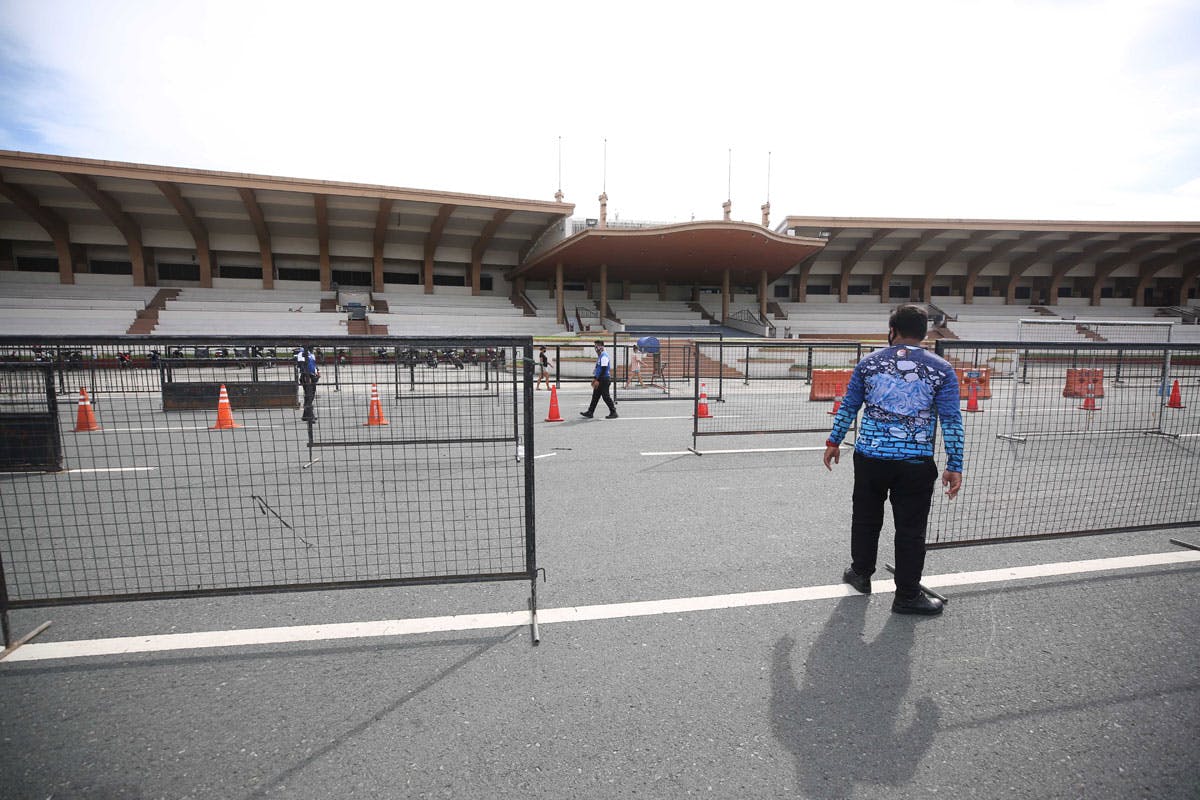
The National Parks Development Committee (NPDC) has also authorized the conversion of Quirino Grandstand into a vaccination site that can accommodate up to 400 individuals a day.
Puyat disclosed the NPDC has approved the request of Manila Mayor Francisco “Isko Moreno” Domagoso to turn parts of Rizal Park into a vaccination area and a mobile hospital.
The board of directors of the NPDC, an attached agency of the DOT, permitted the city government of Manila to set up a drive-thru vaccination facility on Independence Road of the Quirino Grandstand.
Likewise, the NPDC approved Moreno’s petition to build a mobile hospital at Burnham Green in Rizal Park. In his letter to the agency, the mayor asked to put up the medical facility at no cost to the national government, as he vowed that the city leadership would finance everything, from design to management.
The mobile hospital will be used to admit patients if the city suffers another surge of COVID-19 transmissions. Moreno committed to restore Burnham Green to its original condition once the mobile hospital is removed from the area.
Puyat said the retrofitting of tourism sites into vaccination sites and health facilities will serve the medical needs of everyone, not just residents of Manila.
“Through the temporary mobile hospital that will be constructed in Rizal Park, and the drive-thru vaccination site at the Quirino Grandstand, the DOT has repurposed its tourism sites to support the current efforts to protect the public’s health and safety during the crisis,” Puyat said.
“These facilities will be open to all, not just residents of Manila,” she added.
Puyat explained the mobile hospital will admit patients experiencing mild to moderate COVID-19 symptoms.
A drive-thru RT-PCR testing facility is also located at Quirino Grandstand. It used to extend rapid testing for up to 700 persons daily, before it was converted into reverse transcription polymerase chain reaction or RT-PRC testing in January that can take in 100 individuals every day.
More than a million inoculated
Vergeir also reported that 1.1 million individuals have already been immunized against COVID-19 and almost 900,000 of them are healthcare workers serving on the frontlines.
The official said as of April 11, there were 24,823 “reported (or) suspected” cases of “adverse events following immunization.”
For the vaccines made by Chinese drugmaker Sinovac Biotech Ltd., the non-serious adverse events were almost 7,000 while the severe cases were pegged at 164.
For the AstraZeneca jabs, 17,709 vaccinees have experienced adverse events. A total of 17,503 of them are minor while 206 are serious.
“All of this are being investigated and some of the results are already out. Until now experts have not seen ‘direct casuality’ and this means that the vaccines did not cause serious effects,” she added.
Vergeire underscored that based on the review of experts, none of the vaccines available in the country neither caused deaths nor led to COVID-19 infections.


