LIST: Issues Thrown Against ABS-CBN; #VoteYestoABSCBN Pushed
Opponents of ABS-CBN Corp.’s franchise renewal application have thrown everything including the kitchen sink against the network. Its bosses and employees are asking for support to have their franchise renewed.

Television and movie producers have asked supporters of ABS-CBN Corp. to email their representatives and ask them to vote in favor of the renewal of its franchise as the House of Representatives winds down its committee hearings, while the hashtag #VoteYESforABSCBN has become a trending topic on Twitter on Sunday, July 5.
The House legislative franchises committee is scheduled to hold its 12th hearing on the 13 pending bills for the renewal of ABS-CBN Corp.’s franchise on the afternoon of Monday, July 6.
If this turns out to be the last, the powerful 46-member committee chaired by Palawan 1st District Rep. Franz Alvarez could vote on the measure – or continue sitting on it and keep thousands of employees, millions of viewers, the media and business sectors in a state of uncertainty.
If the committee acts in favor of the measure, it has to prepare a report for transmission to the committee on rules – chaired by Majority Leader Ferdinand Martin Romualdez, owner of the Manila Standard and the Journal Group of Publications – to be calendared for debates in the plenary. After debates, the bill can be amended before being approved on second and third reading.
But if the committee ends up acting unfavorably, it will mean the specific franchise proposals filed by ABS-CBN’s sponsors in the 18th Congress will be shelved.
Section 49 of the Rules of the House of Representatives states that the bills shall be “laid on the table” and the authors shall be notified in writing within five days of the reasons for the unfavorable action.
Hence, Theodore Boborol (director of Liza Soberano’s aborted soap opera Make It With You) and Carmi Raymundo (producer and screenwriter of commercial movie hits You Changed My Life and A Second Chance) posted a list of the email addresses of more than 40 members of the House committee on legislative franchises. “Please help us,” Boborol said.
Raymundo wrote a lengthier message: “Kung naniniwala po kayong may serbisyo pa kaming kayang ihatid sa inyo – tulong, impormasyon o mga kwento man – sana po tulungan n’yo kaming iparinig ito sa mga congressmen ninyo (If you believe we have a service we can deliver to you – be it help, information or stories – I hope you can help us make your congressmen listen).”
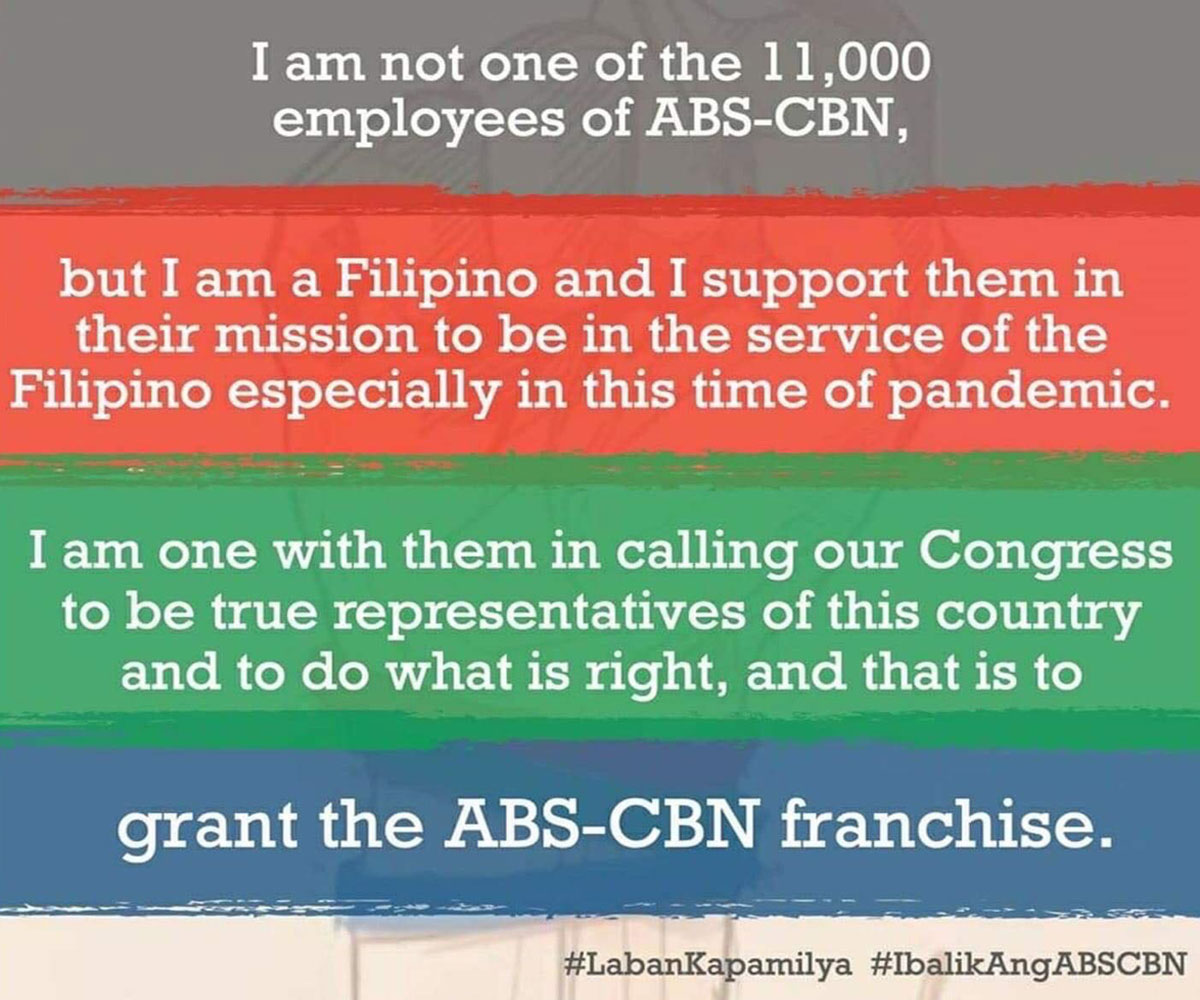
Make It With You actor Khalil Ramos wrote the committee members on behalf of the newly formed artists’ group Aktor–League of Filipino Actors. Ramos asked the congressmen to “please consider the lives and future of 11,000 television workers and their families who have been suffering due to the non-renewal of the network’s franchise.”
Aktor PH is not only an effort by ABS-CBN’s contract artists. GMA actors who have joined the group include Dingdong Dantos, Gabbi Garcia, Gabby Eigenmann, Glaiza de Castro, Janine Gutierrez, Jasmine Curtis-Smith, Lauren Young and Mikoy Morales.
Meanwhile, the National Union of Journalists of the Philippines and the College Editors Guild of the Philippines scheduled a “Caravan to Congress” to support ABS-CBN, with the assembly to be held at 9 a.m. on July 6 at the Commission on Human Rights main office in Quezon City.

Saying it expected the committee to hold its vote on Monday, NUJP said: “Let your voices be heard. Join us in our Caravan to Congress to show support for ABS-CBN and press the committee members to vote YES for the ABS-CBN franchise.”
With their support for ABS-CBN, both NUJP and CEGP were tagged as “creations” of the Communist Party of the Philippines by the National Task Force to End Local Communist Armed Conflict last May.
On Sunday, July 5, the Makati Business Club renewed its call for Congress to act in favor of ABS-CBN’s application. Besides ABS-CBN’s role as a source of news and information in the middle of the coronavirus disease 2019 pandemic, the MBC stressed the network’s benefits to the economy.
“Keeping ABS-CBN on the air will preserve… a major platform for businesses to advertise their goods and services, which would help revive the economy, preserve jobs in those businesses, and increase the taxes the government needs for public services,” the MBC said.
Most especially, it added that “equal treatment of all companies – especially by regulators, prosecutors, and lawmakers – will signal that rule of law prevailed, encouraging foreign and local investors at a time when we most need their help to create new jobs.”
ABS-CBN’s opponents – notably Deputy Speaker Rodante Marcoleta, Cavite 7th District Rep. Jesus Crispin Remulla, Anakalusugan party-list Rep. Mike Defensor and Kabayan party-list Rep. Ron Salo – have hurled numerous allegations against the network, from gripes about its innovations to tax avoidance and labor issues that also beset other broadcasters.
In certain issues raised by the congressmen, government regulators did not see any problem.
Here’s a rundown of the issues being thrown against ABS-CBN.
TVplus, SKY Direct
Marcoleta, Defensor and Remulla questioned how ABS-CBN affiliates TVplus and SKY Cable Corp. were able to continue airing even after the National Telecommunications Commission (NTC) issued on May 5 a cease and desist order or CDO against the network’s free-to-air television and radio operations.
The opponents claimed that the still-unexpired franchise of Amcara Broadcasting Network – which was 49-percent owned by ABS-CBN until Jan. 24, 2019 – was being used to circumvent the CDO.
Amcara’s Channel 43 frequency was used to carry the digital channels – including Knowledge Channel, DZMM Teleradyo and several niche entertainment channels – which are exclusively received by households that purchase the TVplus black box for a one-time payment of around P1,500.
On July 1, the NTC issued an alias CDO against ABS-CBN, construing its provision of programming to another franchisee to be a failure to completely comply with the earlier CDO against the operations of Channel 2. On the same day, the NTC ordered SKY Cable Corp.’s direct broadcast satellite service, SKY Direct, to stop operations even if in 1987, Executive Order No. 205 removed the requirement of a legislative franchise for cable television operations.
Labor issues
Defensor raised the longstanding issue of network employees not being regularized despite some of them working in the company for 10 to 20 years.
ABS-CBN president and chief executive officer Carlo Katigbak promised to “look at and determine kung tama ba talaga ’yung aming practice ngayon (if our current practice is really correct) or this is something we have to change.”
Katigbak, along with the other bosses and employees of ABS-CBN, have asked the public for help in pushing for the renewal of the network’s franchise.

Rowena Hidalgo, a former reporter who won her labor case against ABS-CBN, was invited to the hearing. But she told lawmakers that she accepted the network’s offer to pay her for her 16-year tenure and rehire her as a new employee. She said she did this out of “malasakit (sympathy).”
On the other hand, showbiz news anchor Jobert Sucaldito, who was also invited to the hearing, attacked ABS-CBN in connection with the suspension of his contract earlier this year.
Sucaldito had been sanctioned for berating Till I Met You actress Nadine Lustre on air and saying she should have committed suicide. “May mga nakalagay na caption na parang gustong tumalon sa building. Sana tumalon na lang kung ganun din naman pala (They put a caption about wanting to jump off a building. She should have just jumped if that was the case),” the anchor said.
At the franchise hearing, Sucaldito testified against ABS-CBN: “Nalulungkot ako lalo (I feel sad especially) every time I would hear Sir Carlo Katigbak saying that they are concerned about the people who will lose jobs kasi kawawa naman sila, walang makain (because pity them, they have nothing to eat). But what about us?”
On June 29, Department of Labor and Employment (DOLE) Undersecretary Ana Dione told the committee that the network was dropped as a respondent “in the matter of inspection conducted in its premises” after being “fully compliant” with all labor regulations.
Two days later, the DOLE said in a press statement, not before the committee, that ABS-CBN misrepresented its position on its compliance. The DOLE said labor inspectors found violations of the law and cited the pendency of 67 cases against the company before the National Labor Relations Commission (NLRC).
Meanwhile, ABS-CBN’s opponents were ridiculed for becoming sudden labor champions. Notably, Marcoleta sponsored House Bill No. 4631, which extended the franchise of GMA Network Inc. for another 25 years, in 2017 during the 17th Congress. When ABS-CBN reporter Mike Navallo wrote an exposé about Marcoleta’s previous sponsorships of broadcast franchises, the lawmaker accused him of being “un-Filipino.”
The Talents Association of GMA Network or TAG – which has been involved in numerous labor cases especially regarding the practice of refusing to regularize workers by treating them as “talents” – said the labor issues should not be used as a smokescreen to ultimately deprive ABS-CBN’s 11,000 workers of livelihood.
TAG noted that TV industry workers were already reeling from the stoppage of productions due to COVID-19, which has forced networks to air replays of entertainment programs. “Huwag sanang ilayo ang isyu para lamang mabinbin ang pagbibigay ng prangkisa ng ABS-CBN (The issue should not be diverted just to hamper the grant of the franchise to ABS-CBN),” it said.
GMA is also currently defending its “talent” practice before the Supreme Court, after it was struck down by the NLRC and the Court of Appeals. GMA described the Labor Code’s requirement of regularization as a “classic case of a person who wants to have his cake and eat it too.”
In arguing against guaranteeing its workers’ security of tenure and granting them the benefits required by law, GMA said “talents” must have the freedom to “offer their services as independent contractors.” It asked the SC not to “compel artists and talents to render their services only as employees.”

Use of tax shields?
Salo on July 1 claimed that ABS-CBN used Big Dipper Digital Content and Design Inc. – a subsidiary 95-percent owned by the network that repurposes ABS-CBN’s content into various formats to be licensed by markets abroad – as a tax shield.
This was allegedly done by registering Big Dipper as an information technology enterprise to avail itself of tax incentives granted by the Philippine Economic Zone Authority (PEZA). Salo claimed that in 2019, Big Dipper declared only P474 million of its P25.4-billion profit while also declaring P2.3 billion in tax-free dividends.
However, tax lawyer Othello Carag said Big Dipper could be validly registered under PEZA because services – not just physical goods – could also be exported under the law. This is similar to how business process outsourcing companies can be entitled to incentives under the Special Economic Zone Act. PEZA director general Charito Plaza attested to Big Dipper’s compliance with the requirements.
Meanwhile, Remulla accused ABS-CBN of donating P129 million to its charity arm ABS-CBN Foundation so the amount could be deducted from its computations of income tax liabilities. ABS-CBN Group of Companies chief financial officer Ricardo Tan and ABS-CBN chief financial officer Aldrin Cerrado denied this allegation.
Defensor also claimed that the bulk of ABS-CBN’s P14-billion tax payments consisted of taxes withheld from its payments to suppliers and service providers.
Bureau of Internal Revenue assistant commissioner Manuel Mapoy told the House committee that ABS-CBN had been “regularly paying its corporate taxes for the past years” and that it had “no outstanding delinquent accounts.” Tan said the ABS-CBN Group paid a total of P71.5 billion from 2003 to 2019.
Bayan Muna party-list Rep. Carlos Isagani Zarate said it was right to scrutinize ABS-CBN’s compliance with tax laws, but questioned the wisdom of shutting it down entirely and preventing it from giving the government more revenue in the process.