


Give COVID-19 Cash Aid To All Senior Citizens – Advocates
Government personnel have cited the meager pensions and stipends already granted to the elderly to deny them the P5,000 to P8,000 subsidy under the Social Amelioration Program.

Advocates for the rights of the elderly have called on the government to include all senior citizens in the coverage of the government’s emergency subsidy program for those affected by the coronavirus disease 2019 (COVID-19) pandemic, citing reports that personnel have denied them assistance because they were already receiving pensions and stipends even if these were meager to begin with.
The National Anti-Poverty Commission (NAPC) Senior Citizens Sector and groups led by the Coalition of Services for the Elderly Inc. (COSE) said the elderly are the most vulnerable not just to COVID-19 but also to poor economic wellbeing.
The groups lamented that differences in the interpretation and implementation of the Social Amelioration Program (SAP) meant many senior citizens were excluded from the distribution of the cash assistance, just because they were already getting pensions and stipends pursuant to other laws – even if such amounts were way below the P5,000 to P8,000 emergency subsidy.
In a phone interview, COSE executive director Emily Beridico said her organization has advocated a “universality” in the government’s approach in the distribution of cash assistance for senior citizens, noting that confusion in the rules issued by agencies only serve to slow down the response to their needs.
Beridico told The Philippine STAR that senior citizens who reported being denied the P5,000 to P8,000 cash assistance under the SAP were mainly from the National Capital Region and the provinces of Negros Occidental and Bukidnon.
These senior citizens were supposedly disqualified because they were already receiving pensions from other sources – but Beridico noted that ground personnel did not even consider that these amounts were smaller than the emergency subsidy.
“Interpretation nila… may pension, maliit man o malaki, excluded (Their interpretation is that those receiving pensions, whether big or small, are excluded),” she said, adding that many pensioners were indigent even before the enhanced community quarantine (ECQ) measures disrupted livelihoods and restricted the movement of the poor beginning March.
Those reportedly excluded include senior citizens who receive pensions from the Social Security System (SSS) or the Government Service Insurance System (GSIS). In a statement, COSE cited 2018 government data in saying that 75 percent of SSS pensioners and 24.1 percent of GSIS pensioners receive monthly pensions below P5,000.
Also said to be excluded were those who receive a P500 monthly stipend (called “social pensions”) under the Expanded Senior Citizens Act of 2010 (Republic Act No. 9994), as well as those who get P300 in unconditional cash transfers under the Tax Reform for Acceleration and Inclusion Law (Republic Act No. 10963).
The senior citizens organizations also received reports that seniors with working children were also excluded from the distribution of the dole-out.
“We reiterate that targeting poor senior citizens is overrated in normal times and doing so again doesn’t make much sense during a pandemic where virtually every older woman and man is affected and vulnerable,” the senior citizens’ groups pointed out.
“Clear and simplified guidelines will guarantee protection for all vulnerable senior citizens and will prevent confusion among senior citizens, and the program will not be used for personal or political motives, and the possibility of achieving the main objective of SAP will not be jeopardized,” they said.

Where the confusion lies
Contributing to the confusion were the government’s vague and constantly changing regulations, as well as belated clarifications by officials.
Item VI(3)(a) of Department of Social Welfare and Development Memorandum Circular No. 04, series of 2000, dated March 30, includes households “with members belonging to” the vulnerable sector of senior citizens among the 18 million targeted beneficiaries of the SAP.
The requirement to qualify for the assistance under the circular is that these families should be “low-income households or those in subsistence economy.”
Curiously enough, Item VIII-B only mentioned that senior citizens who were recipients of the P500 “social pension” “shall be immediately validated and subjected to eligibility testing.” No other provision elaborated how families with senior citizens would qualify for the P5,000 to P8,000 subsidy.
Only in an April 6 briefing did Cabinet Secretary Karlo Nograles clarify that senior citizens should be excluded from receiving the P5,000 to P8,000 cash assistance if they were already receiving “pension benefits noong sila pa’y nagtatrabaho (from when they were still working) or pension benefits from other sources.”
Nograles said that “indigent senior citizens” receiving the P500 “social pension” from the DSWD under the Expanded Senior Citizens Act of 2010 would be prioritized for the distribution of the emergency subsidy.
“Ang uunahin natin na senior citizens, siyempre iyong mga indigent senior citizens… So siguro kaya may mga na-e-exclude na senior citizens, dahil iyon ’yung mga senior citizens na mayroon namang natatanggap na pensiyon na hindi social pension ng DSWD (The senior citizens we will prioritize are the indigent senior citizens… So perhaps there are senior citizens getting excluded, that’s because the senior citizens are receiving pension that is not the social pension of DSWD),” he said.
Two days later, Nograles elaborated that indigent senior citizens would not need to secure social amelioration cards (SACs) like beneficiaries who already fall under the Pantawid Pamilyang Pilipino Program (4Ps).
On April 14, DSWD Undersecretary Luzviminda Ilagan wrote Beridico a letter, which clarified that Item VIII-B of MC 2020-04 – regarding the “social pension” recipients” – was actually “implying that they will receive only the P500 stipend per month.” Beridico provided a copy of the letter to The STAR.
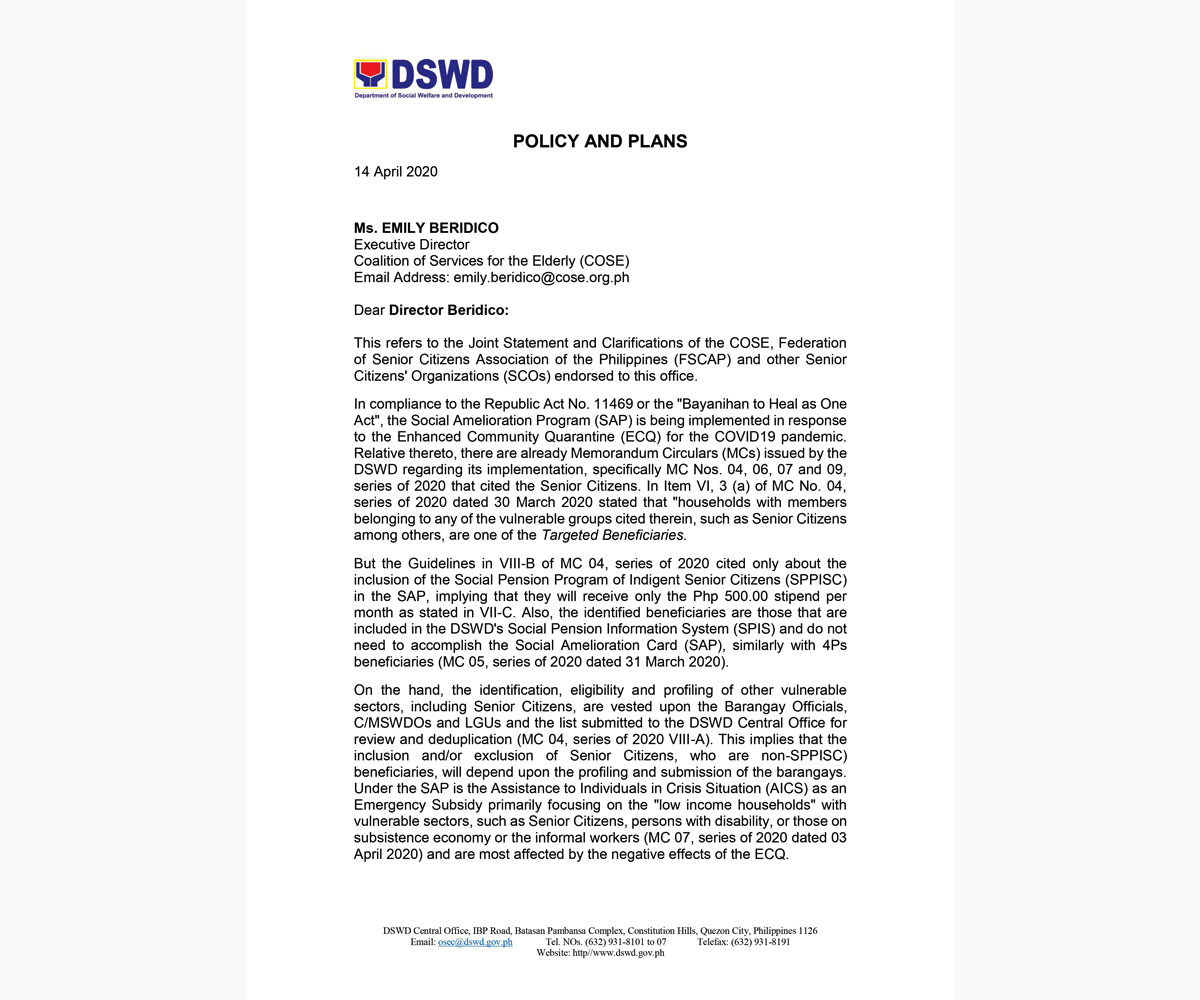
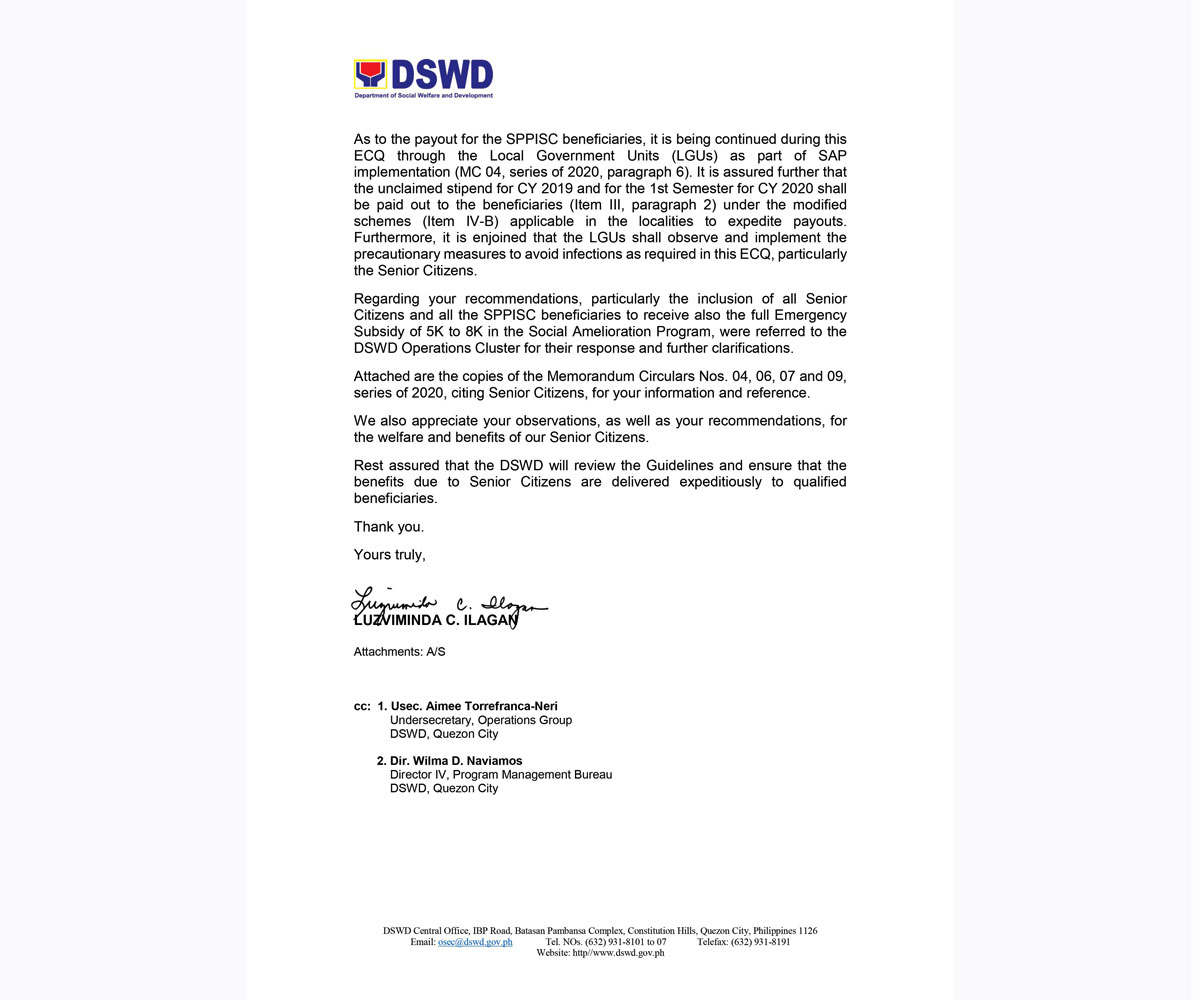
Ilagan, in the letter, interpreted the provision to mean that “the identified beneficiaries are those that are included in the DSWD’s Social Pension Information System (SIPS),” the system used for the agency’s Social Pension Program of Indigent Senior Citizens (SPPISC).
She also stressed that “the identification, eligibility and profiling of other vulnerable sectors,” including senior citizens, “are vested upon” the barangay officials, the city or municipal social welfare development offices (CSWDOs or MSWDOs), and the local government units (LGUs).
“This implies that the inclusion and/or exclusion of Senior Citizens, who are non-SPPISC beneficiaries, will depend upon the profiling and submission of the barangays,” Ilagan wrote.
What the government should do
COSE said these qualifications that shut out senior citizens who are not indigent enough would mean families with elderly members would have to grapple with the “extra toll” imposed by the COVID-19 crisis.
The advocates proposed that “all families living with older persons” be automatically included in the SAP “regardless of the elderly’s economic and pension status.” Older persons living only with their spouses should be prioritized. They said this would be “cost-effective,” since DSWD personnel would not have to do additional work in selecting and validating the beneficiaries.
As for the “social pension,” the advocates said unpaid benefits from 2019 and the first half of this year should be immediately released. In areas where the revalidation process is not yet completed, they said the old list should be used for now to avoid further delays in the payment of the stipend.
“Ensuring the inclusion of all senior citizens in the Social Amelioration Program and delivering the benefit to them immediately, as well as the release of the Social Pension is the least the government can do to protect the older persons,” the groups stressed in a statement.
Joining NAPC and COSE were the Confederation of Older Persons’ Associations of the Philippines (COPAP), the National Federation of Senior Citizens’ Associations of the Philippines (FSCAP), and 12 senior citizens’ organizations from various areas nationwide.
Detained opposition Sen. Leila de Lima threw her support behind the campaign. “Sa kinakaharap natin na krisis, hindi na tayo dapat namimili pa kung sino ang dapat na proprotektahan ng ating gobyerno. Lahat tayo ay apektado kaya dapat lahat tayo ay protektado (In the crisis we are facing, we should not be choosing who should be protected by our government. Every one of us is affected so we should all be protected),” she added.
Ilagan, once a party-list representative of the Gabriela Women’s Party, was non-committal when it came to the senior citizens groups’ proposal. She only promised to refer the proposal to the proper officials.
“Regarding your recommendations, particularly the inclusion of all senior citizens and all the SPPISC beneficiaries to receive also the full emergency subsidy of (P5,000 to P8,000) in the Social Amelioration Program, were referred to the DSWD Operations Cluster for their response and further clarifications,” she wrote. “We also appreciate your observations, as well as your recommendations, for the welfare and benefits of our senior citizens.”