



Following Maria Ressa’s Conviction, Groups Warn Even 12-Year-Old Articles, Posts Online Can Be Used For Libel
Some law experts argue that the case concerning a 2012 report should not have made it to trial in the first place. But precedents may be set if a Manila court’s verdict against Rappler chief Maria Ressa is upheld.

A Manila court has applied the Department of Justice (DOJ)’s novel opinions in convicting Rappler chief executive officer Maria Ressa and former writer-researcher Reynaldo Santos Jr. for cyber libel – setting new precedents that upend the usual understanding of the crime in an increasingly online world.
The verdict handed down by the Manila Regional Trial Court (RTC) Branch 46 on Monday, June 15, revolved around a May 29, 2012 article that cited a supposed intelligence report in talking about the alleged “shady past” of businessman Wilfredo Keng. Ressa and Santos were found guilty beyond reasonable doubt of violating Section 4(c)(4) of the Cybercrime Prevention Act of 2012 – a law enacted several months later on Sept. 12, 2012.
Both Ressa, also Rappler’s executive editor, and Santos were sentenced to six months and one day up to a maximum of six years in prison. They were also ordered to pay P200,000 in moral damages and P200,000 in exemplary damages. On the other hand, Rappler, Inc., was declared to have “no corporate liability.”
The two are allowed to file for a post-conviction bail and challenge the decision of the RTC before higher courts.
Lawyers, however, argued that the case should not have made it to trial in the first place, because the article was originally published months before the Cybercrime Act’s enactment and because Keng filed a complaint only in 2017, several years past the one-year prescriptive period for ordinary cases of libel.
For the court to even hold the trial, state prosecutors had to advance theories that have not been tested in the digital age.
Addressing the issue of the seeming retroactive application of the Cybercrime Act, the DOJ argued that the offense took place on Feb. 19, 2014, when the misspelling of the word “evasion” was corrected. This was based on the theory of “multiple publication.”
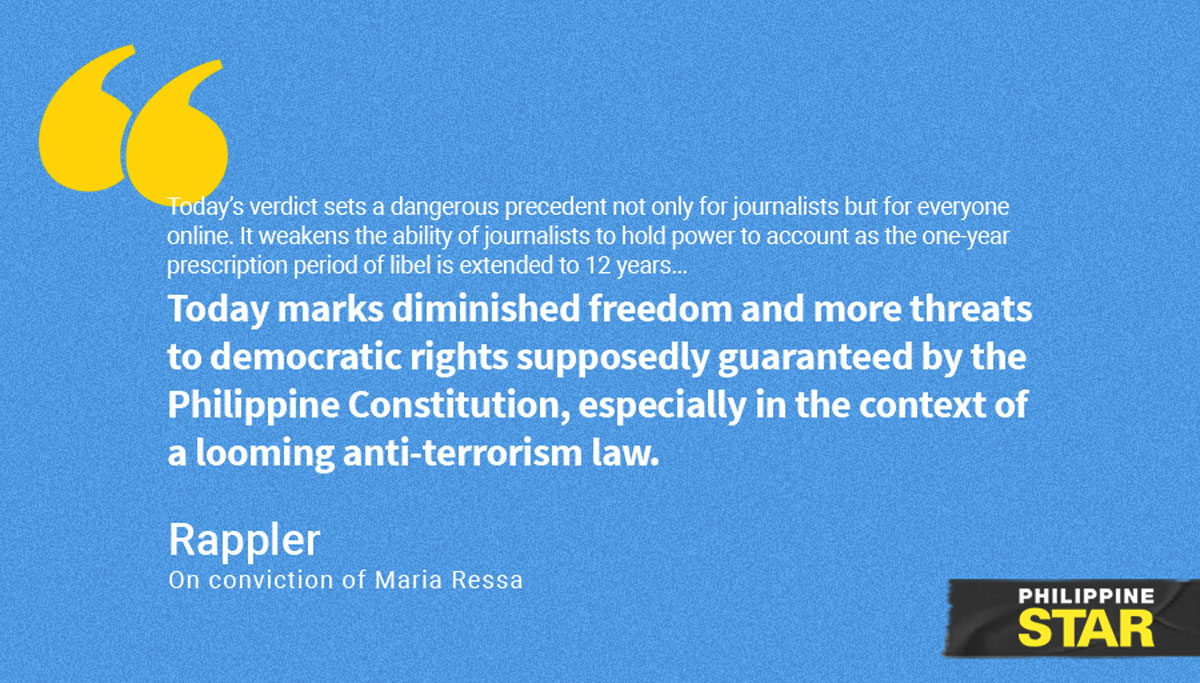
Meanwhile, to allow Keng’s case to prosper despite the years-long delay, prosecutors argued that cybercrime is a separate offense under a special law that provides for a 12-year prescriptive period – meaning one can be sued within 12 years of posting something online, instead of just the usual one-year period for ordinary libel.
Manila RTC Judge Rainelda Estacio-Montesa accepted these unprecedented interpretations to convict Ressa and Santos.
What the 2012 article was about
The article – titled “CJ using SUVs of ‘controversial’ businessman” – came out as the impeachment trial of then chief justice Renato Corona drew to a close. It discussed Corona’s use of high-end vehicles registered in Keng’s name.
It spoke of an intelligence report “prepared in 2002” that “detailed Keng’s past.” It said Keng was under surveillance by the National Security Council for “alleged involvement in illegal activities, namely ‘human trafficking and drug smuggling.’ ”
The report added that the document showed that Keng was involved in a murder case for which he was “never jailed” and that this statement “could be referring to the death of Manila Councilor Chika Go in 2002 where Keng had been identified as a mastermind.”
Santos wrote in the same article that he had a “May 28 (2012) phone interview with Keng,” during which the businessman admitted to owning a Suburban with the same license plate as the one used by Corona, but Keng denied lending the vehicle to the magistrate.
On Feb. 19, 2014, the article was edited to correct one misspelling – the phrase “tax evation” in the 28th paragraph was changed to “tax evasion.”
Citing the edited version as an update and a re-publication in 2014, prosecutors found a way to pin down Ressa and Santos for an article published before the enactment of the Cybercrime Act, skirting the ban on the retroactive application of penal statutes.
What Keng said on the witness stand
Keng testified that his lawyer initially advised him not to “make an enemy out of the media” to avoid more bad publicity. But he claimed that Rappler “republished” the article in 2014 because the outfit and its reporters were “out to attack him.”
He then secured two letters from the Philippine Drug Enforcement Agency dated Aug. 15, 2016 and May 20, 2019 – years after Rappler published the article – which stated that he has “no derogatory record on file” for drug-related crimes.
Keng said his lawyer Leonard de Vera sent Rappler editor-at-large Marites Vitug a copy of the August 2016 certification from PDEA. De Vera also requested that the article be taken down and that the businessman’s side of the story be published.
The businessman said then-writer Katerina Francisco had an interview with De Vera, but the story was never published even as the lawyer kept following up on it from August 2016 to February 2017.
Because of this, Keng said he sought legal assistance to file the complaint before the National Bureau of Investigation sometime in 2017. The case was forwarded to the DOJ for preliminary investigation in early 2018.
Besides the impact on his businesses, Keng blamed the Rappler article for the failure of the candidacy of his daughter Patricia for a party-list seat in the May 2019 elections. That September, President Duterte appointed Patricia to the Philippine Commission on Women as youth sector representative.
Following the court ruling, Keng said he felt vindicated and stressed that his case did not have anything to do with the government, thus Ressa should stop making it appear as an attack on the Philippine media and press freedom.
“My filing and winning this case assures Filipinos that public falsehoods will not remain unchallenged and unchecked in this jurisdiction but will instead be dealt with by law, strengthening the people’s respect for Philippine media in the years to come,” Keng maintained.
‘Multiple publication’
Rappler’s legal team – led by Free Legal Assistance Group regional coordinator Theodore Te – tried to have the case thrown out on procedural grounds before it went to trial, to no avail.
It argued that the “multiple publication” theory was not applicable because the 1988 case of Soriano versus Intermediate Appellate Court concerned the issue of venue and jurisdiction in a libel case, and not the issue of whether the number of offenses is equivalent to the number of times a statement is published.
The group added that the theory was only used in Supreme Court (SC) decisions involving print media, not online articles like Rappler’s. Moreover, it said the “re-publication” of the article in 2014 did not create a substantial change.
The 2004 Brillante decision of the SC cited by Montesa also involved the felony of libel under the Revised Penal Code, not cyber libel. Debunking the “multiple publication” theory was important to avoid the retroactive application of the Cybercrime Act to an article that would be deemed published months before its enactment.

The court’s take
In the 37-page decision, Montesa continued to apply the “multiple publication” theory as settled in Soriano and the 2004 case of Brillante versus Court of Appeals.
“The (court) considers the update a republication of the article. An update connotes that a change was made to the article. Said updated version was the one published and still available on the website of (Rappler Inc.),” read the decision.
“The (court) is of the conclusion that the original version was replaced by the updated one considering that it is no longer accessible in (Rappler’s) website. In other words, the original article published on 29 May 2012 can no longer be found,” it said.
Montesa did not pay much heed to the slightness of the update to the article. Instead, she discredited the testimony of Rappler founder and senior editor Ma. Rosario Hofileña as “self-serving” for lacking support in documentary evidence.
The judge said Hofileña’s testimony was hearsay because of the lack of evidence of her involvement in the update. The judge also faulted the lawyers for not presenting Santos in the witness stand to confirm the existence of the mistake.
‘Utter ignorance of journalism’
But for University of the Philippines College of Mass Communication (UP CMC) journalism professor Danilo Arao, the judgment reflected “utter ignorance of journalism.”
“The judge cannot even distinguish between an executive editor and an editor-in-chief. Perhaps this explains her skewed concept of republication and press freedom,” Arao said, referencing Montesa’s speculation that Ressa’s position was a “clever ruse to avoid liability of the officers of a news organization” under the libel law.
Arao and Lyceum of the Philippines College of Law lecturer Romel Bagares highlighted the practical effects of the judge’s interpretation on the publication of news online.
Bagares cited the digitization of old newspaper articles, published even before the enactment of the Cybercrime Law in 2012, as an example of the absurdity of its retroactive application.
“Under the judge’s interpretation of digital publication and republication, opening access to the digital archives is republication. In other words, your articles from three years ago or even 10 years ago can be used to sue you for cyber libel on the ground that they had been republished, since the prescription period, according to the judge, is 12 years, under the Cybercrime Act,” Bagares said.
Arao, meanwhile, noted that “an output published only once may be seen as updated outputs depending on how it gets packaged online.” Even articles uploaded in the 1990s could be evaluated for violations of the 2012 Cybercrime Law as long as they remain online.
“An internet output may be found in violation of the cybercrime law regardless of when it was posted. The point is clear: government wants mass deletion of critical content,” Arao said.
The UP CMC said the verdict gave rise to a “concept of eternal threat of punishment without any limit in time and cyberspace.”
“The judge’s decision, if not corrected by the Supreme Court, has – in one fell swoop – eliminated the one-year prescriptive period of libel and created a new, strange abomination: the theory of ‘continuing publication.’ The (state) can prosecute even after (10), (12) or more years after publication or posting,” UP CMC said in a statement.
One-year prescriptive period or 12?
Another novel view of the DOJ that the Manila court accepted was that for cybercrime, the prescriptive period – or the time during which a case can be filed from the moment the crime is committed – is 12 years.
This is much, much longer than the one-year prescriptive period for libel under the Revised Penal Code. Rappler’s lawyers argued that the one-year period should be followed and the case should be quashed because Keng filed a complaint three years after the supposed “re-publication” of the article.
However, the court considered cyber libel to be “separate and distinct from the ordinary libel punished under Article 355 of the Revised Penal Code.” Deeming cyber libel to be its own offense under the Cybercrime Prevention Act of 2012, a special law, the court applied the 12-year prescriptive period provided for special law offenses under Act No. 3326.
The National Union of People’s Lawyers disagreed with this interpretation, saying cyber libel “refers to the very same libel punishable under Article 355 of the RPC.”
It cited the SC’s 2014 decision in the case of Disini versus Secretary of Justice, which said cyber libel “merely incorporates to form part of it the provisions of the RPC on libel.”
Internet freedom advocate Marnie Tonson pointed out the definition of cyber libel as “unlawful or prohibited acts of libel as defined in Article 355 of the Revised Penal Code” which just happen to be “committed through a computer system.”
“If the court insists that Act No. 3326 prescription applies to (Republic Act No.) 10175 (or the Cybercrime Law), a penal statute, then it must be interpreted strictly… Act No. 3326 prescription does not apply to the felony of libel itself (which RA 10175 did not amend at all),” Tonson said.
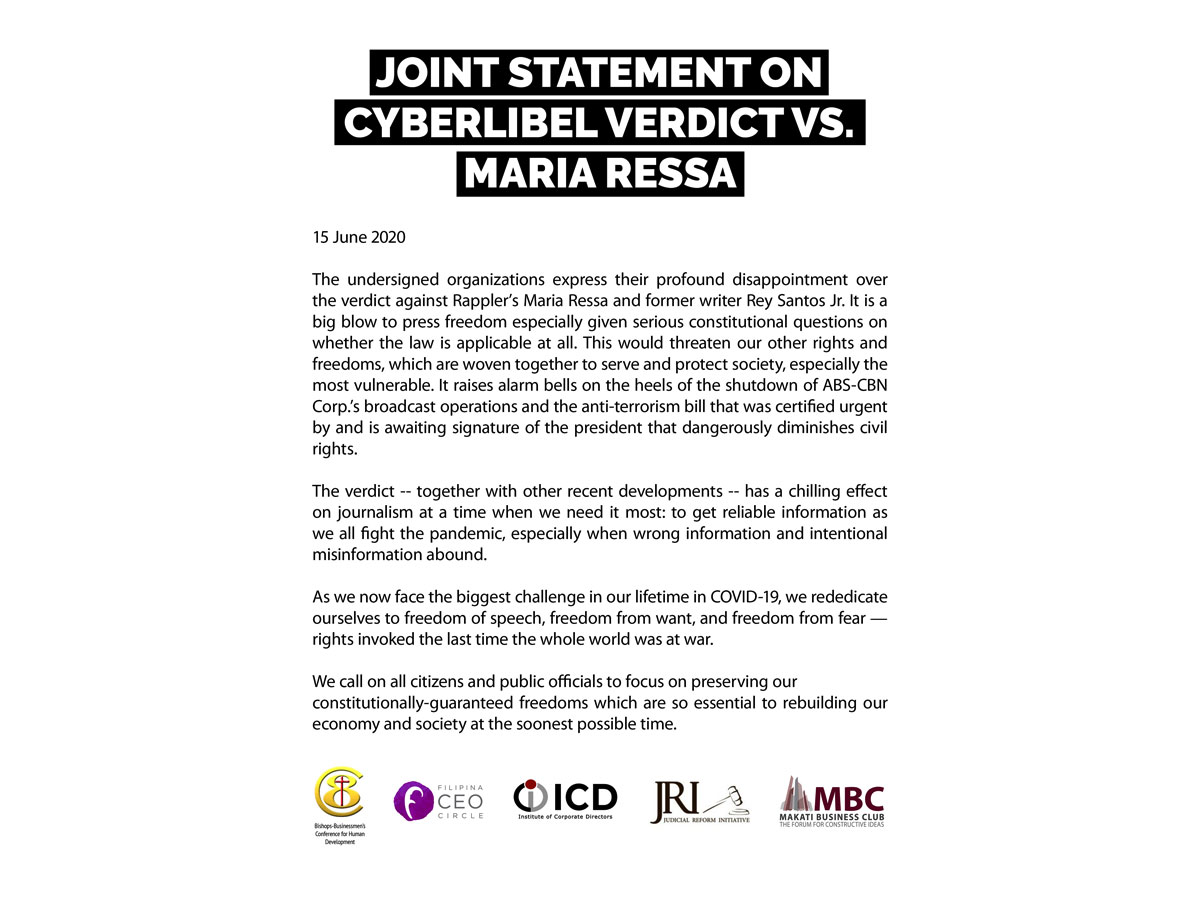
The National Union of Journalists of the Philippines (NUJP) considered the retroactive application of the law as an affirmation of the the state’s "manipulation and weaponization of the law to stifle criticism and dissent."
"In effect, the trial was a test run for the latest weapon the (state) can now wield to intimidate and silence not only the media but all citizens who call out government abuse," the NUJP said.
Where’s the malice?
As for the merits of the case, the court said prosecutors did not have to prove malice because Keng was a private individual. The burden of proof only becomes stricter in the case of public figures, it noted.
It added that the defense “miserably failed” to “show that they have a justifiable reason for the defamatory statements even if (they) were in fact true.”
The court found Santos guilty of writing the article “sans verification as to the veracity of the allegations stated therein,” declaring that Keng’s supposed ties to criminal activity were “sufficiently proven during trial to be untrue.”
Although Santos cited an intelligence report and could not probably obtain in 2012 a letter issued in 2016, for instance, the court still concluded that he “did not bother to verify with any law enforcement agency whether Keng is actually involved in any of the aforementioned crimes.”
The judge questioned why Rappler did not publish Francisco’s report based on the interview with Keng’s lawyer. “If it is true that Rappler, Inc. and the individuals composing it are after fairness and balance, they will publish Keng’s side of the story for clarification despite the existence of more urgent news,” the judge said.
“Both accused did not bother to publish the clarificatory article and they just let the libelous article remain in their website,” the decision stated. “A news organization who claims to adhere to accuracy, fairness and balance in terms of reporting would have retracted, or at the very least, issued a clarificatory article if there have been some indications of falsity to its previous article.”
Outside the court, Keng’s lawyers Ryan Cruz and Melissa Andaya told reporters that their client was vindicated.
“Naipakita naming lahat na… wala talagang ebidensya na mag-uugnay sa kliyente namin sa mga allegation na na-publish sa online article (We were able to show that there really is no evidence to implicate our client in the allegations published in the online article),” Andaya said.
Cruz added: “Hindi naman ito dahilan para magsaya ka talaga dahil ang ipinapakita ng kasong ito, meron pa rin talagang problema sa media natin; meron pa ring mga irresponsible (This is not really a reason to be overjoyed, because this case shows there really is a problem with our media; there are still irresponsible people).”
‘Chilling effect’
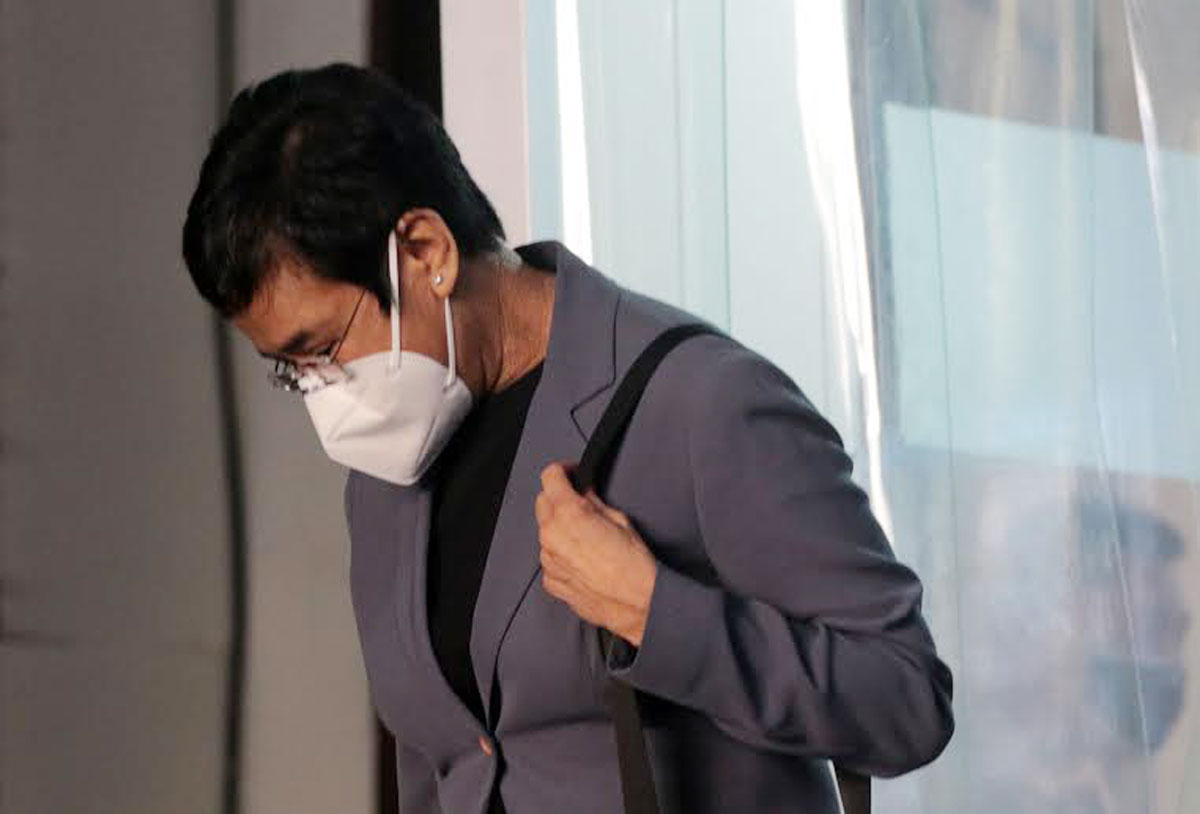
Following her conviction, Ressa urged colleagues in the media not to be cowed from pursuing hard-hitting coverage of issues in Philippine society.
“There’s a Damocles sword hanging over our heads... it’s meant to make you doubt yourself, it’s meant to make you not push as hard because there will be consequences. What you need to do is look ahead and do the stories,” Ressa said.
“I appeal to you, the journalists in the room, the Filipinos who are listening, to protect your rights. We’re meant to be a cautionary tale, we are meant to make you afraid. I appeal again, don’t be afraid,” she added.
NUJP said the decision marked a “dark day not only for independent Philippine media but for all Filipinos” as it “basically kills freedom of speech and of the press.”
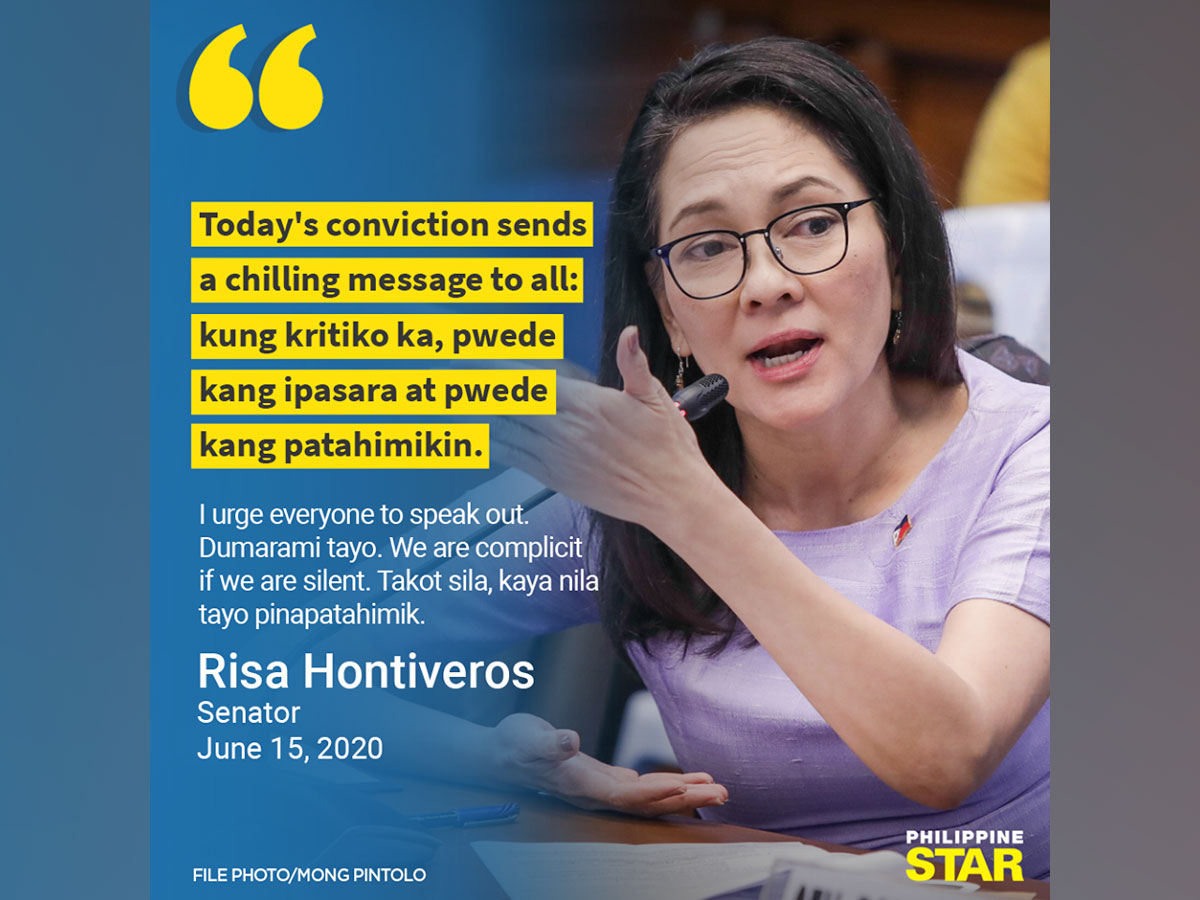
Arao warned that the verdict “sends a chilling effect not just on journalists but on all people” as the legal tactics employed in Rappler’s case are “weaponized to repress.” He added: “After ABS-CBN and Rappler, you (yes, YOU!) could be next.”
UP College of Law professor Paolo Tamase explained that cyber libel cases are meant to instill a “chilling effect” in people – that is, scare them with the possibility of prosecution so they will keep quiet on their own.
“Scrubbing posts you’ve written before the Cybercrime Law came into effect? Changing your Facebook name? Hesitating to post/tweet your criticism of people in power? Even when you’re not actually the one sued for libel or a cybercrime? That is what we call the ‘chilling effect,’” Tamase said.
He added that the chill would get worse with the “blast freezer that is the Anti-Terror Act,” which seeks to criminalize speech that incite the commission of terrorism and membership in an organization tagged by the government as terrorist, among others.
NUJP said the verdict “has implications far beyond the case filed against them” and characterized it as “a test run for the latest weapon the State can now wield to intimidate and silence not only the media but all citizens who call out government abuse.”
“The decision basically affirms the State’s manipulation and weaponization of the law to stifle criticism and dissent, allowing the retroactive application of the law for a supposed offense committed before it existed by the simple expedience of declaring a typographical correction a ‘republication,’ and recalibrating the prescription period for the offense,” NUJP said.
The Foreign Correspondents Association of the Philippines said it was “extremely alarmed” by what it saw as a “new weapon in a growing legal arsenal against constitutionally guaranteed civil liberties in an Asian outpost of democracy.”
The Photojournalists’ Center of the Philippines questioned the “targeted attack on media that has been publishing not only glossy stories on the administration” while pro-administration trolls were allowed to get away with harassment and fake news.
“While trolls have their way by continuing to threaten legitimate media in the practice of their profession, even to the point of branding media personalities as communists, we see that the long arm of the law would rather extend to those just doing their jobs,” PCP said. “What is it afraid of and what is it trying to hide from the media that it seems to have trained its sights on persecuting the fourth estate?”
ABS-CBN News – which Ressa served as chief until 2010 – said it was “one with our fellow journalist in upholding the freedom of the press and the freedom of speech in the country.” ABS-CBN Corp. itself is reeling from the National Telecommunications Commission’s May 5 order for the company to stop its free-to-air broadcast operations, after years of threats by Duterte to block its application for the renewal of its franchise.
The UP CMC said “this is not a threat to media alone” but “more important, it is a bladed weapon poised to cut and bleed out any journalist, any writer, or any Filipino social media user, who posts criticisms of public acts of corruption and incompetence on the internet.”
“It is a threat that should be thwarted with increasing courage and limitless fortitude to question, to investigate, and to expose abuse of power,” it added.
Vice President Leni Robredo led opposition figures in condemning the judgment as “merely the latest instance of law being utilized to muzzle our free press.”
Robredo said: “Silencing, harassing, and weaponizing law against the media sends a clear message to every dissenting voice: keep quiet or you are next.”
Presidential spokesman Harry Roque said Duterte is not behind the alleged crackdown on the free press after Ressa and Santos were convicted of cyber libel on Monday.
Chief presidential legal counsel Salvador Panelo scoffed that the verdict would be “used by the critics and detractors” of the administration here and abroad “to peddle the canard that her conviction is the death knell to press freedom in this country and, expectedly, they will… make a hero out of Ms. Ressa.”
Panelo said Ressa “should stop telling her fellow journalists that this is a case against all of them too when she and her reporter… were the only ones sued and convicted.”
He offered this as his evidence that there is still “robust” press freedom: “Other journalists severely critical of the President more than Ms. Ressa are still writing their biased articles with venom and abandon, without being sued, charged or arrested. The critics and dissenters continue to air their protests in various media platforms against the President’s pronounced policies.”


