Facebook Probes Surge Of Fake Accounts; DOJ Taps NBI, PNP
Investigations are underway following the surge of impostor accounts bearing names of legitimate Facebook users in the country. Facebook, which takes down billions of fake accounts each year, explicitly prohibits creating inauthentic profiles.

Social media company Facebook has initiated an investigation following the surge of fake accounts bearing the names of legitimate users in the Philippines.
“We understand the concerns raised by our community in the Philippines,” the company said in a statement e-mailed to The Philippine STAR early evening on Sunday, June 7.
“We’re investigating reports of suspicious activity on our platform and taking action on any accounts that we find to be in violation of our policies. We encourage people to continue reporting any accounts they believe may be inauthentic,” it added.
Over the weekend, Facebook users raised concerns over the creation of multiple dummy accounts bearing their names. Some even reported receiving threatening messages.
The hashtag #HandsOffOurStudents trended on Twitter following reports that many of those affected were students of the University of the Philippines (UP).
While initially reported as an attack targeting UP students and alumni, users not affiliated with the university also took note of dummy or similar accounts bearing their names.
On Saturday night, Tug-ani – the student publication of UP Cebu – said dozens of empty duplicate accounts bearing active usernames of students were created.
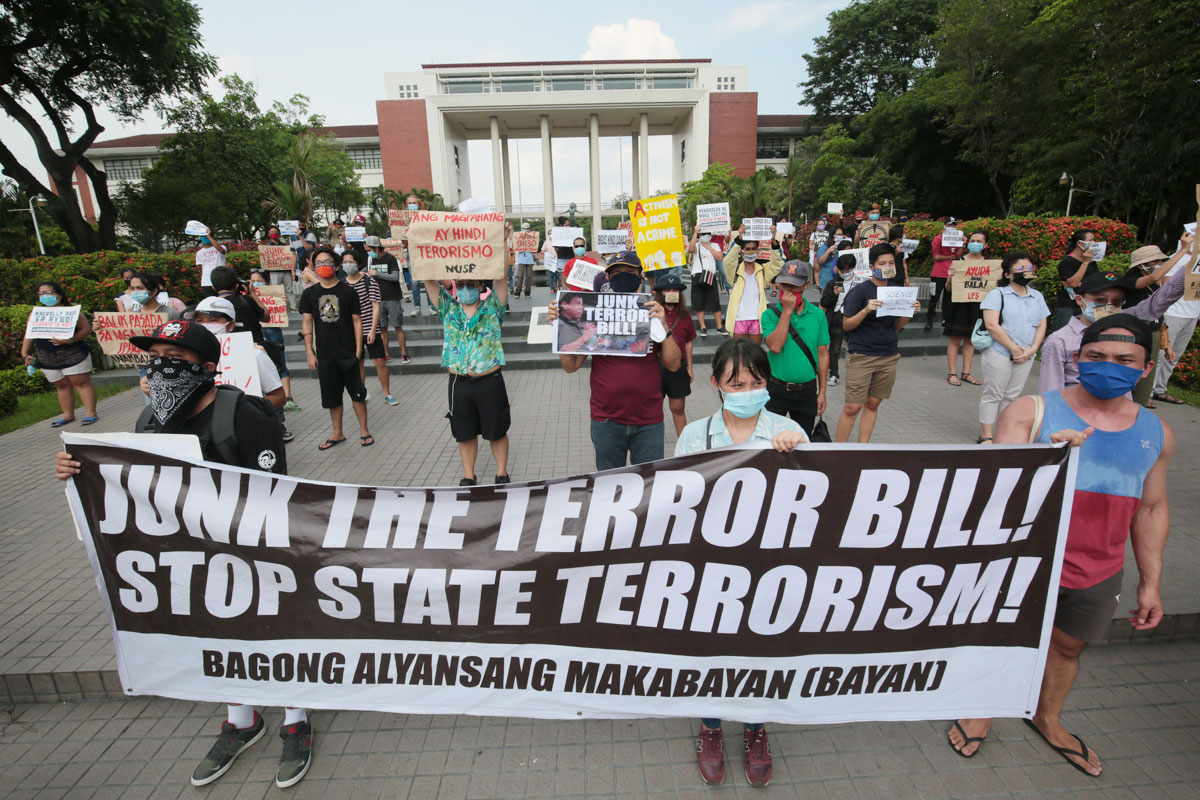
It happened a day after the arrest of eight people over the protests held at UP Cebu against the anti-terror bill pending in Congress.
Early Sunday, the UP administration issued an advisory saying it has received reports that fake or dummy Facebook accounts have been created for students, officials and alumni.
Some faculty members also reported discovering dummy accounts with their names.
“We urge the members of the UP community to check their names and accounts and to make the proper report to the Data Protection Officer (DPO) of Facebook,” the UP administration said.
“Rest assured that the UP System Data Protection Officer has reached out to the Philippine National Privacy Commission (NPC) to help students and alumni report fake or dummy accounts in their name to the DPO of Facebook,” it added.
As the day unfolded, it became clear that the incident affected more than just those affiliated with UP.
De La Salle University also issued a statement regarding the surge of empty or fake Facebook accounts posing as members of the university community.
“Posting from these accounts are unauthorized and do not reflect the views and position of the institution,” the university noted.
“We urge members of the Lasallian community to remain vigilant and refrain from responding or clicking on any links in the suspicious email or friend requests,” it said.
The Data Protection Office of the Ateneo de Manila University said it has also received reports of Facebook accounts of students and personnel either being hacked or cloned.
"A few other schools have been getting similar reports. We are currently verifying them and coordinating with data protection units of these other educational institutions, the National Privacy Commission, and even Facebook to pursue any or all necessary interventions," it said.
A student from the Polytechnic University of the Philippines College of Communication even received a message from the fake account with her name, warning her about her critical stance against the government, college publication The Communicator reported.
Tug-ani also reported that some duplicate accounts are sending threats to the original namesakes.
Cause for worry
Justice Secretary Menardo Guevarra has ordered the agency’s cybercrime office to coordinate with counterparts in the National Bureau of Investigation and Philippine National Police to investigate the apparent proliferation of fake or dummy accounts on Facebook.
“This gives me cause for worry. We don’t need false information at a time when we’re dealing with a serious public health crisis,” he said in a statement sent to reporters.
Computer-related identity theft is a prohibited act under Republic Act No. 10175 or the Cybercrime Prevention Law.
It is defined as the “intentional acquisition, use, misuse, transfer, possession, alteration or deletion of identifying information belonging to another, whether natural or juridical, without right.”
It carries a penalty of prision mayor (imprisonment of up to 12 years) and/or a fine of at least P200,000 up to a maximum amount commensurate to the damage incurred. The law provides that the penalty shall be one degree lower if no damage has yet been caused.
Meanwhile, Privacy Commissioner Raymund Liboro announced that the NPC is monitoring reports about the proliferation of alleged impostor Facebook accounts that have victimized Filipino data subjects.
“While the extent of these incidents is not yet fully determined at this time, we have been receiving reports from different sectors, mostly coming from academic institutions,” he said. “We immediately brought this to the attention of Facebook. According to Clare Amador, Facebook representative in the Philippines, they are already investigating this particular matter as well as other information on unauthorized FB accounts.”
Liboro also instructed Facebook to report any significant findings as soon as these become available.
Fake accounts
The problem of fake accounts is not new to Facebook.
In its latest community standards enforcement report, the company estimated that fake accounts represented approximately five percent of its worldwide monthly active users in the last two quarters.
“Our goal is to remove as many fake accounts on Facebook as we can. These include accounts created with malicious intent to violate our policies, and personal profiles created to represent a business, organization or non-human entity, such as a pet,” it stressed.
“We prioritize enforcement against fake accounts that seek to cause harm. Many of these accounts are used in spam campaigns and are financially motivated,” it said.
Over the years, the company has taken down billions of fake accounts on the platform for violating community standards against misrepresentation.
From January to March 2020 alone, Facebook said it has taken down 1.7 billion fake accounts from the social media platform.
This does not include attempts to create fake accounts that are blocked at the time of account creation, which number in the millions.
The number of accounts taken down in the first quarter of the year is higher than the 1.1 billion fake accounts disabled from October to December 2019, but lower than the 2.2 billion accounts from the same period last year.
In 2019, the total number of fake accounts disabled from the popular social media platform reached over 6.5 billion, data released by Facebook showed.
In over 99.5 percent of the cases, Facebook was able to take action against the accounts even before these were flagged by users.
The company said it is investing millions of dollars and deploying sophisticated technology to proactively identify and remove fake accounts from the social media platform.
Misrepresentation is against the community standards of the social media platform, with Facebook saying “authenticity is the cornerstone of our community.”
“We believe that people are more accountable for their statements and actions when they use their authentic identities. That’s why we require people to connect on Facebook using the name they go by in everyday life,” it said. “Our authenticity policies are intended to create a safe environment where people can trust and hold one another accountable.”
Under the company’s guidelines, users are not allowed to create inauthentic profiles or impersonating others by creating a profile “assuming the persona of or speaking for another person or entity.”
Also prohibited are providing false birthdays, creating a profile for someone under 13 years old, maintaining multiple accounts, sharing an account with another person, and creating another account after being banned from the site.