



Drug War: PNP Can’t Turn Back Now
The Philippine National Police has recalibrated the war against illegal drugs and trained its guns on the big fish. But it says bloodshed can’t be avoided.
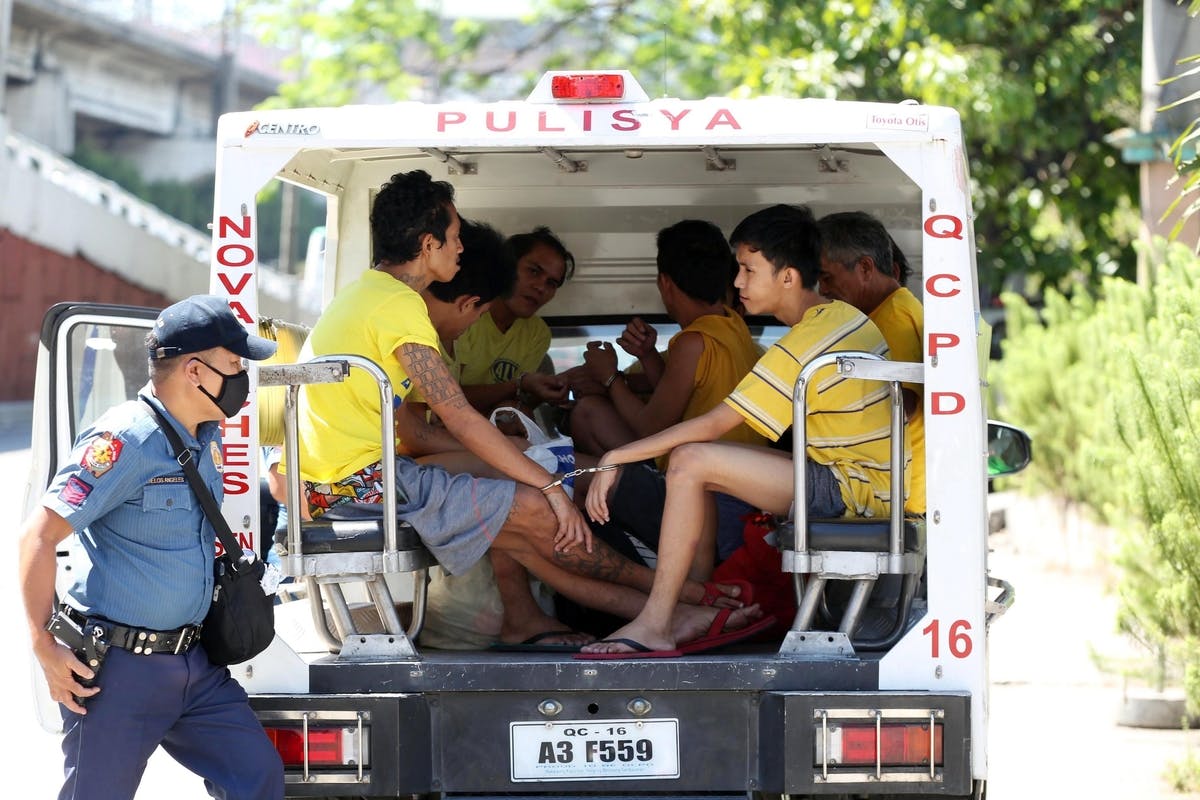
The Philippine National Police has vowed to triple efforts to curb the illegal drug trade in the country. As it announced earlier, the war would focus on large-scale drug suppliers, and bloody operations could still be expected.
“What we are sure of is this is not yet over,” PNP Chief Gen. Oscar Albayalde told reporters recently.
President Duterte had also voiced frustrations that the drug problem persists despite the deaths of thousands. But he declared the war would continue.
The goal, Albayalde said, is to achieve a drug-free Philippines in the remaining half of Duterte’s term.
When he was campaigning for the highest office in the land in 2016, Duterte promised a brutal crackdown on illegal drugs.
Since Oplan Tokhang was launched on July 1, 2016 — or a day after Duterte assumed office on June 30, 2016 — to May 31 of this year, the PNP reported that 6,600 individuals had been killed in police operations.
The agency also disclosed that at least 29,000 cases of killings, categorized as “deaths under inquiry” had been recorded from July 1, 2016 to Feb. 4, 2019.
Based on PNP’s records, there were 1.2 million drug pushers and users who surrendered to the police, congesting the country’s jails. There were also 240,565 suspected drug pushers and users arrested in 153,276 anti-drug operations since Oplan Tokhang began.
Despite these staggering numbers, the PNP chief admitted they still have a long way to go in ridding the country of the drug menace.The International Criminal Court has launched a preliminary examination of a complaint filed against Duterte, former PNP chief and now Sen. Ronald dela Rosa and several others for crimes against humanity in connection with the killings.
Iceland has also initiated an international regular monitoring of the rights situation in the Philippines. The United Nations Human Rights Council narrowly approved on Thursday a resolution mandating a comprehensive international review of the country’s drug war. The text, initially proposed by Iceland, secured the backing of 18 states in the 47-member rights council, with 14 nations voting against and 15 abstentions.
Duterte and other administration officials condemned the resolution, saying the international community does not understand the illegal drug problem in the Philippines and should keep its hands off the way the government is addressing the scourge.
Albayalde chided human rights groups and other critics of the Duterte administration who have been questioning the regularity of the anti-drug campaign by saying most of the drug offenders are killed in cold blood.
As proof that drug suspects fought back or nanlaban, Albayalde said 50 police officers have been killed and 144 others were wounded in shootouts with drug personalities.
“Fifty police officers killed is perhaps the painful proof that our detractors need to accept the fact that slain drug suspects
indeed put up violent resistance to evade the law. Do they want more dead lawmen to convince them some more?” he said.
In fact, the PNP is bracing for more casualties as it recalibrates its campaign to target large-scale drug rings in the country rather than peddlers on the streets. The PNP and other government officials have also maintained that the 27,000 supposed drug war casualties being cited by human rights groups are an exageration.

PNP Chief Gen. Oscar Albayalde insists during a press conference on June 10, 2019 that all police actions related to the government's anti-drug campaign are governed by a set of operational procedures that are founded on principles of respect for human rights. Photo by Michael Varcas, The Philippine STAR
Policing the police
But is the recalibration somehow an admission that there was something wrong in the drug war when it was initially waged? As part of the recabliration, the Philippine Drug Enforcement Agency is now the lead office in charge of the anti-drug campaign, as provided under the Dangerous Drugs Act.
Albayalde conceded that there were unscrupulous members of the organization who apparently took advantage of the drug war to advance their illicit activities. He said the PNP has trained its sights on them.
Dela Rosa, during his stint as PNP chief, instituted stricter vetting of anti-narcotics operatives after some policemen were found to be using the war on drugs as cover for extortion.
The PNP Counter-Intelligence Task Force, now the Integrity Monitoring and Enforcement Group, was also formed during Dela Rosa's watch as a deterrent to scalawags in uniform.
At least 2,400 rogue police officers were kicked out of the service since July 2016 for various grave offenses. Of the number, 422 consisting of 10 commissioned officers, 403 non-commissioned officers and nine non-uniformed personnel were dismissed for drug-related offenses.
Among these are the three policemen who were found guilty by a court of murdering 17-year-old Kian delos Santos in August 2017.
Delos Santos, a suspected drug courier, was killed in what police claimed was a shootout in Caloocan City, but an investigation later revealed he was defenseless when policemen shot him.
The police officers — Arnel Oares, Jeremias Pereda and Jerwin Cruz — were sentenced to life in prison. Despite these setbacks, Albayalde expressed confidence they are gaining ground in the drug war.
He cited as proof the surveys showing that a majority of Filipinos feel safer under the current administration. The PNP also said the crime rate has gone down.
“This is a clear manifestation that we are winning the war against illegal drugs,” he said.
Albayalde also recently launched a new strategy focusing on spiritual reformation to prevent police officers from becoming criminals to complement the punitive actions against scalawags.
The strategy applies the “squad concept” that puts emphasis on values formation, spiritual development and strengthening of families of police personnel.
The concept is adapted from the Philippine Military Academy where small groups consisting of six to eight persons are formed. They are led by a squad leader who monitors their group for anyone who commits offenses.
“The squad leader will guide the rest of the squad in achieving something and the rest of those in the squad will make sure that the order of the squad leader is followed,” Albayalde said.


